We’d like to remind Forumites to please avoid political debate on the Forum.
This is to keep it a safe and useful space for MoneySaving discussions. Threads that are – or become – political in nature may be removed in line with the Forum’s rules. Thank you for your understanding.
📨 Have you signed up to the Forum's new Email Digest yet? Get a selection of trending threads sent straight to your inbox daily, weekly or monthly!
Best way to compare pension funds for long term growth?

Zerforax
Posts: 446 Forumite




I have an old workplace pension (Pot 1) and a current workplace pension (Pot 2).
Pot 1 has a 0.3% annual charge (between the annual management charge and fund charge) whereas Pot 2 is 0.75% annual charge for up to £100k and then 0.4% for any amounts above that.
Based on the annual charges, I left Pot 1 where it was since the often easy advice is go with the lowest charges.
Based on the annual charges, I left Pot 1 where it was since the often easy advice is go with the lowest charges.
Both Pot 1 and Pot 2 are in growth funds. It seems Pot 1 is a bit more spread and balanced whereas Pot 2 is a bit more US / tech weighted. I've been trying to compare the two funds in terms of performance but it is hard to easily compare (both have had good growth in the past year as markets have done well).
Pot 2 is currently offering £1,000 bonus for transferring other pension pots with them. I have calculated the new combined Pot would be ~£400 more a year in annual charges so then the bonus will cover 2.5 years worth of higher charges.
Therefore I think the only question is which pension fund do I think will perform better than the other over the next few years. I think Pot 2 will do better (BlackRock run fund) but it's not based on a lot.
Anything else I should be considering?
0
Comments
-
VolatilityZerforax said:Anything else I should be considering?Thus the old Gentleman ended his Harangue. The People heard it, and approved the Doctrine, and immediately practised the Contrary, just as if it had been a common Sermon; for the Vendue opened ...THE WAY TO WEALTH, Benjamin Franklin, 1758 AD1 -
Depends on what you think is likely to happen to US tech stocks over the next few years then.Zerforax said:Both Pot 1 and Pot 2 are in growth funds. It seems Pot 1 is a bit more spread and balanced whereas Pot 2 is a bit more US / tech weighted.1 -
Before you transfer to obtain the cash back check if there is a tie-in clause that means you would have to keep it there longer than 2,5 years and therefore end up paying more.
A fee of 0.3% is not bad.
You should be considering how many years of further accumulation are planned and the pension investments growth/risk figures. There is always a choice of where your money is invested regardless of which provider/platform you have.🐻 A little FIRE lights the cigar1 -
Both have followed similar trajectories relative to what the markets have been doing.FatherAbraham said:
VolatilityZerforax said:Anything else I should be considering?
On the whole I think I just need to target growth and ride through any ups and down. Time in the market, rather than trying to time the market yada yada..squirrelpie said:
Depends on what you think is likely to happen to US tech stocks over the next few years then.Zerforax said:Both Pot 1 and Pot 2 are in growth funds. It seems Pot 1 is a bit more spread and balanced whereas Pot 2 is a bit more US / tech weighted.ali_bear said:Before you transfer to obtain the cash back check if there is a tie-in clause that means you would have to keep it there longer than 2,5 years and therefore end up paying more.
A fee of 0.3% is not bad.
You should be considering how many years of further accumulation are planned and the pension investments growth/risk figures. There is always a choice of where your money is invested regardless of which provider/platform you have.The terms say 50% after 3 months and then the remaining 50% after 24 months. The bonus is a nice extra but it can't be the deciding factor.Agree the 0.3% fee is decent, which is why I've left Pot 1 there so for long.I still have at least 20 years before being able to access and ~30 years before pension age. Which is why I should target growth for the long term. I usually just pick a high growth default fund as I don't want to go into the very specific detail of finding a particular fund.0 -
I'd pay more for better performance. Thing is though most fund managers can't consistently out perform. We have control of our costs do what can to reduce them. My pension costs are trivial £400 total seems dear ket alone increase, I use a capped fee platform. Seemingly 0.3% is low.
Moving to an area of higher costs to harvest cashback seems to have it a wonky.
If the question is which pot is best when they have different constituents to hard to know about the future. Can they be compared to an index for the past decade that might suggest which could be the future outperfromer.1 -
You say you don't want to delve into investments too much but you should at least bone up on what alternatives are available within pots 1 and 2. You might find that pot 1 has something closer to the Pot 2 default fund (if you think pot 2's default fund is the better bet for the future).
Checking the performance of the two pots ought to be easy - just pick a day (1 January say) in one year and the next, see what each pot was worth on those two days and you can work out the annual performance. So if pot 1 was worth £1000 on 01/01/24 and £2000 on 01/01/25 while Pot 2 was worth £2000 on 01/01/24 and £3000 on 01/01/25 you know Pot 1 is doing better than Pot 2. Or rather you know it did better in 2024. Past performance is no guide to future performance, as they say.1 -
kempiejon said:I'd pay more for better performance. Thing is though most fund managers can't consistently out perform. We have control of our costs do what can to reduce them. My pension costs are trivial £400 total seems dear ket alone increase, I use a capped fee platform. Seemingly 0.3% is low.
Moving to an area of higher costs to harvest cashback seems to have it a wonky.
If the question is which pot is best when they have different constituents to hard to know about the future. Can they be compared to an index for the past decade that might suggest which could be the future outperfromer.Yes paying more for better performance makes sense but I guess we don't know or can't control performance!I guess the blended charge would move from currently at 0.375% to 0.51%. My combined pension pot is a large amount hence the £400 annual increase by moving all to Pot 2.DRS1 said:You say you don't want to delve into investments too much but you should at least bone up on what alternatives are available within pots 1 and 2. You might find that pot 1 has something closer to the Pot 2 default fund (if you think pot 2's default fund is the better bet for the future).
Checking the performance of the two pots ought to be easy - just pick a day (1 January say) in one year and the next, see what each pot was worth on those two days and you can work out the annual performance. So if pot 1 was worth £1000 on 01/01/24 and £2000 on 01/01/25 while Pot 2 was worth £2000 on 01/01/24 and £3000 on 01/01/25 you know Pot 1 is doing better than Pot 2. Or rather you know it did better in 2024. Past performance is no guide to future performance, as they say.
Yes that is a fair point. I found some charts on both platforms but I couldn't seem to compare like-for-like but I will try again!0 -
You may have annual statements or be able to log in to see values for the pots. Of course it becomes tricky if you are still contributing to one but not the other but then if you are in one fund the best approach would be to look at the unit value of the fund.
And the annual statements may show the position on different days.
Another possibility is to see if the default funds are generally available and if so look them up on something like trustnet or morningstar. Or you could find them on HL and put them into a comparison chart eg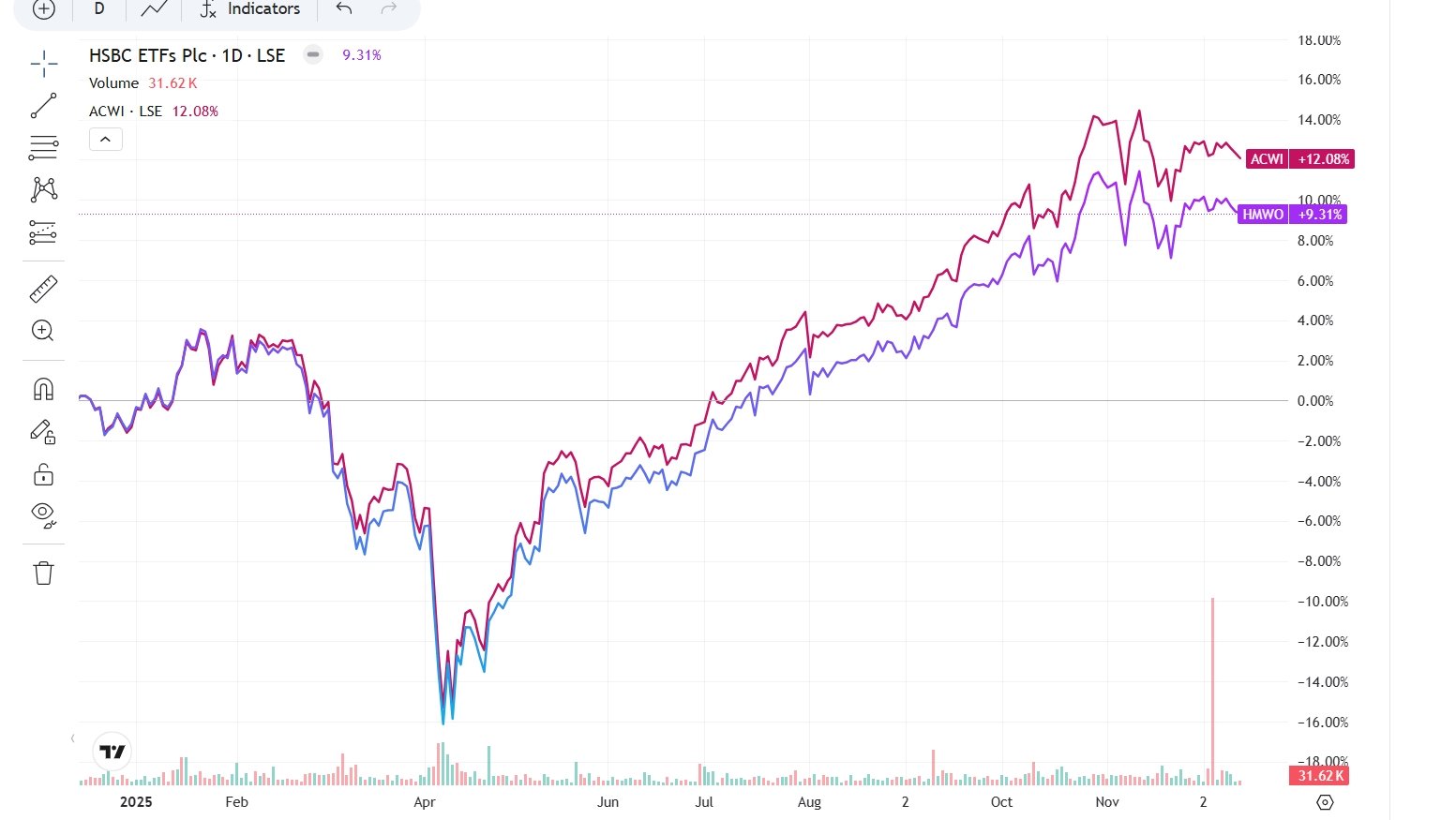
1 -
Unless there is anything special about your workplace pensions (protected access age, guaranteed annuity rates, etc), or you value the enhanced FSCS protection, the cheapest and most flexible answer is usually to move your money to a platform that uses industry standard investment options that can be compared on trustnet, analysed on morningstar, etc and easily transferred between providers in-specie in future without time out of the market.Zerforax said:
My combined pension pot is a large amount hence the £400 annual increase by moving all to Pot 2.
Personally I don't see much benefit in moving large amounts between workplace pension providers (especially if you use an expensive one short-term for cashback) as the random financial impact each time you are in cash out of the market (which generally goes up more than down) can far outweigh the cashback. However that risk is usually worth taking to get the money out of workplace scheme(s) into a long term ultra low cost situation.
If you have large pension(s) then I'd suggest you look into SIPPs that offer capped charges for holding exchange traded assets (Fidelity, AJ Bell, etc) or fixed charges (Interactive Investor) and only suffer the time out of the market once in order to get access to a huge universe of standard investment options.
0.3% might not sound like much but my two SIPPs each cost less than half of that (platform ongoing, trades and fund manager costs where applicable) so shop around to see what's possible with your account valuation and consider how those capped/fixed charges might reduce as a % as the account hopefully grows.
It's worth checking if your current expensive workplace scheme allows occasional partial transfers out while continuing to be a contributing member.
1 -
Alexland said:
Unless there is anything special about your workplace pensions (protected access age, guaranteed annuity rates, etc), or you value the enhanced FSCS protection, the cheapest and most flexible answer is usually to move your money to a platform that uses industry standard investment options that can be compared on trustnet, analysed on morningstar, etc and easily transferred between providers in-specie without time out of the market.Zerforax said:
My combined pension pot is a large amount hence the £400 annual increase by moving all to Pot 2.
Personally I don't see much benefit in moving large amounts between workplace pension providers (especially if you use an expensive one short-term for cashback) as the random financial impact each time you are in cash out of the market (which generally goes up more than down) can far outweigh the cashback. However that risk is usually worth taking to get the money out of workplace scheme(s) into a long term ultra low cost situation.
If you have large pension(s) then I'd suggest you look into SIPPs that offer capped charges for holding exchange traded assets (Fidelity, AJ Bell, etc) or fixed charges (Interactive Investor) and only suffer the time out of the market once in order to get access to a huge universe of standard investment options.
0.3% might not sound like much but my two SIPPs each cost less than half of that (platform ongoing, trades and fund manager costs where applicable) so shop around to see what's possible with your account valuation and consider how those capped/fixed charges might reduce as a % as the account hopefully grows.
It's worth checking if your current expensive workplace scheme allows occasional partial transfers out while continuing to be a contributing member.My one and only workplace pension scheme offers funds at signfiicantly cheaper expenses than the retail market and there are no platform fees either. All paid for by my previous employer (I am retired now in my 40s) which is kind of them given I was also made redundant (which I was glad of as I hated the place) with a nice payoff. I also rolled all previous pensions into this one fortunately to save the headache of manging multiple ones and save on running costs as I do not think there is a more generous plan than my one.I am pretty sure there is the 55 protected age but will double check. Even if not, its still worthwhile staying with.0








Confirm your email address to Create Threads and Reply

Categories
- All Categories
- 355.4K Banking & Borrowing
- 254.8K Reduce Debt & Boost Income
- 456K Spending & Discounts
- 248.1K Work, Benefits & Business
- 605.4K Mortgages, Homes & Bills
- 178.9K Life & Family
- 263.2K Travel & Transport
- 1.5M Hobbies & Leisure
- 16.1K Discuss & Feedback
- 37.7K Read-Only Boards