We’d like to remind Forumites to please avoid political debate on the Forum.
This is to keep it a safe and useful space for MoneySaving discussions. Threads that are – or become – political in nature may be removed in line with the Forum’s rules. Thank you for your understanding.
📨 Have you signed up to the Forum's new Email Digest yet? Get a selection of trending threads sent straight to your inbox daily, weekly or monthly!
The Forum now has a brand new text editor, adding a bunch of handy features to use when creating posts. Read more in our how-to guide
Drawdown period calculations

BogStandardBob
Posts: 22 Forumite



How do you work out how long your pot will last for? The Which calculator sounds very optimistic to me - e.g. a million would last for 23 years if you take out £62k the first year and increase it by 2% a year with a moderate portfolio and middling growth.
https://www.which.co.uk/money/pensions-and-retirement/accessing-your-pensions/pension-income-drawdown/income-drawdown-calculator-making-your-money-last-ajWVD8L3bN92
Are most of you basing how much you need on a higher annual % increase than 2%? Is it too optimistic to select 'middling' growth? Thanks.
https://www.which.co.uk/money/pensions-and-retirement/accessing-your-pensions/pension-income-drawdown/income-drawdown-calculator-making-your-money-last-ajWVD8L3bN92
Are most of you basing how much you need on a higher annual % increase than 2%? Is it too optimistic to select 'middling' growth? Thanks.
0
Comments
-
Given that average inflation (RPI) was 4.6% over the last 10 years, 2% increase seems low.1
-
Thanks. I thought that that might be offset against possibly spending less (due to less appetite for travelling etc) as I age.zagfles said:Given that average inflation (RPI) was 4.6% over the last 10 years, 2% increase seems low.0 -
Then again £62k pa on a pot of £1million looks like a withdrawal rate of 6.2% which seems very high.0
-
There is a lot of data/discussion about Safe Withdrawal rates.BogStandardBob said:How do you work out how long your pot will last for? The Which calculator sounds very optimistic to me - e.g. a million would last for 23 years if you take out £62k the first year and increase it by 2% a year with a moderate portfolio and middling growth.
https://www.which.co.uk/money/pensions-and-retirement/accessing-your-pensions/pension-income-drawdown/income-drawdown-calculator-making-your-money-last-ajWVD8L3bN92
Are most of you basing how much you need on a higher annual % increase than 2%? Is it too optimistic to select 'middling' growth? Thanks.
The traditional theory is that when you start drawdown ( at say 60), then in the first year you take 3.5%/4% of the pot as a withdrawal. Then each year you increase that with inflation ( regardless of whether the investments in the pot have gone up or down) . In this scenario you should only have a 5% chance of running out before you are in your Nineties based on historical statistics. In fact it is quite likely you will die with more than you started with, if markets are kind. It is a kind of safety first policy.
Another way is to increase the withdrawals when times are good and reduce when times are bad. Plus many other other variations on a theme.
Also some take out a higher % before the state pension arrives, and less afterwards.0 -
RPI is not a good measure of inflation. But I'd still allow for more than 2%.
Calculators like this are fine as far as it goes but the answer depends hugely on the various assumptions, all of which you can combine into a single figure that expresses how much you expect ( and plan for) your overall investment to grow above inflation ("real" returns)
The Excel NPER formula can then work out the number of periods the payments will last.
E.g. for 3% investment growth above inflation ( which could be growth of 7% and inflation of 4%, or growth of 5% and inflation of 2%, etc)
=NPER(3%,-62000,1000000)
You'll find the answers you get are massively dependent on the value you choose for the average future post-inflation return, and that's the bit that nobody can tell you !
Assume you only just match inflation ( 0% real growth) , a million would last 16 years.
Assume you get 6% more than inflation, and they'll last 58 years.
Assume 6.2% and they'll last forever. (The formula will give an error because the answer is infinite!)
So the answer is *probably* somewhere between 16 years and forever. Does that help ? :-)
It's likely an even wider range, because the returns won't be the same every year, and a sequence of bad years at the start will leave you worse off than the same sequence of bad years near the end, even if the annual return remains the same. So your returns could match inflation, on average, but run out before 16 years.
And it's possible that you get negative average returns, which will also shorten the time it lasts.
2 -
People will argue whether the number is 3% or 4%, but here goes:
For a UK retiree, with 60% equities and 40% bonds, a 3.5% initial withdrawal rate, increasing every year by CPI inflation, would historically (in the past, not the future) have lasted 30 years without running out, in 100% of cases tested.
Of course, there is a vast variation in the outcomes. Some of those people would have almost run out, and just made it to 30 yrs. Others would have ended up with millions left in the pot. Therefore, some suggest starting at 5%, and hoping all goes well. If things go badly, you would have to be prepared to cut back to make the money last. I think I can fairly say that no-one around here expects to exactly implement a fixed 3.5%+inflation drawdown plan. You review every few years and adjust up or down accordingly, with due consideration to what you actually need.
Also note that annuities are currently paying about 5%+CPI - more depending on your age or health. You give up control and inheritance of the pot, but you know that a regular income is there for a lifetime. Maybe a good plan to buy enough annuity to cover all the bills.
6.2% is a very high starting point. Could work if you only want it to last 24 years. Could work if you expect to decrease withdrawals when State Pension kicks in. Could work if your investments get lucky. Must be prepared to be adaptable at this rate.1 -
The chart on the front page of this site is quite instructive:
https://www.firecalc.com/
Shows what would *actually* have happened to the value of the investments of three people who retired in 1973, 1974, or 1975. It's an American site but the message applies here too.
0 -
I ran some simulations of a 6.2% withdrawal rate over 30 years.
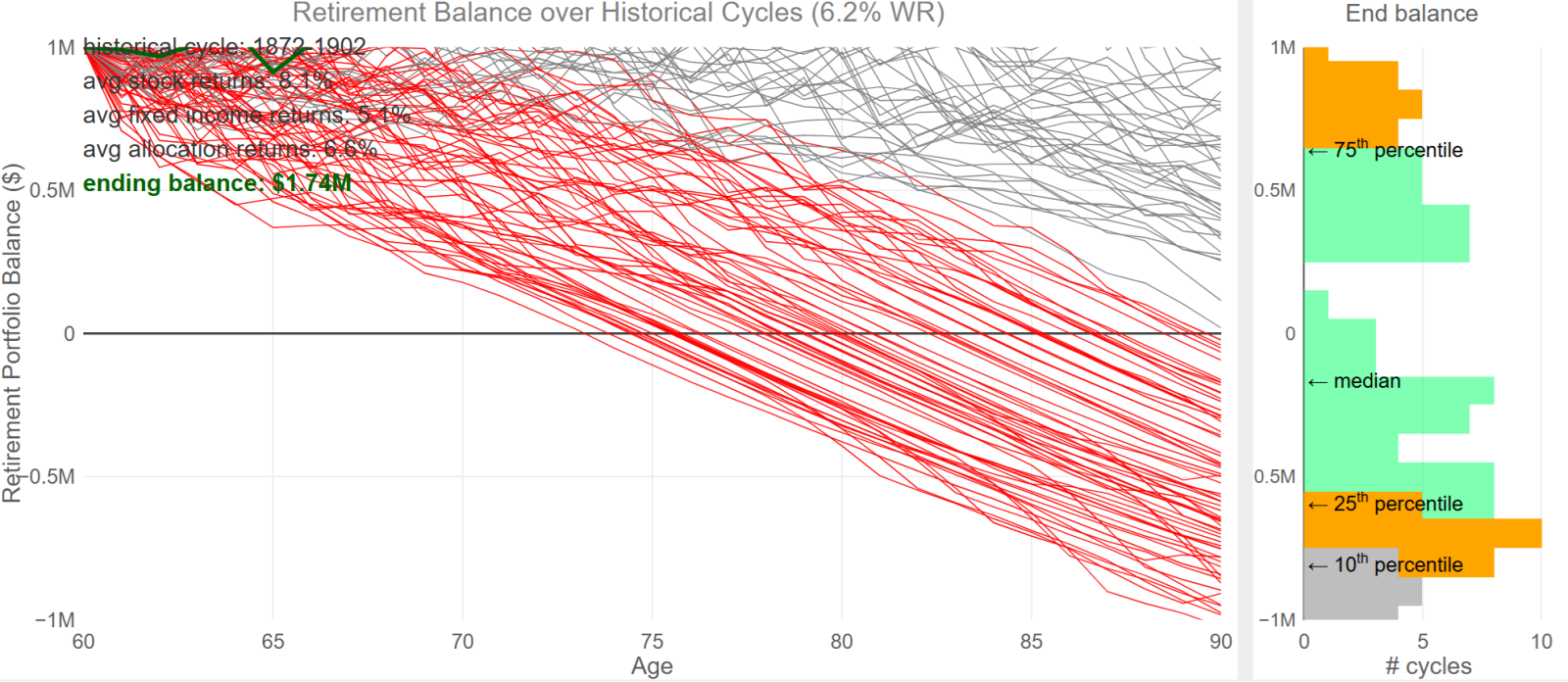
20% of cases still ended up with more than 1/2 million. Another 20% survived, succeeded, didn't run out. 60% ran out of money, some quite egregiously, the worst case being after 13 years1 -
I guess I haven't reached that sweet spot yet (age/health/annuity rate). Age 62. Wife 55. Just threw some numbers at HL website for curiosity. No health issues addedSecret2ndAccount said:
Also note that annuities are currently paying about 5%+CPI - more depending on your age or health. You give up control and inheritance of the pot, but you know that a regular income is there for a lifetime. Maybe a good plan to buy enough annuity to cover all the bills.
4.253% 50% spouse 10 yr guarantee
3.828% 100% spouse. Nil guarantee
0 -
They could be paying out to your wife for 45 or 50 years. What SWR starting % would you pick at those ages? 3.5% is good for 30 yrs.0







Confirm your email address to Create Threads and Reply

Categories
- All Categories
- 354.1K Banking & Borrowing
- 254.3K Reduce Debt & Boost Income
- 455.3K Spending & Discounts
- 247.1K Work, Benefits & Business
- 603.7K Mortgages, Homes & Bills
- 178.3K Life & Family
- 261.2K Travel & Transport
- 1.5M Hobbies & Leisure
- 16.1K Discuss & Feedback
- 37.7K Read-Only Boards