We’d like to remind Forumites to please avoid political debate on the Forum.
This is to keep it a safe and useful space for MoneySaving discussions. Threads that are – or become – political in nature may be removed in line with the Forum’s rules. Thank you for your understanding.
📨 Have you signed up to the Forum's new Email Digest yet? Get a selection of trending threads sent straight to your inbox daily, weekly or monthly!
DB pension
Comments
-
After Barber there was a lot of discussion about how to equalise NRAs. Move everyone to 60? Too expensive. Move everyone to 65? The women will complain - you are making their benefits worse and making them work 5 more years. A non-starter for many. Some talked about a compromise make NRA 62 (or 63). I am not sure that many schemes adopted that solution but it was certainly out there.
But OP if you have an NRA of 62 that does not mean you have to take the benefits then. It is well worth checking what happens if you defer to say 65. It is also possible there are some GMP complications though I am guessing your GMP age is 60.
But if you check you may also find that like some in public sector schemes there is absolutely no reason to defer taking the pension. We don't know the scheme and so we can't say for sure whether deferring would be a good thing or just a way to lose X years of pension payments.0 -
Thank for your replies. The NRD is definitely 62 ( from employment with Legal & General) & I have written confirmation of this. I will make enquiries about what would be the effect of not taking the pension at 621
-
The commutation ratio is £52170 divided by £2790, the latter being the difference in pension, so result is 18.7 . This means if you stuck the LS in an ISA which matched the rate of increase of the pension, or you stuck the extra pension amount every year in the same ISA, it would take you 18.7 years for the extra pension to pull ahead. In practice with basic-rate tax it'll be more like 24 years. This is quite a long payback time, many schemes only offer ratio 12 which is poor.goldfinch25 said:I have a DB pension that is payable from December at age 62. I have the option of an annual pension of £10615.56 or lump sum of £52170.36 & pension of £7825.56.
I work part-time & will continue with this so I will not be dependent on my pension at this time. My state pension is payable at age 67.
My intention is to take the full pension but is there anything else I should consider?
Also should I make additional payments to my NEST pension or would I be better saving elsewhere?
Personally in your shoes I'd take the lump sum and not worry about what happens after age 85, but your opinion may vary.1 -
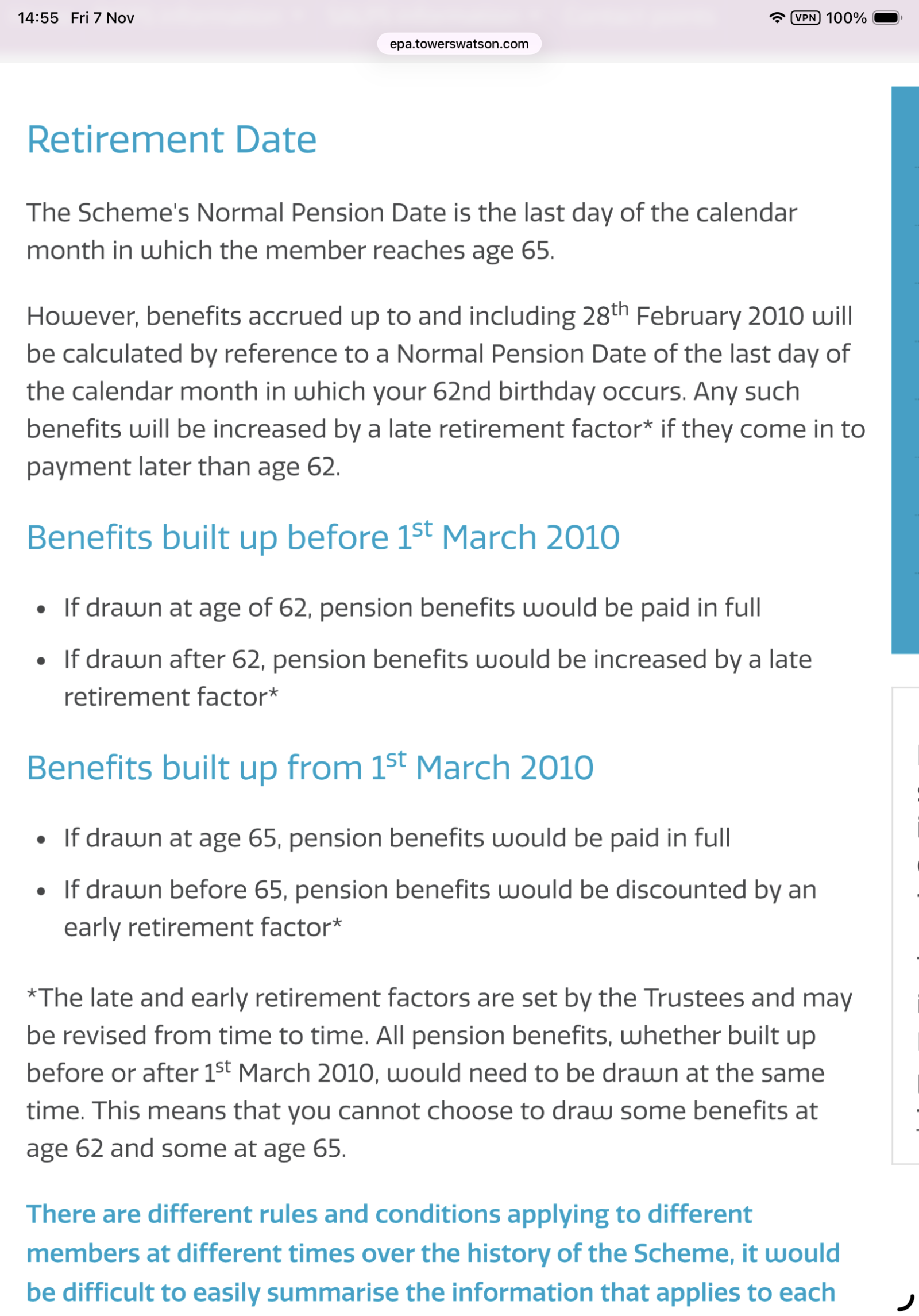
Our retirement age was 62 for pre 2010 benefits and was quite common in financial services.
0 -
You owe @Cobbler_tone a fiverMarlowMallard said:
The commutation ratio is £52170 divided by £2790, the latter being the difference in pension, so result is 18.7 . This means if you stuck the LS in an ISA which matched the rate of increase of the pension, or you stuck the extra pension amount every year in the same ISA, it would take you 18.7 years for the extra pension to pull ahead. In practice with basic-rate tax it'll be more like 24 years. This is quite a long payback time, many schemes only offer ratio 12 which is poor.goldfinch25 said:I have a DB pension that is payable from December at age 62. I have the option of an annual pension of £10615.56 or lump sum of £52170.36 & pension of £7825.56.
I work part-time & will continue with this so I will not be dependent on my pension at this time. My state pension is payable at age 67.
My intention is to take the full pension but is there anything else I should consider?
Also should I make additional payments to my NEST pension or would I be better saving elsewhere?
Personally in your shoes I'd take the lump sum and not worry about what happens after age 85, but your opinion may vary. 3
3 -
Be clear in your mind that there are two separate issues.goldfinch25 said:Thank for your replies. The NRD is definitely 62 ( from employment with Legal & General) & I have written confirmation of this. I will make enquiries about what would be the effect of not taking the pension at 62
Most DB pensions increase every year anyway ( whether in payment or not) by some factor related to inflation.
However if you defer your pension past 62, what you need to know is how much ( if any) it revalues on top of the normal annual increase.0 -
I would normally say take the extra pension each year however I concur with MarlowMollard in your scenario taking the tax free lump sum may be preferable due to the break even point of c.24 years. I'm not entirely sure if I were in your shoes which option I would go for.MarlowMallard said:
The commutation ratio is £52170 divided by £2790, the latter being the difference in pension, so result is 18.7 . This means if you stuck the LS in an ISA which matched the rate of increase of the pension, or you stuck the extra pension amount every year in the same ISA, it would take you 18.7 years for the extra pension to pull ahead. In practice with basic-rate tax it'll be more like 24 years. This is quite a long payback time, many schemes only offer ratio 12 which is poor.goldfinch25 said:I have a DB pension that is payable from December at age 62. I have the option of an annual pension of £10615.56 or lump sum of £52170.36 & pension of £7825.56.
I work part-time & will continue with this so I will not be dependent on my pension at this time. My state pension is payable at age 67.
My intention is to take the full pension but is there anything else I should consider?
Also should I make additional payments to my NEST pension or would I be better saving elsewhere?
Personally in your shoes I'd take the lump sum and not worry about what happens after age 85, but your opinion may vary.1 -
Another factor to consider is how the pension increases in payment. Whilst a public sector pension does increase by inflation, most private sector pensions are capped in some way.SarahB16 said:
I would normally say take the extra pension each year however I concur with MarlowMollard in your scenario taking the tax free lump sum may be preferable due to the break even point of c.24 years. I'm not entirely sure if I were in your shoes which option I would go for.MarlowMallard said:
The commutation ratio is £52170 divided by £2790, the latter being the difference in pension, so result is 18.7 . This means if you stuck the LS in an ISA which matched the rate of increase of the pension, or you stuck the extra pension amount every year in the same ISA, it would take you 18.7 years for the extra pension to pull ahead. In practice with basic-rate tax it'll be more like 24 years. This is quite a long payback time, many schemes only offer ratio 12 which is poor.goldfinch25 said:I have a DB pension that is payable from December at age 62. I have the option of an annual pension of £10615.56 or lump sum of £52170.36 & pension of £7825.56.
I work part-time & will continue with this so I will not be dependent on my pension at this time. My state pension is payable at age 67.
My intention is to take the full pension but is there anything else I should consider?
Also should I make additional payments to my NEST pension or would I be better saving elsewhere?
Personally in your shoes I'd take the lump sum and not worry about what happens after age 85, but your opinion may vary.
I had a similar pension choice to the OP at age 60. The commutation rate was similar and the annual increases were poor. 50% was at the company’s discretion and they’ve never given an increase yet. The other 50% was CPI capped at 2.5% so in effect it doesn’t keep pace with inflation. I took the maximum lump sum and we put it into our S&S ISAs over the next couple of years.
2 -
This... my little DB pension increases by max 2.5% a year once in payment, but if I continue to defer it then it gets revalued at up to 5%, and with the added benefit that this is averaged out back to 2008 - given all the low inflation years we have had, there is plenty of headroom for much bigger annual increases if needed.bjorn_toby_wilde said:
Another factor to consider is how the pension increases in payment. Whilst a public sector pension does increase by inflation, most private sector pensions are capped in some way.SarahB16 said:
I would normally say take the extra pension each year however I concur with MarlowMollard in your scenario taking the tax free lump sum may be preferable due to the break even point of c.24 years. I'm not entirely sure if I were in your shoes which option I would go for.MarlowMallard said:
The commutation ratio is £52170 divided by £2790, the latter being the difference in pension, so result is 18.7 . This means if you stuck the LS in an ISA which matched the rate of increase of the pension, or you stuck the extra pension amount every year in the same ISA, it would take you 18.7 years for the extra pension to pull ahead. In practice with basic-rate tax it'll be more like 24 years. This is quite a long payback time, many schemes only offer ratio 12 which is poor.goldfinch25 said:I have a DB pension that is payable from December at age 62. I have the option of an annual pension of £10615.56 or lump sum of £52170.36 & pension of £7825.56.
I work part-time & will continue with this so I will not be dependent on my pension at this time. My state pension is payable at age 67.
My intention is to take the full pension but is there anything else I should consider?
Also should I make additional payments to my NEST pension or would I be better saving elsewhere?
Personally in your shoes I'd take the lump sum and not worry about what happens after age 85, but your opinion may vary.
I had a similar pension choice to the OP at age 60. The commutation rate was similar and the annual increases were poor. 50% was at the company’s discretion and they’ve never given an increase yet. The other 50% was CPI capped at 2.5% so in effect it doesn’t keep pace with inflation. I took the maximum lump sum and we put it into our S&S ISAs over the next couple of years.1 -
That £52k lump sum could quite easily and with minimal risk make you the £2790 you lose in annual pension…and you’d still have the £52k perhaps even growing (depending on how you invest it). You could get £20k of it (maybe £40k if you have a spouse) into an ISA quickly so little tax issues.I had the same choice a few years ago and took the lump sum and I’d do it again today in the same position. I like being in control of my own fortune…0














Confirm your email address to Create Threads and Reply

Categories
- All Categories
- 355.8K Banking & Borrowing
- 254.9K Reduce Debt & Boost Income
- 456.2K Spending & Discounts
- 248.3K Work, Benefits & Business
- 605.9K Mortgages, Homes & Bills
- 179K Life & Family
- 263.8K Travel & Transport
- 1.5M Hobbies & Leisure
- 16.2K Discuss & Feedback
- 37.7K Read-Only Boards