We’d like to remind Forumites to please avoid political debate on the Forum.
This is to keep it a safe and useful space for MoneySaving discussions. Threads that are – or become – political in nature may be removed in line with the Forum’s rules. Thank you for your understanding.
36% IHT rate
Comments
-
1) No consequence, you clearly meant 1,200k - 84.6k - 65k = £1,050,400aroominyork said:Amount to legatees 1,200k - 70.2k - 60k = £1,050,400 (plus taper relief).
2) Non-exempt gifts made by the first spouse reduce the transferable NRB available on the second death irrespective of time elapsed. If made by the second spouse they reduce his/her own NRB. So the baseline and all other figures are the same in either case. This is making quite a few assumptions about the timing of gifts as well as unchanged IHT allowances, of course.
3) Ha!
4) I see. But even without the benefit of GA to the charity and to your own income tax position, the net result of giving the charity £55k in your lifetime appears to be the same for everyone as if you bequeathe it. Your wills are simpler and your executor is spared a stage of the administration.
1 -
I don't agree about point #4. IHT remains at 40% and legatees receive £947k.
 0
0 -
Well, I make the final amount to legatees £1,087,000 with the lifetime charity gift, as opposed to £1,092,800 with the 10% legacy. (Residential relief of £350k is missing from your IHT calculation above.)
But you're right that the reduced rate is advantageous in your case. Apologies, my arithmetic failed me.
0 -
Thanks for correcting the £650/£1m mistake.
 So where does that leave us? A lifetime £55k charity gift results in the legatees receiving £1,120m - £1,087m = £33k less, so they have funded 60% of the £55k lifetime charity gift rather than 49.5% if left in the will. Agreed?0
 -
Absolutely, and I do agree that your estate benefits from keeping the charity gift in the will. For other estates the balance may tip the other way due to the effect of Gift Aid.
0 -
You are right about GA tipping the balance the other way. Legatees would receive £1,093,600, rather than £1,092,800 under the '10% of net estate to charity' option.
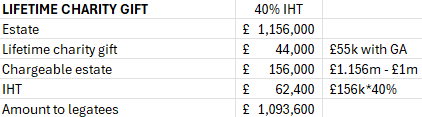 Of course there are practical issues. You do not know how much the 10% equivalent would be. More likely, you may need the capital to provide an income during your lifetime. I guess you could estimate and make the donation on your deathbed...0
 -
I'm going back to square one and this link I posted earlier which supports 24% of the charity gift being paid by legatees. Is it wrong?
 Then going back to your first post yesterday with the 49.5% figure, probate_slave, that reduces as the estate grows.
 If there is no RNRB to apply, it remains fixed at 24% for all three estate sizes on this spreadsheet. What say you...?0
 -
The New College, Oxford calculation is impeccable as one might expect. However, it is targeted at unmarried alumni where the greatest untapped wealth lies, hence no reference to transferable or residential NRBs.
The fact that the charity bequest appears to work more favourably for unmarried estates is only a consequence of the more generous IHT treatment of married estates overall.
If you are asking why your metric of 24% is constant for unmarried estates, that is just a mathematical quirk. For your own estate the figure expressed algebraically is 100(0.024E - 1600)/(0.1E - 65000) which is clearly dependent on the value of E, the gross estate.2 -
I don't think "24% is constant for unmarried estates"; 24% is constant when there is no RNRB, whether married or unmarried. It is also 24% when there is a transferred NRB and £650k is allowed. When there is a RNRB, the percentage reduces as the size of the estate increases, trending towards 24%.0
-
OK, I see what you mean now. Indeed, without the RNRB and TRNRB, the proportion of the charitable bequest suffered by residuary beneficiaries is 24%, at least for our simplistic model. And with them, it tends asymptotically to 24% as E approaches infinity. But I'm afraid this only makes me doubt the usefulness of this particular metric, since we would hardly want to lose residential relief.
0






Confirm your email address to Create Threads and Reply

Categories
- All Categories
- 355.7K Banking & Borrowing
- 254.9K Reduce Debt & Boost Income
- 456.1K Spending & Discounts
- 248.3K Work, Benefits & Business
- 605.8K Mortgages, Homes & Bills
- 179K Life & Family
- 263.6K Travel & Transport
- 1.5M Hobbies & Leisure
- 16.2K Discuss & Feedback
- 37.7K Read-Only Boards