We’d like to remind Forumites to please avoid political debate on the Forum.
This is to keep it a safe and useful space for MoneySaving discussions. Threads that are – or become – political in nature may be removed in line with the Forum’s rules. Thank you for your understanding.
📨 Have you signed up to the Forum's new Email Digest yet? Get a selection of trending threads sent straight to your inbox daily, weekly or monthly!
The Forum now has a brand new text editor, adding a bunch of handy features to use when creating posts. Read more in our how-to guide
What to do with £110k
Comments
-
Its a heart decision rather than a head decision a lot of the time. So, it depends on where you keep your brain.harlequinnyc said:Imo, paying off the mortgage is an absolute no brainer.
But seriously, it depends on the whole scenario and it could be a no brainer for some but a poor decision for others.I am an Independent Financial Adviser (IFA). The comments I make are just my opinion and are for discussion purposes only. They are not financial advice and you should not treat them as such. If you feel an area discussed may be relevant to you, then please seek advice from an Independent Financial Adviser local to you.3 -
..wise words above.Very much depends on your state of mind.For me, it was just about the piece of mind by not having any debt....and there is not a column on a spreadsheet for that!.."It's everybody's fault but mine...."3
-
It's a maths and risk decision.
If you can guarantee higher saving rates (taking into account any tax on interest) than your mortgage rate then it may be marginal.
I built a model for my partner regarding this dilemma on the sale of a second property and whether to clear her current mortgage immediately. Factoring in the redemption penalty, current payments (and what she could do with them) and saving products available. She was better off to clear it (including redemption penalty) and worked out better off before the end of her fix, whilst freeing up her overpayment of £1,400 per month. Maybe more importantly, the emotional impact of clearing a mortgage and having immediate bundles of cash each month should never be underestimated.
With the OP (in reverse), it is almost like suggesting that someone without a mortgage, should re-mortgage into their 70's to get some cash and invest it elsewhere. I hope no-one would seriously suggest that, unless they were clearing off a high interest debt! That's clearly not the case in this instance.
1 -
It seems this is definitely the case. The mortgage free wannabee board on here during a sustained period of low interest rates makes as much sense to me as a trump presidency or two. I simply cannot fathom it. Need to find a heart lol.dunstonh said:
Its a heart decision rather than a head decision a lot of the time. So, it depends on where you keep your brain.harlequinnyc said:Imo, paying off the mortgage is an absolute no brainer.
But seriously, it depends on the whole scenario and it could be a no brainer for some but a poor decision for others.2 -
When I paid off my fixed 3.25% mortgage, the one year fixed bond (actually CD as I'm in the US) rate was around 1%. I did it by making regular extra payments and thought of it as part of my fixed income allocation in my overall portfolio. I reduced the amounts I invested into bond index trackers in my pensions and general accounts and continued to invest the same amounts into equity index trackers. I've been mortgage free for 14 years and having no mortgage in retirement is great as it really takes pressure off pensions etc to produce income.nicknameless said:
It seems this is definitely the case. The mortgage free wannabee board on here during a sustained period of low interest rates makes as much sense to me as a trump presidency or two. I simply cannot fathom it. Need to find a heart lol.dunstonh said:
Its a heart decision rather than a head decision a lot of the time. So, it depends on where you keep your brain.harlequinnyc said:Imo, paying off the mortgage is an absolute no brainer.
But seriously, it depends on the whole scenario and it could be a no brainer for some but a poor decision for others.And so we beat on, boats against the current, borne back ceaselessly into the past.1 -
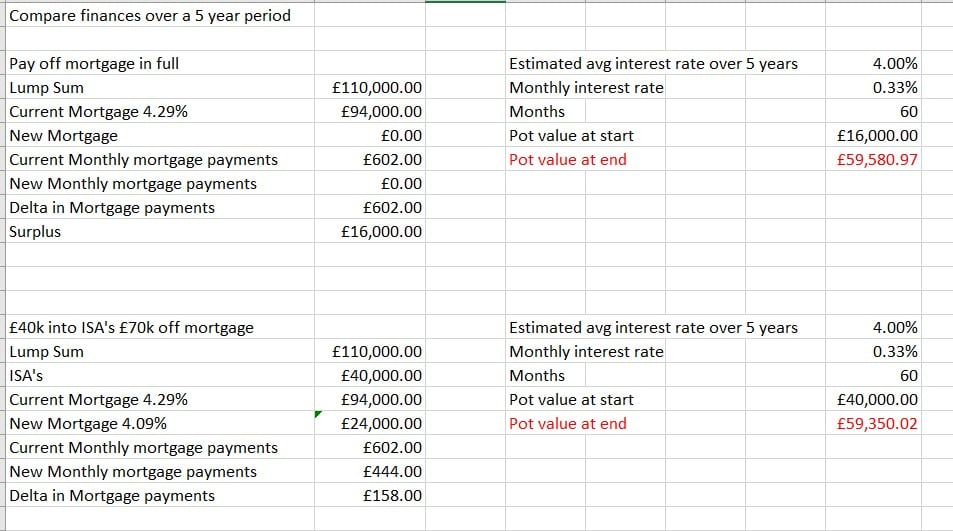
Just modelled the 2 scenarios I have been mostly thinking about, and there is nothing in it really. This is assuming that all extra money was put into savings to compare like with like, whereas in reality we will probably spend some of it. Assumed interest rates remain at 4% for 5 years, which is obviously a guess. This is assuming that all money goes into ISA's so there would be no tax to pay on interest. I think in reality, we would probably have more money at the end of the 5 year period using option 2, as we would see the £40k as being locked away in ISA's rather than additional disposable income.
 1
1 -
Makes sense. Ultimately it comes down to the relationship between savings/investment rates and mortgage rates. Someone may be getting 5% on savings and a 1. something% fixed mortgage rate but there won't be many of those left! There'll be a time when it makes sense to clear it.swindiff said:Just modelled the 2 scenarios I have been mostly thinking about, and there is nothing in it really. This is assuming that all extra money was put into savings to compare like with like, whereas in reality we will probably spend some of it. Assumed interest rates remain at 4% for 5 years, which is obviously a guess. This is assuming that all money goes into ISA's so there would be no tax to pay on interest. I think in reality, we would probably have more money at the end of the 5 year period using option 2, as we would see the £40k as being locked away in ISA's rather than additional disposable income.
I said before...who realistically would remortgage in order to invest cash...unless you are going on red or black?!
That is without the ongoing/future commitments to a mortgage.
It is apparent that there are those who will try and rinse every penny, no matter the 'hassle factor' and probably quite enjoy the cut and thrust of chasing investments....not forgetting that property (maybe not second property now) is a good investment in itself. There are also those who will leave hundreds of thousands in a savings account and be happy with the interest and tax bill. My 88 year old dad has £35k in a 0% current account, designated for his 'new car' that is clearly never going to get bought now. He also draws his state pension out as cash every Monday and hands my mum 'housekeeping'. I can only tell him that he won't pay tax on it but isn't making the most of my inheritance.
He's good with the ISA's though.1 -
I guess the question is whether the pension savings you have projected to go to retirement are enough, without the extra £110k. If so, then perhaps you don't need to set much extra aside... If that was the case, I'd probably pay the mortgage off in full, free up £600 a month, and perhaps split that between spending and saving
 2
2 -
Bluebell1000 said:I guess the question is whether the pension savings you have projected to go to retirement are enough, without the extra £110k. If so, then perhaps you don't need to set much extra aside... If that was the case, I'd probably pay the mortgage off in full, free up £600 a month, and perhaps split that between spending and savingThis is the key. What level of retirement income will give you the lifestyle that you (and your OH) want to achieve. I suggest that you read a bit of the Number thread in the stickies on this board.You seem to have been planning your retirement dates and retirement savings without taking this £110K into account, and your OH is already unhappy with the sacrifices in your current living standards in order to achieve your goals.As someone who has seen too many people concentrate far too much on their retirement dreams at the expense of living in the present, only to then fail to reach that retirement, then I think that you need to spend far more time talking to your OH and reach a compromise on your joint goals for both the future and the now."When the people fear the government there is tyranny, when the government fears the people there is liberty." - Thomas Jefferson2
-
Sorry can't recall your figures earlier and leeway with pensions etc. and don't know your earnings etc. Have you modelled similar with the money going into pensions (sal sac and / or SIPP) with a longer term investment strategy. I think it's obvious that fixed rates savings are not going to be a benefit as an alternate vehicle to the mortgage.swindiff said:Just modelled the 2 scenarios I have been mostly thinking about, and there is nothing in it really. This is assuming that all extra money was put into savings to compare like with like, whereas in reality we will probably spend some of it. Assumed interest rates remain at 4% for 5 years, which is obviously a guess. This is assuming that all money goes into ISA's so there would be no tax to pay on interest. I think in reality, we would probably have more money at the end of the 5 year period using option 2, as we would see the £40k as being locked away in ISA's rather than additional disposable income.
With my mrs as an example we can put £100 against a 2.39% mortgage rate or use it as sal sac to be worth about £140 in the pension vehicle. £2.40 vs £40 - in that example.
Apologies if I'm missing something obvious.
Edited to add - that example doesn't account for the expected growth rate in the pension (AVCs available to take in approx. 12 years).1












Confirm your email address to Create Threads and Reply

Categories
- All Categories
- 354.1K Banking & Borrowing
- 254.3K Reduce Debt & Boost Income
- 455.3K Spending & Discounts
- 247.1K Work, Benefits & Business
- 603.7K Mortgages, Homes & Bills
- 178.3K Life & Family
- 261.2K Travel & Transport
- 1.5M Hobbies & Leisure
- 16.1K Discuss & Feedback
- 37.7K Read-Only Boards