We’d like to remind Forumites to please avoid political debate on the Forum.
This is to keep it a safe and useful space for MoneySaving discussions. Threads that are – or become – political in nature may be removed in line with the Forum’s rules. Thank you for your understanding.
📨 Have you signed up to the Forum's new Email Digest yet? Get a selection of trending threads sent straight to your inbox daily, weekly or monthly!
The Forum now has a brand new text editor, adding a bunch of handy features to use when creating posts. Read more in our how-to guide
Estimated savings for solar panels



I've just been reading the "Solar panels – are they worth it?" article and was surprised to see that the predicted electricity bill savings is in the range of £104 to £372 over a year depending on various factors. Even the maximum saving of £372 seems incredibly low! I was under the impression that assuming you have enough panels they should cover the majority if not all of your electricity usage.
According to the calculators on OVO (our current gas and electric supplier) and "makemyhousegreen.com" the yearly saving if we have 12 panels would be £1370 or £1650 respectively. If we went up to 23 solar panels (theoretically) the yearly saving would be £2370 which is our entireyearly electric bill.
Am I missing something since I can't figure out why the article on here has such low values for annual saving.
According to the calculators on OVO (our current gas and electric supplier) and "makemyhousegreen.com" the yearly saving if we have 12 panels would be £1370 or £1650 respectively. If we went up to 23 solar panels (theoretically) the yearly saving would be £2370 which is our entireyearly electric bill.
Am I missing something since I can't figure out why the article on here has such low values for annual saving.
0
Comments
-
Panels won't cover some of your usage because they don't work at night (or when there's no sun) and evenings/night are when you need the most light.
As well as not producing when you need the electricity there's the opposite effect of producing it when you aren't using it, so for example bright sunny day when you're at work.
So they are over-egging it.
This assumes you don't have a battery system so can't store the electricity.
How are you expecting the panels to produce your electricity at night?0 -
Sadly it’s not quite as black and white as it sounds. You generate far more power than you can use during the summer months and nothing like enough in the winter. Some winter days will barely cover background usage. Similarly you generate zero at night.The Green and Ethical forum here would be a better place to discuss solar, lots of experts and seasoned veterans there. I’ve recently added more panels and batteries alongside an existing system and since the beginning of March have used less than 50kWh on the meter, so a bit over a tenners worth. Pretty pleased with that.0
-
lisyloo said:Panels won't cover some of your usage because they don't work at night (or when there's no sun) and evenings/night are when you need the most light.
As well as not producing when you need the electricity there's the opposite effect of producing it when you aren't using it, so for example bright sunny day when you're at work.
So they are over-egging it.
This assumes you don't have a battery system so can't store the electricity.
How are you expecting the panels to produce your electricity at night?
Ok thank you. I'm not expecting the panels to produce electricity at night ... I forgot to add that these estimate both include a battery. I wouldn't consider getting panels without a battery since as you say you have no way to store extra unused energy or use any of the generated energy at night which seems incredibly inefficient!
0 -
Interesting that you say you generate far more electricity that you can use during the summer months as that alone would save us £250+ for Jun to August.tim_p said:Sadly it’s not quite as black and white as it sounds. You generate far more power than you can use during the summer months and nothing like enough in the winter. Some winter days will barely cover background usage. Similarly you generate zero at night.The Green and Ethical forum here would be a better place to discuss solar, lots of experts and seasoned veterans there. I’ve recently added more panels and batteries alongside an existing system and since the beginning of March have used less than 50kWh on the meter, so a bit over a tenners worth. Pretty pleased with that.
Thanks for the tip, I'll try posting on the Green and Ethical forum to see what people say.0 -
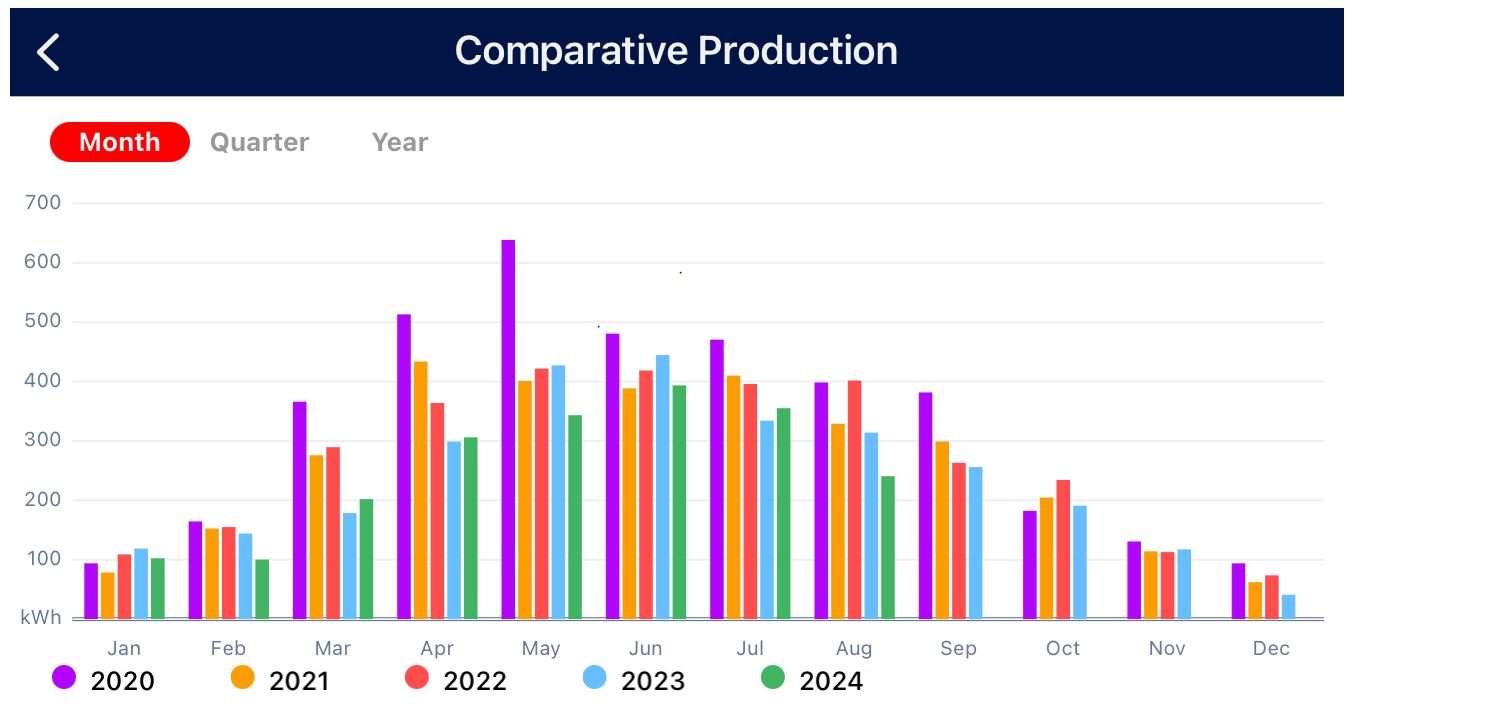
You're not going to produce enough in the winter
0 -
I meant enough to cover your usage.
0 -
Yeah as I said I was never expecting that I was mainly asking how the actual savings compared to the article which suggest £372 is an absolute top end of what someone might save over a year.lisyloo said:I meant enough to cover your usage.
Thank you for posting the graph though it's very interesting to get a rough idea of how it changed over the year. It sounds pretty much unanimous that the savings should be a lot more than the article suggests.0 -
Typically produce over 1000kWh (1MWh) per month between April and Aug, so averages at 30kWh per day, often it’s over 50. Worst months Nov/Dec/Jan/Mar max out at around 300kWh imported. Hope to see a slight drop this year as I’ve doubled battery capacity since this March. We’ll see!SkySi said:
Interesting that you say you generate far more electricity that you can use during the summer months as that alone would save us £250+ for Jun to August.tim_p said:Sadly it’s not quite as black and white as it sounds. You generate far more power than you can use during the summer months and nothing like enough in the winter. Some winter days will barely cover background usage. Similarly you generate zero at night.The Green and Ethical forum here would be a better place to discuss solar, lots of experts and seasoned veterans there. I’ve recently added more panels and batteries alongside an existing system and since the beginning of March have used less than 50kWh on the meter, so a bit over a tenners worth. Pretty pleased with that.
Thanks for the tip, I'll try posting on the Green and Ethical forum to see what people say.0 -
That's really helpful thank you!tim_p said:
Typically produce over 1000kWh (1MWh) per month between April and Aug, so averages at 30kWh per day, often it’s over 50. Worst months Nov/Dec/Jan/Mar max out at around 300kWh imported. Hope to see a slight drop this year as I’ve doubled battery capacity since this March. We’ll see!SkySi said:
Interesting that you say you generate far more electricity that you can use during the summer months as that alone would save us £250+ for Jun to August.tim_p said:Sadly it’s not quite as black and white as it sounds. You generate far more power than you can use during the summer months and nothing like enough in the winter. Some winter days will barely cover background usage. Similarly you generate zero at night.The Green and Ethical forum here would be a better place to discuss solar, lots of experts and seasoned veterans there. I’ve recently added more panels and batteries alongside an existing system and since the beginning of March have used less than 50kWh on the meter, so a bit over a tenners worth. Pretty pleased with that.
Thanks for the tip, I'll try posting on the Green and Ethical forum to see what people say.0






Confirm your email address to Create Threads and Reply

Categories
- All Categories
- 353.4K Banking & Borrowing
- 254.1K Reduce Debt & Boost Income
- 455K Spending & Discounts
- 246.5K Work, Benefits & Business
- 602.8K Mortgages, Homes & Bills
- 178K Life & Family
- 260.5K Travel & Transport
- 1.5M Hobbies & Leisure
- 16K Discuss & Feedback
- 37.7K Read-Only Boards