We’d like to remind Forumites to please avoid political debate on the Forum.
This is to keep it a safe and useful space for MoneySaving discussions. Threads that are – or become – political in nature may be removed in line with the Forum’s rules. Thank you for your understanding.
📨 Have you signed up to the Forum's new Email Digest yet? Get a selection of trending threads sent straight to your inbox daily, weekly or monthly!
The Forum now has a brand new text editor, adding a bunch of handy features to use when creating posts. Read more in our how-to guide
Percentages

sgx2000
Posts: 584 Forumite



Just curious....
Discounting DB pensions...
What percentage of annual UK retirement pensions are taken as annuity vs draw down?
Oh! and allowing that many older pensions already in payment would be annuities.
What percentage of pensions taken for the first time this year are annuity vs drawdown?
Discounting DB pensions...
What percentage of annual UK retirement pensions are taken as annuity vs draw down?
Oh! and allowing that many older pensions already in payment would be annuities.
What percentage of pensions taken for the first time this year are annuity vs drawdown?
1
Comments
-
Just curious...
But after the announcement of the 'Pension Freedoms' I did wonder how many people who opted for draw down would have the financial experience/self discipline to stick to a (reasonably) safe withdrawal rate.
Or were lump sums taken out to pay for new cars, sumptious weddings, dream holidays etc "because the money is just sat there".1 -
I found this : https://www.fca.org.uk/data/retirement-income-market-data-2021-22
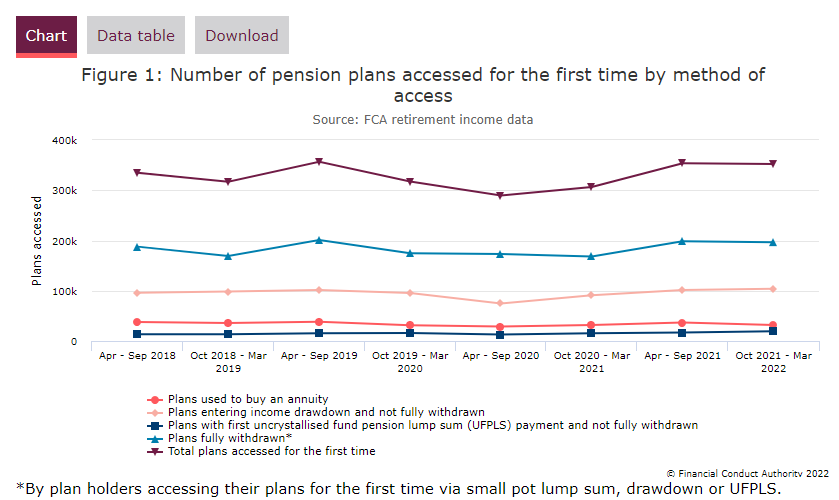
This seems to suggest that over 3x as many pensions are used for drawdown as compared to buying an annuity (though this gap might have shrunk since annuities became better value following the collapse in the bond market just after this chart ends).
Indeed, the majority of the public is not financially disciplined in the slightest (Apple is the highest valued company on Earth after all).Silvertabby said:I did wonder how many people who opted for draw down would have the financial experience/self discipline to stick to a (reasonably) safe withdrawal rate.
Or were lump sums taken out to pay for new cars, sumptious weddings, dream holidays etc "because the money is just sat there".Know what you don't4 -
I noticed that the above chart stops before the big increase in annuity rates came along.1
-
I'm not sure what conclusions you can draw from this, as lots of people could have multiple pensions and access each one differently. For example the 'plans fully withdrawn' line is likely to include people with plenty of provision else where, maybe buying an annuity with a much larger pot or have a sufficient DB pot and no need for a small DC pension.
Without this breakdown, its wrong to assume that everybody who bought an annuity, for example, is all they did and have for their pension income provision.
Possibly an interesting plot would be size of plan versus method, I would expect the fully withdrawn would be smaller pots and annuities bought would be larger pots.1 -
...not to mention the number of parents who now feel moral pressure (if they didn't before!) to help offspring onto the housing ladder...Silvertabby said:Just curious...
But after the announcement of the 'Pension Freedoms' I did wonder how many people who opted for draw down would have the financial experience/self discipline to stick to a (reasonably) safe withdrawal rate.
Or were lump sums taken out to pay for new cars, sumptious weddings, dream holidays etc "because the money is just sat there".Googling on your question might have been both quicker and easier, if you're only after simple facts rather than opinions!3 -
There is an IFS webinar on YouTube that covered some of this territory, it is called 'what do pension freedoms mean for financing retirement'.
It seemed like lots of people retiring now do still have some DB provision, so as @NoMore said, you can't really infer much from what they do with their DC pots. Things will get more interesting in 20 years when my cohort hits retirement age with lots of us having no DB (I'm one of those).
There is understandably a big increase in annuities just now and I think they also said that people who were more financially literate were more likely to take an annuity (though that might have been a different webinar).2 -
I'd have thought this would be the other way round, as individuals who are less financially sophisticated tend to avoid the stock market. Annuities are very simple to comprehend... they pay you a defined amount of money till you die. More so than expecting the average Joe to calculate a safe draw-down rate by capital reduction, market volatility and projected returns?Cairnpapple said:There is understandably a big increase in annuities just now and I think they also said that people who were more financially literate were more likely to take an annuity (though that might have been a different webinar).
Know what you don't2 -
It is worth noting that you can use drawdown and then buy an annuity, but not vice versa. For example, you might use drawdown to draw rapidly down on the pot until your State Pension starts, then buy an annuity to secure a known level of income for life. This means drawdown is likely to remain significantly higher than the annuity figure.
One of the interesting data points is that the percentage of people cashing in pensions in full has remained fairly steady since pension freedoms were introduced in 2015, at around 50-60%. There is little evidence of a rush to cash in pension pots just because people could. If people were doing that in significant numbers, there would have been a big surge in full encashments in 2015, followed by a drop as most of those who wanted to cash in their pensions would have already done so.
Full encashments will cover small pots and people taking DC pensions linked to a DB scheme as part of the overall lump sum. Relatively few of those are going to be people cashing in £100k+ and paying additional rate tax so they can buy a Lambo.
2 -
Yes indeed! That's why it stuck in my head, because it was surprising. I'm not going to watch it again, but maybe if someone else does they could report back and tell me if I'm wrong.Exodi said:
I'd have thought this would be the other way round, as individuals who are less financially sophisticated tend to avoid the stock market. Annuities are very simple to comprehend... they pay you a defined amount of money till you die. More so than expecting the average Joe to calculate a safe draw-down rate by capital reduction, market volatility and projected returns?Cairnpapple said:There is understandably a big increase in annuities just now and I think they also said that people who were more financially literate were more likely to take an annuity (though that might have been a different webinar).
If I recall correctly, they weren't just comparing annuity versus drawdown - it was annuity/drawdown/take out the whole pot at once/don't know. So a higher proportion of financially literate people taking annuities doesn't necessarily mean less were doing drawdown - it could mean less in the whole pot or don't know group.1












Confirm your email address to Create Threads and Reply

Categories
- All Categories
- 354K Banking & Borrowing
- 254.3K Reduce Debt & Boost Income
- 455.3K Spending & Discounts
- 247.1K Work, Benefits & Business
- 603.7K Mortgages, Homes & Bills
- 178.3K Life & Family
- 261.2K Travel & Transport
- 1.5M Hobbies & Leisure
- 16.1K Discuss & Feedback
- 37.7K Read-Only Boards