We’d like to remind Forumites to please avoid political debate on the Forum.
This is to keep it a safe and useful space for MoneySaving discussions. Threads that are – or become – political in nature may be removed in line with the Forum’s rules. Thank you for your understanding.
What is this pension pot worth?
Comments
-
Yes, the SWR is almost a worst case scenario and if hopefully the pot does OK for the first 10 years, you can up it a bit. Or you can vary the income taken in line with changing requirements. Plus of course it is still protected from IHT ( for now anyway)Pat38493 said:
It certainly means that it's worth considering in my view. However, depending on your individual situation, if the annuity level if only just above the SWR, you are still might only have (for example) a 5% chance of being better off - i.e. you are still paying a lot of potential upside for that guarantee - for basic essential income this might make sense but for luxuries depends on your risk attitude maybe?michaels said:
So what is interesting to me is how different those rates are from when I did my main retirement plan 3 years ago.Albermarle said:
The above is using today's annuity rates. In 10 or 20 years time they could be quite different ( better or worse) , but the Armed Forces pension would still pay out the same.Secret2ndAccount said:michaels said:
I suspect buying an equivalent index linked (any cap?) 50% spousal benefit annuity giving the same certain return at age 53 would cost a lot more than £833k - more like 1.2 -1.5mSecret2ndAccount said:Very quick calc, I get £833,000
You have to allow for the possibility of living beyond 80, or periods of high inflation. The provider is taking all the risk. If you were working with a pot, you would have to hold some back for possibilities. That's the difference between your 653k and my 833k.Here’s the latest table from Hargreaves Lansdown:
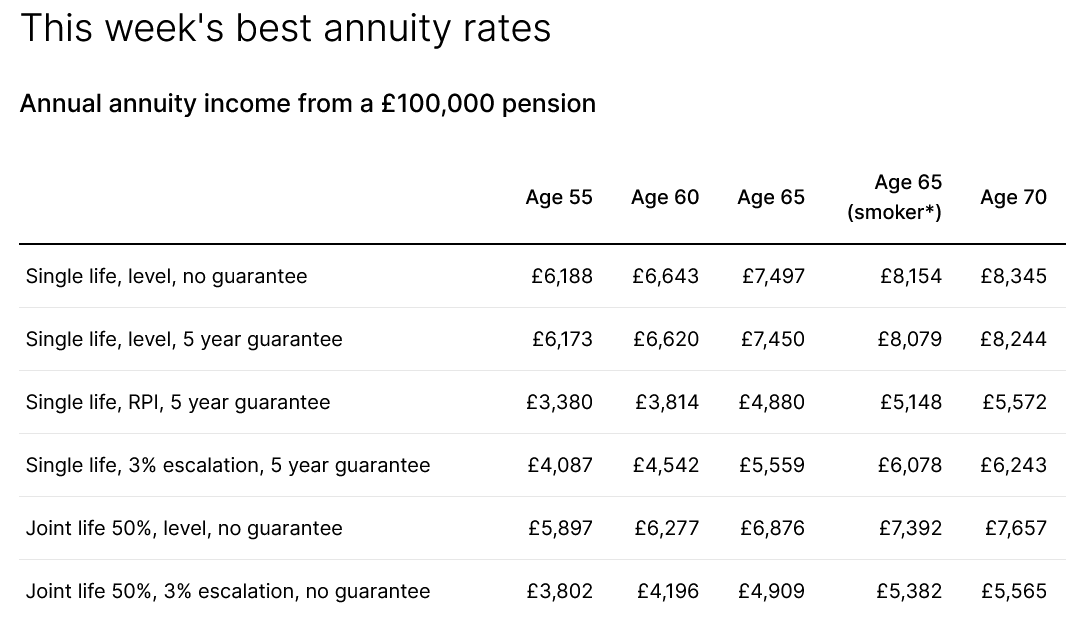
At 55, comparing row 1 with row 5 suggests that the joint life 50% adds 5% to the cost.
Extrapolating the Age 60 and Age 55 values back to Age 53, the RPI annuity gives 3208 at age 53
OP Wants 18,700 from age 53 so the cost is 18,700 / 3208 * 100k = 583k. Add 5%: 612k
From age 67 need an additional 6,300. Similar calculation yields 101k -> 106k
612k + 106k + the 66k lump sum = 784k
So, doing the calculation on paper instead of in my head, I would like to revise my number to 784k
This assumes OP is has no health issues, does not smoke and has a spouse. If (s)he is single, a smoker, or unwell, then the cost would be lower.
If you had done the same calculation two years ago the amount would have been a lot more than £784K
I would say that annuities now beat swr for those retiring at 55 which rather upends my plans and I suspect many others.1 -
I think you have to look at an RPI indexed annuity to compare with a sustainable withdrawal rate and then also factor in that with a SWR there's a high probability that you will have money left over to leave to heirs or will have been able to spend. The annuity really pays off if you live a long time ie past your mid 80s and half of the people will die before that so the annuity will end up a bad deal for them. With an annuity you are selling your risk of running out of money to an insurance company and that might be a very sensible move for some people, particularly those that only need to do a partial annuitization to secure their retirement.michaels said:
So what is interesting to me is how different those rates are from when I did my main retirement plan 3 years ago.Albermarle said:
The above is using today's annuity rates. In 10 or 20 years time they could be quite different ( better or worse) , but the Armed Forces pension would still pay out the same.Secret2ndAccount said:michaels said:
I suspect buying an equivalent index linked (any cap?) 50% spousal benefit annuity giving the same certain return at age 53 would cost a lot more than £833k - more like 1.2 -1.5mSecret2ndAccount said:Very quick calc, I get £833,000
You have to allow for the possibility of living beyond 80, or periods of high inflation. The provider is taking all the risk. If you were working with a pot, you would have to hold some back for possibilities. That's the difference between your 653k and my 833k.Here’s the latest table from Hargreaves Lansdown:
At 55, comparing row 1 with row 5 suggests that the joint life 50% adds 5% to the cost.
Extrapolating the Age 60 and Age 55 values back to Age 53, the RPI annuity gives 3208 at age 53
OP Wants 18,700 from age 53 so the cost is 18,700 / 3208 * 100k = 583k. Add 5%: 612k
From age 67 need an additional 6,300. Similar calculation yields 101k -> 106k
612k + 106k + the 66k lump sum = 784k
So, doing the calculation on paper instead of in my head, I would like to revise my number to 784k
This assumes OP is has no health issues, does not smoke and has a spouse. If (s)he is single, a smoker, or unwell, then the cost would be lower.
If you had done the same calculation two years ago the amount would have been a lot more than £784K
I would say that annuities now beat swr for those retiring at 55 which rather upends my plans and I suspect many others.And so we beat on, boats against the current, borne back ceaselessly into the past.2 -
Yes, RPI indexed plus 100% spousal benefit to be equivalent to drawdown, I see my pension saving as being for me to to never run out of money rather than worrying about a legacy; my kids can earn their own money plus I hope not to pass anything on before they are old enough that they should have sorted their own provision. In theory with SWR you don't increase your spending after the first X years.Bostonerimus1 said:
I think you have to look at an RPI indexed annuity to compare with a sustainable withdrawal rate and then also factor in that with a SWR there's a high probability that you will have money left over to leave to heirs or will have been able to spend. The annuity really pays off if you live a long time ie past your mid 80s and half of the people will die before that so the annuity will end up a bad deal for them. With an annuity you are selling your risk of running out of money to an insurance company and that might be a very sensible move for some people, particularly those that only need to do a partial annuitization to secure their retirement.michaels said:
So what is interesting to me is how different those rates are from when I did my main retirement plan 3 years ago.Albermarle said:
The above is using today's annuity rates. In 10 or 20 years time they could be quite different ( better or worse) , but the Armed Forces pension would still pay out the same.Secret2ndAccount said:michaels said:
I suspect buying an equivalent index linked (any cap?) 50% spousal benefit annuity giving the same certain return at age 53 would cost a lot more than £833k - more like 1.2 -1.5mSecret2ndAccount said:Very quick calc, I get £833,000
You have to allow for the possibility of living beyond 80, or periods of high inflation. The provider is taking all the risk. If you were working with a pot, you would have to hold some back for possibilities. That's the difference between your 653k and my 833k.Here’s the latest table from Hargreaves Lansdown:
At 55, comparing row 1 with row 5 suggests that the joint life 50% adds 5% to the cost.
Extrapolating the Age 60 and Age 55 values back to Age 53, the RPI annuity gives 3208 at age 53
OP Wants 18,700 from age 53 so the cost is 18,700 / 3208 * 100k = 583k. Add 5%: 612k
From age 67 need an additional 6,300. Similar calculation yields 101k -> 106k
612k + 106k + the 66k lump sum = 784k
So, doing the calculation on paper instead of in my head, I would like to revise my number to 784k
This assumes OP is has no health issues, does not smoke and has a spouse. If (s)he is single, a smoker, or unwell, then the cost would be lower.
If you had done the same calculation two years ago the amount would have been a lot more than £784K
I would say that annuities now beat swr for those retiring at 55 which rather upends my plans and I suspect many others.I think....1 -
I think, with the AFPS, that the pension paid at 53 is level, not inflation linked. Its only when you hit SPA that you get it increased by inflation during the 53-SPA period & then indexation going forward. Hence the jump to £25k in the OPSecret2ndAccount said:michaels said:
I suspect buying an equivalent index linked (any cap?) 50% spousal benefit annuity giving the same certain return at age 53 would cost a lot more than £833k - more like 1.2 -1.5mSecret2ndAccount said:Very quick calc, I get £833,000
You have to allow for the possibility of living beyond 80, or periods of high inflation. The provider is taking all the risk. If you were working with a pot, you would have to hold some back for possibilities. That's the difference between your 653k and my 833k.Here’s the latest table from Hargreaves Lansdown:
At 55, comparing row 1 with row 5 suggests that the joint life 50% adds 5% to the cost.
Extrapolating the Age 60 and Age 55 values back to Age 53, the RPI annuity gives 3208 at age 53
OP Wants 18,700 from age 53 so the cost is 18,700 / 3208 * 100k = 583k. Add 5%: 612k
From age 67 need an additional 6,300. Similar calculation yields 101k -> 106k
612k + 106k + the 66k lump sum = 784k
So, doing the calculation on paper instead of in my head, I would like to revise my number to 784k
This assumes OP is has no health issues, does not smoke and has a spouse. If (s)he is single, a smoker, or unwell, then the cost would be lower.
1 -
It goes up with CPI From age 55.Andy_L said:
I think, with the AFPS, that the pension paid at 53 is level, not inflation linked. Its only when you hit SPA that you get it increased by inflation during the 53-SPA period & then indexation going forward. Hence the jump to £25k in the OPSecret2ndAccount said:michaels said:
I suspect buying an equivalent index linked (any cap?) 50% spousal benefit annuity giving the same certain return at age 53 would cost a lot more than £833k - more like 1.2 -1.5mSecret2ndAccount said:Very quick calc, I get £833,000
You have to allow for the possibility of living beyond 80, or periods of high inflation. The provider is taking all the risk. If you were working with a pot, you would have to hold some back for possibilities. That's the difference between your 653k and my 833k.Here’s the latest table from Hargreaves Lansdown:
At 55, comparing row 1 with row 5 suggests that the joint life 50% adds 5% to the cost.
Extrapolating the Age 60 and Age 55 values back to Age 53, the RPI annuity gives 3208 at age 53
OP Wants 18,700 from age 53 so the cost is 18,700 / 3208 * 100k = 583k. Add 5%: 612k
From age 67 need an additional 6,300. Similar calculation yields 101k -> 106k
612k + 106k + the 66k lump sum = 784k
So, doing the calculation on paper instead of in my head, I would like to revise my number to 784k
This assumes OP is has no health issues, does not smoke and has a spouse. If (s)he is single, a smoker, or unwell, then the cost would be lower.
1 -
I thought that was only if you got the full service pension and served till age 55 rather than the immediate pension?Ivrytwr3 said:
It goes up with CPI From age 55.Andy_L said:
I think, with the AFPS, that the pension paid at 53 is level, not inflation linked. Its only when you hit SPA that you get it increased by inflation during the 53-SPA period & then indexation going forward. Hence the jump to £25k in the OPSecret2ndAccount said:michaels said:
I suspect buying an equivalent index linked (any cap?) 50% spousal benefit annuity giving the same certain return at age 53 would cost a lot more than £833k - more like 1.2 -1.5mSecret2ndAccount said:Very quick calc, I get £833,000
You have to allow for the possibility of living beyond 80, or periods of high inflation. The provider is taking all the risk. If you were working with a pot, you would have to hold some back for possibilities. That's the difference between your 653k and my 833k.Here’s the latest table from Hargreaves Lansdown:
At 55, comparing row 1 with row 5 suggests that the joint life 50% adds 5% to the cost.
Extrapolating the Age 60 and Age 55 values back to Age 53, the RPI annuity gives 3208 at age 53
OP Wants 18,700 from age 53 so the cost is 18,700 / 3208 * 100k = 583k. Add 5%: 612k
From age 67 need an additional 6,300. Similar calculation yields 101k -> 106k
612k + 106k + the 66k lump sum = 784k
So, doing the calculation on paper instead of in my head, I would like to revise my number to 784k
This assumes OP is has no health issues, does not smoke and has a spouse. If (s)he is single, a smoker, or unwell, then the cost would be lower.
1 -
Later versions of the Armed Forces pension schemes may have different rules, but we left (in our 40s) under AFPS75.Andy_L said:
I thought that was only if you got the full service pension and served till age 55 rather than the immediate pension?Ivrytwr3 said:
It goes up with CPI From age 55.Andy_L said:
I think, with the AFPS, that the pension paid at 53 is level, not inflation linked. Its only when you hit SPA that you get it increased by inflation during the 53-SPA period & then indexation going forward. Hence the jump to £25k in the OPSecret2ndAccount said:michaels said:
I suspect buying an equivalent index linked (any cap?) 50% spousal benefit annuity giving the same certain return at age 53 would cost a lot more than £833k - more like 1.2 -1.5mSecret2ndAccount said:Very quick calc, I get £833,000
You have to allow for the possibility of living beyond 80, or periods of high inflation. The provider is taking all the risk. If you were working with a pot, you would have to hold some back for possibilities. That's the difference between your 653k and my 833k.Here’s the latest table from Hargreaves Lansdown:
At 55, comparing row 1 with row 5 suggests that the joint life 50% adds 5% to the cost.
Extrapolating the Age 60 and Age 55 values back to Age 53, the RPI annuity gives 3208 at age 53
OP Wants 18,700 from age 53 so the cost is 18,700 / 3208 * 100k = 583k. Add 5%: 612k
From age 67 need an additional 6,300. Similar calculation yields 101k -> 106k
612k + 106k + the 66k lump sum = 784k
So, doing the calculation on paper instead of in my head, I would like to revise my number to 784k
This assumes OP is has no health issues, does not smoke and has a spouse. If (s)he is single, a smoker, or unwell, then the cost would be lower.
We both took maximum term commutation (yes, 1:12 but raised enough to pay off our mortgage 18 years early). Our reduced pensions then flat lined until we were 55, at which point they were restored to their full pre-commutation rates and further increased by being index linked back to the day we left service.
3 -
One important way to look at the worth of the OP's pension is to ask how much of their income it will cover. ie rather than comparing it with some external pot of money, compare it to their personal financial needs. I feel that for most people in the UK the OP's pension and SP would provide a comfortable retirement (assuming today's pounds), so they are doing ok. They will have guaranteed income and some capital on hand for emergencies. My philosophy to retirement income is to cover basic needs like food, housing and utilities with guaranteed income sources like SP, DB pensions or annuities. People should protect themselves against longevity and sell such risk to an insurance company. For most people it won't end up being the optimum for their finances, but it will allow them to sleep well and probably enjoy their retirement more than constantly fretting over stock market values. But don't over annuitize.
And so we beat on, boats against the current, borne back ceaselessly into the past.3











Confirm your email address to Create Threads and Reply

Categories
- All Categories
- 355.2K Banking & Borrowing
- 254.7K Reduce Debt & Boost Income
- 455.8K Spending & Discounts
- 247.9K Work, Benefits & Business
- 605K Mortgages, Homes & Bills
- 178.8K Life & Family
- 262.8K Travel & Transport
- 1.5M Hobbies & Leisure
- 16.1K Discuss & Feedback
- 37.7K Read-Only Boards