We’d like to remind Forumites to please avoid political debate on the Forum.
This is to keep it a safe and useful space for MoneySaving discussions. Threads that are – or become – political in nature may be removed in line with the Forum’s rules. Thank you for your understanding.
Pension has tanked :(
Comments
-
I don't know much about that fund but most of the outperformance was in the last 10 years and when I see that graph, it looks like they took some pretty high risks in the last few years to me. I think I'll still take my chances with tracker funds.Linton said:
Actually going back as far as I can with Trustnet, BG American has well outperformed the S&P500:Pat38493 said:Almost all active fund managers fail to beat the benchmark / market they are trying to beat over the long term.
Your chances as a DIY investor of picking the one fund manager who does that is almost zero. Even professionals usually don't manage it.
Hence the recommendations above to use tracker funds - low charges and will beat most active funds over the long term.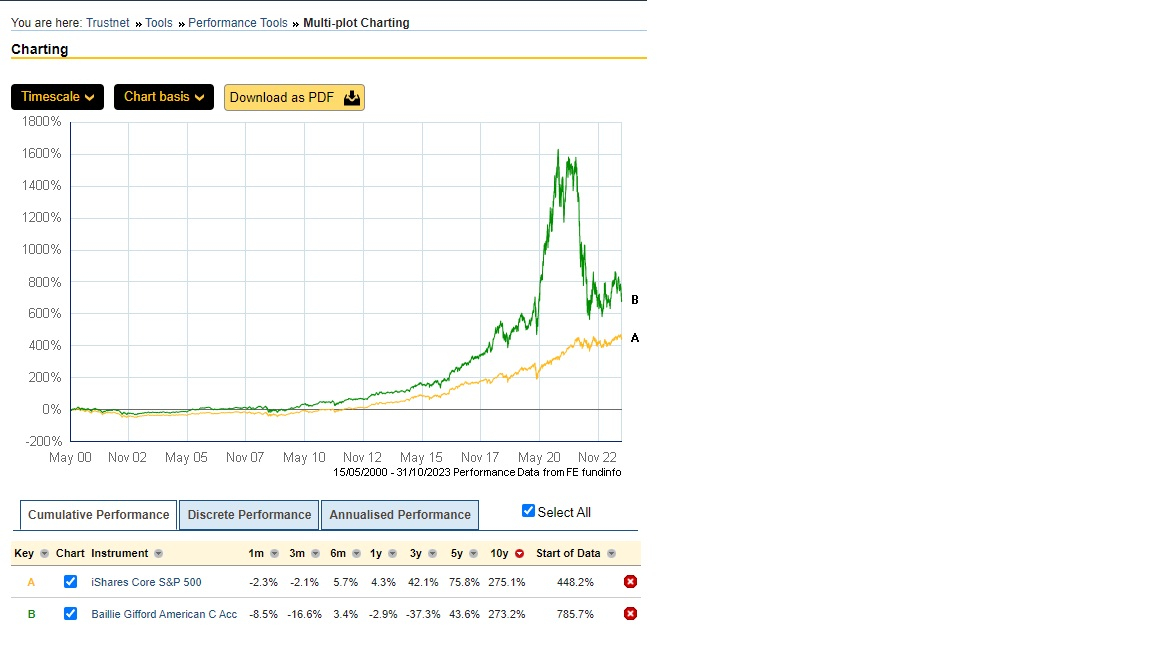
Or isnt 20+ years long term enough?2 -
Baillie Gifford themselves said back in 2021 I think that 5 years of their expected future performance had been effectively compressed into 6 months, or words to that effect. Think it was for SMT but the same principle applies. I don't think that they took any materially different or higher risks than they had before or since within the portfolio but the market pricing was the issue. Increasing discount rates have hit all growth (long duration) stocks hard in the last couple of years. The trend line of performance appears to have resumed if that chart is to be believed.
Edit to note that as it's a linear not a log scale it's quite hard to be sure about performance detail a few years back.1 -
I certainly didn't think I'd ever see the words 'diversification' in the same sentence as 'Crypto' and 'Baillie Gifford American'. From 'how risky are these two assets from 1/10' I think both of these score 'Yes'.
Baillie Guildford has less than 50 punt holdings from memory, it's the sort of fund where you might think "99% of my portfolio in an all-world index fund, but for fun I'll put 1% in the Baillie Gifford American to see if I get lucky". I wouldn't dream of considering it as the US allocation in my portfolio.
Except from <50 random companies in the US and Japan (?), you have no other market representation.
Europe (inc UK), Emerging Markets and Pacific make up about a third of total market capitalisation but are absent from your portolio. The worlds biggest companies that make up the foundations of peoples portfolios (e.g. Apple, Microsoft, etc), entirely missing.
I wouldn't worry about crystallising losses - if the market is down, then you'd expect the fund you'd move to be down (cheaper) as well. Personally I'd consider moving my portfolio (including selling Crypto while it's up) to an all world index fund asap.Know what you don't1 -
Or isnt 20+ years long term enough?
A perfect example to illustrate some relevant points.
Firstly, many of us will be investing for more than 20 years, so they need to keep it up for another 20. Secondly, how did we identify the BG American fund twenty years ago as one that would beat the index funds when the vast majority of such funds 20 years ago have not gone on to do so?
Thirdly, if we’d piled into BG American in June 2020, after 20 years of outperformance, we’d be sitting on a loss while the index has gone up handsomely; this is the trap with outperforming active funds - the punters blinded by recency bias put their money in too late (Cathy Wood’s ARK is a classic example and Blue Whale might be next). See Morningstar’s ‘mind the gap’ research for why investors don’t get the returns of the funds they invest in, on average.
Fourthly, how do we know how much was luck and how much was manager skill when BG American does so well? Either way, it has deserted them for the last two and a half years; does one lose skill that dramatically? https://www.ifa.com/pdfs/academic-paper-luck-skill-and-investment-performance.pdf?file=academic-paper-luck-skill-and-investment-performance.pdf
2 -
To take on 2 key points of the argument.....JohnWinder said:Or isnt 20+ years long term enough?A perfect example to illustrate some relevant points.
Firstly, many of us will be investing for more than 20 years, so they need to keep it up for another 20. Secondly, how did we identify the BG American fund twenty years ago as one that would beat the index funds when the vast majority of such funds 20 years ago have not gone on to do so?
Thirdly, if we’d piled into BG American in June 2020, after 20 years of outperformance, we’d be sitting on a loss while the index has gone up handsomely; this is the trap with outperforming active funds - the punters blinded by recency bias put their money in too late (Cathy Wood’s ARK is a classic example and Blue Whale might be next). See Morningstar’s ‘mind the gap’ research for why investors don’t get the returns of the funds they invest in, on average.
Fourthly, how do we know how much was luck and how much was manager skill when BG American does so well? Either way, it has deserted them for the last two and a half years; does one lose skill that dramatically? https://www.ifa.com/pdfs/academic-paper-luck-skill-and-investment-performance.pdf?file=academic-paper-luck-skill-and-investment-performance.pdf
1) You assume that a choice of funds is made at random. So yes I would agree that choosing an index fund is better than choosing funds at random. However Baillie Gifford are not simply one fund manager of many selling much the same funds. They have a well developed house style based on growth investing and when the markets are in a growth mood their funds perform better than many others.
It is not a matter of the fund just being uniquely lucky but rather of the fund following a consistent strategy and the investor deciding whether that strategy is appropriate for their circumstances. Just like any other equity investment, whether its a BG fund or an index fund the short/medium term outcome is unporedictable.
2) Secondly you are making the point that someone starting investing in the single 2 year period around 2020 would have experienced a large loss in the subsequent year or so. No one with any experience judges their equity strategy on a 2 year timeframe. For most equity funds, and certainly for many BG funds you need to be thinking decades. 2 years is irrelevent. So yes if you do not have the experience to understand this you would be better advised to steer well clear and invest in an index fund.
4 -
What was the timeframe of that investment and the current value?ha-pajama said:we've invested £105K into the pension/ISAs and it's current value is £91K.
Many people are currently sitting on pension funds that show a lower value than they did not very long (2 years?) ago - that is particularly galling if the contributions were at a high rate in that short term period and an absolute loss is now visible.0 -
Indeed, I look at the very meagre growth in my wife’s and my SIPP and wonder why I didn’t put more in the Money Market Funds which is at least keeping up with interest rates, if not fully with inflation.Grumpy_chap said:
What was the timeframe of that investment and the current value?ha-pajama said:we've invested £105K into the pension/ISAs and it's current value is £91K.
Many people are currently sitting on pension funds that show a lower value than they did not very long (2 years?) ago - that is particularly galling if the contributions were at a high rate in that short term period and an absolute loss is now visible.0 -
‘However Baillie Gifford are not simply one fund manager of many selling much the same funds. They have a well developed house style based on growth investing’
I don’t think that helped the investor 20 years ago to decide do I go BG or a different active fund. Yes, the investor knew that BG had a house style as would every fund have a style, but that doesn’t say the fund will beat the index it competes against as BG does and did beat. Especially in this case as ‘growth’ and ‘value’ investing in large US stocks have given near identical returns since 2020 (‘value’ slightly better’). But even if the period had rewarded ‘growth’ investors the most, which suited BG as a ‘growth’ investor, how would the punters have known the next 20 years would reward ‘growth’ investors ahead of ‘mixed’ investors? Only by taking a punt, and worse yet BG might have had the same bad luck/skill for the first decade that they’ve exhibited for the last three years which would shake a lot of investors out of a fund.
No one with any experience judges their equity strategy on a 2 year timeframe. For most equity funds, and certainly for many BG funds you need to be thinking decades. 2 years is irrelevent. So yes if you do not have the experience to understand this you would be better advised to steer well clear and invest in an index fund.’Indeed, and that’s a large cohort.
0












Confirm your email address to Create Threads and Reply

Categories
- All Categories
- 353.6K Banking & Borrowing
- 254.2K Reduce Debt & Boost Income
- 455.1K Spending & Discounts
- 246.6K Work, Benefits & Business
- 603K Mortgages, Homes & Bills
- 178.1K Life & Family
- 260.7K Travel & Transport
- 1.5M Hobbies & Leisure
- 16K Discuss & Feedback
- 37.7K Read-Only Boards