We’d like to remind Forumites to please avoid political debate on the Forum.
This is to keep it a safe and useful space for MoneySaving discussions. Threads that are – or become – political in nature may be removed in line with the Forum’s rules. Thank you for your understanding.
📨 Have you signed up to the Forum's new Email Digest yet? Get a selection of trending threads sent straight to your inbox daily, weekly or monthly!
The Forum now has a brand new text editor, adding a bunch of handy features to use when creating posts. Read more in our how-to guide
Poor pension performance
Comments
-
Hi all new to this forum

I have seen a loss also related to Bonds/income focused funds. Not as bad as the OP and I am a couple years away from retiring, but was wondering what to do. I know if I sell now that loss will be realised, but do you think these will recover over the next few years?0 -
Bond funds have given decent returns over the last 12 months, should be up 10% or more. Have you looked at yours? The interest rate hit last year was a one-off, unless base rates double again (unlikely.) Therefore some of the losses have been recouped from the lows.grumpsthegit said:Hi all new to this forum
I have seen a loss also related to Bonds/income focused funds. Not as bad as the OP and I am a couple years away from retiring, but was wondering what to do. I know if I sell now that loss will be realised, but do you think these will recover over the next few years?
Personally I'd say stick with what you have, but it's obviously your decision. If you move out of bonds into shares you increase the volatility and risk, for the chance of greater returns. You might not feel inclined to do that near to retirement.1 -
I have seen a loss also related to Bonds/income focused funds.Bond is a term that covers many things. So, it really depends on what you mean by bonds.
Income focused funds do not necessarily mean bonds. You can have 100% stockmarket income funds.
Gilts are the biggest faller with fixed interest securities. And gilts are typically the most common form of fixed interest security held. So, its probably those that you are referring to.but do you think these will recover over the next few years?Assuming gilts, then my answer would be no. Excluding income, the unit prices of gilt funds are back to around early 1990s levels.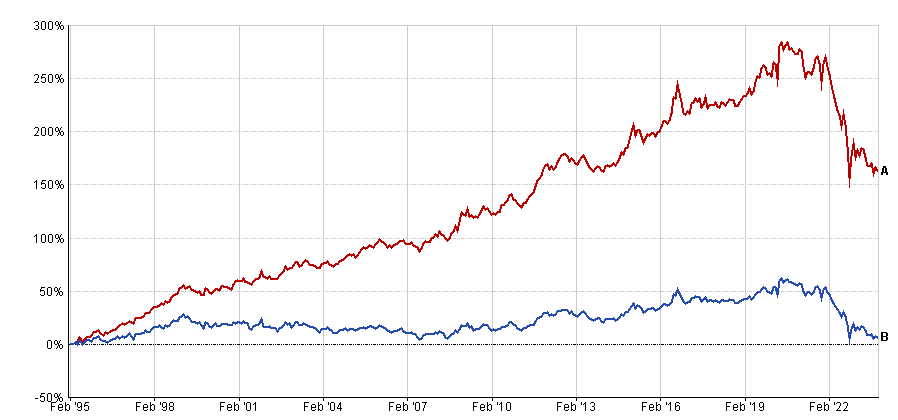
Above is a chart showing a long standing all market gilt fund. The blue line shows the unit price with income paid out. The red line shows the return if income was reinvested.
Broadly speaking, the blue shows that when interest rates rise, the unit price falls and vice versa. You can see the multiple interest rate cycles in the blue line. So, to see the blue line return to the levels of 2020/21 you would need a range of scenarios that are unlikely to happen. It would need inflation to be close to zero and interest rates close to zero. With income removed, you expect the unit price to be wavy line with periods above the launch price and below it but not really going anywhere without the income.
So, you will have to wait enough years for the income to make up most of the shortfall. Maybe 6-8 years.
I am an Independent Financial Adviser (IFA). The comments I make are just my opinion and are for discussion purposes only. They are not financial advice and you should not treat them as such. If you feel an area discussed may be relevant to you, then please seek advice from an Independent Financial Adviser local to you.1 -
The average duration of the "bond fund" will also directly impact the scale of losses and time to recovery. If people were lifestyled into long bonds their pain is going to be far more compared to those with medium to short duration bonds. For people in "all market bond" funds their pain will be somewhere in between.dunstonh said:I have seen a loss also related to Bonds/income focused funds.Bond is a term that covers many things. So, it really depends on what you mean by bonds.
Income focused funds do not necessarily mean bonds. You can have 100% stockmarket income funds.
Gilts are the biggest faller with fixed interest securities. And gilts are typically the most common form of fixed interest security held. So, its probably those that you are referring to.but do you think these will recover over the next few years?Assuming gilts, then my answer would be no. Excluding income, the unit prices of gilt funds are back to around early 1990s levels.
Above is a chart showing a long standing all market gilt fund. The blue line shows the unit price with income paid out. The red line shows the return if income was reinvested.
Broadly speaking, the blue shows that when interest rates rise, the unit price falls and vice versa. You can see the multiple interest rate cycles in the blue line. So, to see the blue line return to the levels of 2020/21 you would need a range of scenarios that are unlikely to happen. It would need inflation to be close to zero and interest rates close to zero. With income removed, you expect the unit price to be wavy line with periods above the launch price and below it but not really going anywhere without the income.
So, you will have to wait enough years for the income to make up most of the shortfall. Maybe 6-8 years.And so we beat on, boats against the current, borne back ceaselessly into the past.2 -
Thanks Dunston:dunstonh said:I have seen a loss also related to Bonds/income focused funds.Bond is a term that covers many things. So, it really depends on what you mean by bonds.
Income focused funds do not necessarily mean bonds. You can have 100% stockmarket income funds.
Gilts are the biggest faller with fixed interest securities. And gilts are typically the most common form of fixed interest security held. So, its probably those that you are referring to.but do you think these will recover over the next few years?Assuming gilts, then my answer would be no. Excluding income, the unit prices of gilt funds are back to around early 1990s levels.
Above is a chart showing a long standing all market gilt fund. The blue line shows the unit price with income paid out. The red line shows the return if income was reinvested.
Broadly speaking, the blue shows that when interest rates rise, the unit price falls and vice versa. You can see the multiple interest rate cycles in the blue line. So, to see the blue line return to the levels of 2020/21 you would need a range of scenarios that are unlikely to happen. It would need inflation to be close to zero and interest rates close to zero. With income removed, you expect the unit price to be wavy line with periods above the launch price and below it but not really going anywhere without the income.
So, you will have to wait enough years for the income to make up most of the shortfall. Maybe 6-8 years.
I have about 40% of my Portfolio in
Royal London Sterling Extra Yield Bond Class Y
Aviva Investors UK Listed Equity Income Class 2
Hargreaves Lansdown UK Income Class A
Artemis High Income Class MI
None are looking good at the moment - at least they have generated some income that I have reinvested and i guess the longer I hold the more income I will get to offset the loss.....
0 -
just reread your reply Dunston and yes looks like I am in for a long haul to recoup :-( what a bummer0
-
It seems my problem is not having a FA acting for me. Somewhere, that piece of advice has evaded me!dunstonh said:Returns are not down to the pension provider. They are just the administrator following yours or your adviser's instructions.
They just put it where you or your adviser tells them. They are not responsible for the returns.0 -
The problem isn't necessarily having or not having an IFA or FA. The problem many people have is a disconnection between themselves and their invested money; they still have a Defined Benefit mentality in a Defined Contribution world. With a DB pension you put money in and after a number of years you are guaranteed a pension benefit, the employee only has to keep working and contributing. With DC pensions there is no guarantee and all the risk has been transferred from the employer/insurance company to the employee. DC pensions are more flexible than DB pensions, but they require the employee to make investment and drawdown decisions.ThomasJ said:
It seems my problem is not having a FA acting for me. Somewhere, that piece of advice has evaded me!dunstonh said:Returns are not down to the pension provider. They are just the administrator following yours or your adviser's instructions.
They just put it where you or your adviser tells them. They are not responsible for the returns.And so we beat on, boats against the current, borne back ceaselessly into the past.0 -
The graph and explanation is informative regarding how bond funds behave. Perhaps one could say ‘when you gain (or lose) on the capital side, you lose (or gain) on the interest side’.
‘but do you think these will recover over the next few years?
Assuming gilts, then my answer would be no.’
My answer would be ‘yes’, for these reasons. Firstly, the OP told us she was not yet retired, so a reasonable assumption is reinvesting interest payments. Secondly, this was confirmed in a later post. Thirdly, if a fund is yielding 2% then drops in value by half, it will now be yielding 4% ie faster growth. Fourthly, as the fund progressively replaces older lower yielding bonds with newer higher yielding ones the fund will grow faster than it previously was. Bond investors should prefer higher yielding bonds; just make sure that their potential for capital loss is not more than you can tolerate (by not holding bonds with too long a maturity period).
A fifth reason might be in the title of this recent thread: ‘how long…to recover…’; not ‘do they recover?’.
https://forums.moneysavingexpert.com/discussion/6470635/how-long-do-bond-funds-take-to-recover-after-a-sharp-rise-in-yields/p1
0 -
That's a really Bogleheads thread.JohnWinder said:The graph and explanation is informative regarding how bond funds behave. Perhaps one could say ‘when you gain (or lose) on the capital side, you lose (or gain) on the interest side’.‘but do you think these will recover over the next few years?
Assuming gilts, then my answer would be no.’My answer would be ‘yes’, for these reasons. Firstly, the OP told us she was not yet retired, so a reasonable assumption is reinvesting interest payments. Secondly, this was confirmed in a later post. Thirdly, if a fund is yielding 2% then drops in value by half, it will now be yielding 4% ie faster growth. Fourthly, as the fund progressively replaces older lower yielding bonds with newer higher yielding ones the fund will grow faster than it previously was. Bond investors should prefer higher yielding bonds; just make sure that their potential for capital loss is not more than you can tolerate (by not holding bonds with too long a maturity period).
A fifth reason might be in the title of this recent thread: ‘how long…to recover…’; not ‘do they recover?’.
https://forums.moneysavingexpert.com/discussion/6470635/how-long-do-bond-funds-take-to-recover-after-a-sharp-rise-in-yields/p1And so we beat on, boats against the current, borne back ceaselessly into the past.0












Confirm your email address to Create Threads and Reply

Categories
- All Categories
- 354.1K Banking & Borrowing
- 254.3K Reduce Debt & Boost Income
- 455.3K Spending & Discounts
- 247.1K Work, Benefits & Business
- 603.7K Mortgages, Homes & Bills
- 178.3K Life & Family
- 261.2K Travel & Transport
- 1.5M Hobbies & Leisure
- 16.1K Discuss & Feedback
- 37.7K Read-Only Boards