We’d like to remind Forumites to please avoid political debate on the Forum.
This is to keep it a safe and useful space for MoneySaving discussions. Threads that are – or become – political in nature may be removed in line with the Forum’s rules. Thank you for your understanding.
📨 Have you signed up to the Forum's new Email Digest yet? Get a selection of trending threads sent straight to your inbox daily, weekly or monthly!
The Forum now has a brand new text editor, adding a bunch of handy features to use when creating posts. Read more in our how-to guide
We're aware that some users are currently experiencing errors on the Forum. Our tech team is working to resolve the issue. Thanks for your patience.
Do you carry on using retirement planning tools after retirement?
Comments
-
By one’s 80s buying an annuity could be a very good option. Rates are much higher than when younger and inflation would be less of a concern, though not to be ignored.sgx2000 said:My concern at 63, and fast approaching retirement is ....
Will your mental acuity match your desire to manage your own funds into your 80's or 90's???
Surely non of us can predict this....3 -
sgx2000 said:My concern at 63, and fast approaching retirement is ....
Will your mental acuity match your desire to manage your own funds into your 80's or 90's???
Surely non of us can predict this....
If we don't buy an annuity, then we'll definitely look at simplifying everything as we get older. Especially if interest rates are less important by then, due to level of guaranteed income from elsewhere.
Amalgamate pensions, or just let them run (out!), once they're in payment.
Have 2 joint current accounts and one (or 2) savings accounts. Stop switching funds around.
Maybe move back into Premium Bonds?
That is, unless one of our niblings turns out to be the next ML and then we'll turn it all over to them!!
How's it going, AKA, Nutwatch? - 12 month spends to date = 3.24% of current retirement "pot" (as at end December 2025)2 -
I retired earlier than planned at 60 and for the first five years of retirement I monitored all expenditure very closely (monthly detailed analysis) and kept a close eye on my 35 year spreadsheet. I was very concerned about sequence of returns risk prior to us both reaching SP age (66). We were also moving and downsizing so our expenditure needed monitoring.
However, now I've been retired five years and we are both approaching SP age, everything seems to be under control. So I am now just doing an overall monthly expenditure review and I do an annual check on our long-term plan.
I realise the benefits of simplifying things now because we are through the potentially "worrying" early years and I also realise that my wife will not be able to cope with a complicated financial setup if I drop dead. I also recently took out an annuity with half my SIPP which (together with SPs and my wife's small pension) gives us the base level of secure income we need (and enough for my wife if I die). So the remainder of my SIPP is invested for the long term.
My FiL just went into a home and we had to to sort out his financial affairs, which were unnecessarily complicated because of the fairly random way he had done things. It's been challenging sorting them out, so there is a lot of benefit in simplifying things IMO for the benefit of partners or people that may need to sort out your affairs if you peg it.....3 -
Timeline grabs a valuation from adviser software once a week and does a weekly report on people at risk or moving outside tolerances.
Firstly, Timeline is not very good on the short term because if you look at the fund balance downloads which gives you information by quarter, you can see that although Timeline calculates the growth and inflation scenarios by calendar month, it puts all of your annual spending and contributions on January 1st, when in reality you are probably spreading it over the year. This most likely makes virtually no difference on a 40 year long term plan, but certainly it means the quarterly predicted balances in the first year will be totally "wrong".
With modelling, the first thing to remember is that your modelling will be wrong or the model will show such a wide band that trying to be as accurate as possible is pointless. i.e. whether your outgoings are measured by year or month really doesn't make any difference (assuming a withdrawal on 1st Jan for the year is actually a bit safer on the modelling than monthly).
Timeline isn't a pure cashflow modeller. Its a basic modeller but a good stress tester. You often fund the comprehensive modellers lack a good stress tester. However, Timeline has its limitations too. It focuses on economic and investment data for stress testing. However, it has no functionality for stress testing personal events. i.e. the better software will have a range of personal stress test issues. The key one being death of a partner (which leads to the loss of a state pension, perhaps lost annuity or 50% DB pension etc). Timeline can do those things by creating a second scenario and a bunch of adjustments but its not a button press like the others.
Timeline could show a high success rate for a couple whilst both are alive and lead to a false sense of security if you fail to set additional scenarios showing earlier death. Doing so, can change a 99% success rate whilst both alive into an unsustainable outcome on earlier death of one of them.
I have not found a cashflow modeller that ticks all the boxes. That happens with most software. Investment platforms are similar. No one platform has all the functionality how you would like it. So, you need to accept compromises.
I am an Independent Financial Adviser (IFA). The comments I make are just my opinion and are for discussion purposes only. They are not financial advice and you should not treat them as such. If you feel an area discussed may be relevant to you, then please seek advice from an Independent Financial Adviser local to you.4 -
Thanks @dunstonh - I suppose as DIY investors we don't have access to that level of automation at a reasonable price. However, how does it then deal with the situation I mentioned? Presumably if there is a 40% crash of the stock market at some point, all of the alarms for all your clients will go off when the balances are updated to the new much lower values, even though the 40% stock market crash might have already been part of a prior scenario that passed a few months earlier.dunstonh said:Timeline grabs a valuation from adviser software once a week and does a weekly report on people at risk or moving outside tolerances.
0 -
Its worth noting that whilst three of the crashes in the last 25 years have been in the circa 40% range, there have been crashes historically which have been double that.Pat38493 said:
Thanks @dunstonh - I suppose as DIY investors we don't have access to that level of automation at a reasonable price. However, how does it then deal with the situation I mentioned? Presumably if there is a 40% crash of the stock market at some point, all of the alarms for all your clients will go off when the balances are updated to the new much lower values, even though the 40% stock market crash might have already been part of a prior scenario that passed a few months earlier.dunstonh said:Timeline grabs a valuation from adviser software once a week and does a weekly report on people at risk or moving outside tolerances.
And remember that timeline is 1915 to 2022 with its modelling. Gilts suffered losses over 2022/23 that were last seen before 1915. So, playing it safe by modelling scenarios from the current position, even if it's after a fall, is a sensible thing to do.
It can be worth taking timeline out of real terms and showing it in nominal: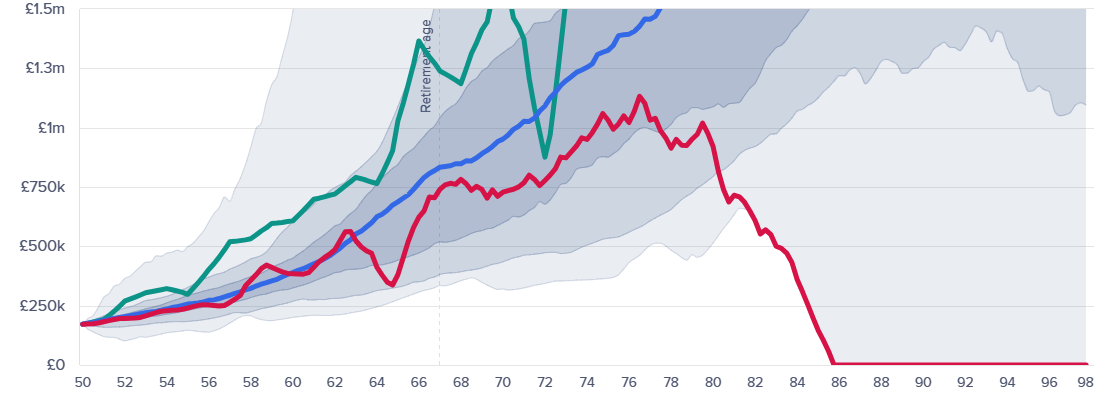
This is a chart from someone with a 95% success rate. Their fund was over £1m at age 76 but ran out by age 86 in the worst case scenario. When shown in real terms, it looks like this: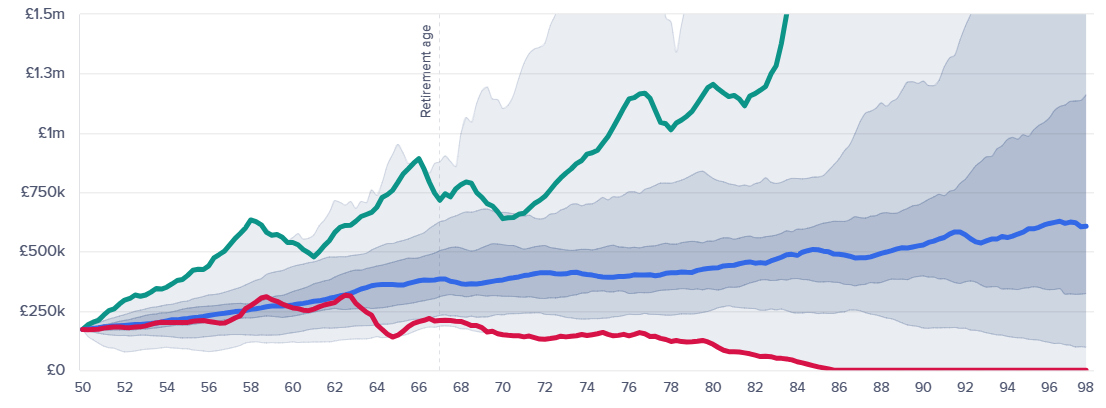
Real terms makes the declines look steadier and whilst more realistic, we need to remember that consumers/investors make decisions on behaviour in the now. Going back to that chart, the worst case scenario was actually above the median at a few stages.
Nobody is unhappy if their investments outperform their planning. Cashflow modelling in this scenario is more about making sure you have enough. i.e. looking at the worst case to pessimistic scenario range. From this point in time, if your plan works 85% of the time, you would be pretty happy.
Also, you have to factor in longevity and timeline does that in the longevity section. So, whilst the chance of running out of money at age 98 is 7%. The chance of being alive at that point is 10%. So, the chance of running out of money AND being alive is less than 1%.
You have to look not just at the charting for the values but also the longevity. Indeed, the longevity data in timeline is more important than a values chart that says you could run out of money by age 86 or have over £2m. How much use is there in data that says you could have anything between £0 and £2m? Whereas the longevity chart shows age 86 as 53% survival probability with 100% success rate for portfolio and 100% for longevity adjusted.
I am an Independent Financial Adviser (IFA). The comments I make are just my opinion and are for discussion purposes only. They are not financial advice and you should not treat them as such. If you feel an area discussed may be relevant to you, then please seek advice from an Independent Financial Adviser local to you.8 -
mmm - I assume that timeline works like the SWR software by simulating taking successive periods given by your remaining lifetime. So if you want to analyse a 30 year period from now timeline would model periods begining in 1915 to 1992.dunstonh said:
Its worth noting that whilst three of the crashes in the last 25 years have been in the circa 40% range, there have been crashes historically which have been double that.Pat38493 said:
Thanks @dunstonh - I suppose as DIY investors we don't have access to that level of automation at a reasonable price. However, how does it then deal with the situation I mentioned? Presumably if there is a 40% crash of the stock market at some point, all of the alarms for all your clients will go off when the balances are updated to the new much lower values, even though the 40% stock market crash might have already been part of a prior scenario that passed a few months earlier.dunstonh said:Timeline grabs a valuation from adviser software once a week and does a weekly report on people at risk or moving outside tolerances.
And remember that timeline is 1915 to 2022 with its modelling. Gilts suffered losses over 2022/23 that were last seen before 1915. So, playing it safe by modelling scenarios from the current position, even if it's after a fall, is a sensible thing to do.
It can be worth taking timeline out of real terms and showing it in nominal:
This is a chart from someone with a 95% success rate. Their fund was over £1m at age 76 but ran out by age 86 in the worst case scenario. When shown in real terms, it looks like this:
Real terms makes the declines look steadier and whilst more realistic, we need to remember that consumers/investors make decisions on behaviour in the now. Going back to that chart, the worst case scenario was actually above the median at a few stages.
Nobody is unhappy if their investments outperform their planning. Cashflow modelling in this scenario is more about making sure you have enough. i.e. looking at the worst case to pessimistic scenario range. From this point in time, if your plan works 85% of the time, you would be pretty happy.
Also, you have to factor in longevity and timeline does that in the longevity section. So, whilst the chance of running out of money at age 98 is 7%. The chance of being alive at that point is 10%. So, the chance of running out of money AND being alive is less than 1%.
You have to look not just at the charting for the values but also the longevity. Indeed, the longevity data in timeline is more important than a values chart that says you could run out of money by age 86 or have over £2m. How much use is there in data that says you could have anything between £0 and £2m? Whereas the longevity chart shows age 86 as 53% survival probability with 100% success rate for portfolio and 100% for longevity adjusted.
I would contend that this is fine for sanity checking prior to retirement and for providing nice examples to show IFA customers what could happen. However I dont not believe it is at all helpful for managing one's finances in retirement.
To quote @dunstonh:
How much use is there in data that says you could have anything between £0 and £2m?
This is of course assuming a particular pre-determined spending pattern. Clearly the "prediction" is not much use at all but unfortunately it represents reality. Probabliity %s of running out of money before you die are pretty meaningless...
The longevity %s have some meaning because they are based on millions of data points thuogh of course you would be foolish to assume that you personally are average. However the economic data is based in a single overall sequence of events out of the uncountable number of event sequences that could have taken place but did not.
Furthermore it assumes that any sequence from the total dataset is equally likely given whatever his the current situation. But it is actually very dependent on what happened in the years prior to the simulation. For example as has been pointed out the year after a 50% crash is (I guess) less likely to see another 50% crash than a year in which the market reaches new heights.
On the other hand we have the problem seen in the SWR simulations whereby failures turn out to be due to a very small number of separate events - in this case the great crash of the late 1920s and (I think) the poor marjet performance coupled with high inflation of the 1970s. What actually is the probability of one off events?
If you dont meet one of those two such events at a critical time, which you almost certainly wont, then your are pretty safe. In fact SWRE calculations suggest it is likely that you will die richer than when you started. So the modelling can both be very pessimistic and over-optimistic.
Saying that it's playing safe because elsewhere there are great uncertainties doesnt add to the meaningfulness of the probabilities.
So what to do? The first step I think is to accept that you simply do not know what the future will bring and that looking at tea leaves does not provide further knowledge. so you have no choice but to try to deal with whatever happens at the time.
The second thing to accept is that there could be some events that you will not be able to withstand. So just focus on those you can manage.
1 -
When I retire the only spreadsheet I'll be using will be one for annual budgeting. And that will have only:-
Total Income
Spending
Holidays
Bills0 -
Thanks - very useful comments. I guess the other point is that if you are in a bridging situation where you are planning to make much larger withdrawals in the first 10-12 years, you might see a success rate of 95% plus, but still see running out of money within 8 years in worst case scenarios well before anticipated longevity is making much difference. This is maybe where either flexibility or annuities or gilt ladders might come into the mix?dunstonh said:
Its worth noting that whilst three of the crashes in the last 25 years have been in the circa 40% range, there have been crashes historically which have been double that.Pat38493 said:
Thanks @dunstonh - I suppose as DIY investors we don't have access to that level of automation at a reasonable price. However, how does it then deal with the situation I mentioned? Presumably if there is a 40% crash of the stock market at some point, all of the alarms for all your clients will go off when the balances are updated to the new much lower values, even though the 40% stock market crash might have already been part of a prior scenario that passed a few months earlier.dunstonh said:Timeline grabs a valuation from adviser software once a week and does a weekly report on people at risk or moving outside tolerances.
And remember that timeline is 1915 to 2022 with its modelling. Gilts suffered losses over 2022/23 that were last seen before 1915. So, playing it safe by modelling scenarios from the current position, even if it's after a fall, is a sensible thing to do.
It can be worth taking timeline out of real terms and showing it in nominal:
This is a chart from someone with a 95% success rate. Their fund was over £1m at age 76 but ran out by age 86 in the worst case scenario. When shown in real terms, it looks like this:
Real terms makes the declines look steadier and whilst more realistic, we need to remember that consumers/investors make decisions on behaviour in the now. Going back to that chart, the worst case scenario was actually above the median at a few stages.
Nobody is unhappy if their investments outperform their planning. Cashflow modelling in this scenario is more about making sure you have enough. i.e. looking at the worst case to pessimistic scenario range. From this point in time, if your plan works 85% of the time, you would be pretty happy.
Also, you have to factor in longevity and timeline does that in the longevity section. So, whilst the chance of running out of money at age 98 is 7%. The chance of being alive at that point is 10%. So, the chance of running out of money AND being alive is less than 1%.
You have to look not just at the charting for the values but also the longevity. Indeed, the longevity data in timeline is more important than a values chart that says you could run out of money by age 86 or have over £2m. How much use is there in data that says you could have anything between £0 and £2m? Whereas the longevity chart shows age 86 as 53% survival probability with 100% success rate for portfolio and 100% for longevity adjusted.0 -
What about current assets or is all your income guaranteed? Assuming your investments matter how will you assess whether you have sufficient to meet your future needs?westv said:When I retire the only spreadsheet I'll be using will be one for annual budgeting. And that will have only:-
Total Income
Spending
Holidays
Bills0









Confirm your email address to Create Threads and Reply

Categories
- All Categories
- 354.5K Banking & Borrowing
- 254.4K Reduce Debt & Boost Income
- 455.4K Spending & Discounts
- 247.4K Work, Benefits & Business
- 604.2K Mortgages, Homes & Bills
- 178.5K Life & Family
- 261.6K Travel & Transport
- 1.5M Hobbies & Leisure
- 16K Discuss & Feedback
- 37.7K Read-Only Boards