We’d like to remind Forumites to please avoid political debate on the Forum.
This is to keep it a safe and useful space for MoneySaving discussions. Threads that are – or become – political in nature may be removed in line with the Forum’s rules. Thank you for your understanding.
📨 Have you signed up to the Forum's new Email Digest yet? Get a selection of trending threads sent straight to your inbox daily, weekly or monthly!
The Forum now has a brand new text editor, adding a bunch of handy features to use when creating posts. Read more in our how-to guide
Final Salary Pension
Comments
-
2% reduction seems very low. Public sector early retirement factors are at least 4% per year, which would skew your figures.arnoldy said:Here is an example at trying to get a "ranging shot" of when it might be a good idea to take a deferred pension. Yes there are caveats about taking pension early (or indeed waiting) so do your own calcs and thinking. But it might help. I've made up the numbers to illustrate. Best probably to get an IFA opinion as ever rather than internet musings.
Pension NRA 63, estimated Date of Death 83 (national average), Early retirement factor 2% pa.
Taking at NRA you get 100% pension for 20 years = 1 x 20 = 20
Taking 5 years early you get 90% for 25 years = 0.9 x 25 = 22.5
So overall you could get more taking early (lower pension for longer).
All I'm trying to say is it is not necessarily true that waiting to NRA (and spending savings or DC pension to get there) is always the right thing.0 -
Good example although I suspect most people would be amazed to only lose 10% for taking it 5 years early.arnoldy said:Here is an example at trying to get a "ranging shot" of when it might be a good idea to take a deferred pension. Yes there are caveats about taking pension early (or indeed waiting) so do your own calcs and thinking. But it might help. I've made up the numbers to illustrate. Best probably to get an IFA opinion as ever rather than internet musings.
Pension NRA 63, estimated Date of Death 83 (national average), Early retirement factor 2% pa.
Taking at NRA you get 100% pension for 20 years = 1 x 20 = 20
Taking 5 years early you get 90% for 25 years = 0.9 x 25 = 22.5
So overall you could get more taking early (lower pension for longer).
All I'm trying to say is it is not necessarily true that waiting to NRA (and spending savings or DC pension to get there) is always the right thing.
15-20% might be more realistic?0 -
Yes its only an example of methodology. You could use any combination for NRA, date of death and Early retirement factors. Equally some public sector NRAs are very low (55 or 60 are not uncommon). For a Public sector pension NRA 60 and 4% pa reduction its not worth taking early on the face of it.Silvertabby said:
2% reduction seems very low. Public sector early retirement factors are at least 4% per year, which would skew your figures.arnoldy said:Here is an example at trying to get a "ranging shot" of when it might be a good idea to take a deferred pension. Yes there are caveats about taking pension early (or indeed waiting) so do your own calcs and thinking. But it might help. I've made up the numbers to illustrate. Best probably to get an IFA opinion as ever rather than internet musings.
Pension NRA 63, estimated Date of Death 83 (national average), Early retirement factor 2% pa.
Taking at NRA you get 100% pension for 20 years = 1 x 20 = 20
Taking 5 years early you get 90% for 25 years = 0.9 x 25 = 22.5
So overall you could get more taking early (lower pension for longer).
All I'm trying to say is it is not necessarily true that waiting to NRA (and spending savings or DC pension to get there) is always the right thing.
Public sector pensions get a guaranteed inflation increase in deferment or payment so that's another benefit compared to private DB when trying to wrestle with the numbers and risk/health of fund, or future inflation, in private DBs.0 -
AFAIK, 4% is pretty typical for private sector as well. It should also be noted that it is not always a linear calculation.Silvertabby said:
2% reduction seems very low. Public sector early retirement factors are at least 4% per year, which would skew your figures.arnoldy said:Here is an example at trying to get a "ranging shot" of when it might be a good idea to take a deferred pension. Yes there are caveats about taking pension early (or indeed waiting) so do your own calcs and thinking. But it might help. I've made up the numbers to illustrate. Best probably to get an IFA opinion as ever rather than internet musings.
Pension NRA 63, estimated Date of Death 83 (national average), Early retirement factor 2% pa.
Taking at NRA you get 100% pension for 20 years = 1 x 20 = 20
Taking 5 years early you get 90% for 25 years = 0.9 x 25 = 22.5
So overall you could get more taking early (lower pension for longer).
All I'm trying to say is it is not necessarily true that waiting to NRA (and spending savings or DC pension to get there) is always the right thing.
For example it could be 3% for just one year early , but say 18% for 5 years early. Not sure how common that is, but it certainly can happen.0 -
The DB pension scheme I am in gives a table of commutation factors by age so it's not the same deduction for each year before NRA but for example it's a 6.8% deduction for retiring just 1 year early, further 6.3% for 2 years early. Taking it at 55 gives 0.513 of the pension.Albermarle said:
AFAIK, 4% is pretty typical for private sector as well. It should also be noted that it is not always a linear calculation.Silvertabby said:
2% reduction seems very low. Public sector early retirement factors are at least 4% per year, which would skew your figures.arnoldy said:Here is an example at trying to get a "ranging shot" of when it might be a good idea to take a deferred pension. Yes there are caveats about taking pension early (or indeed waiting) so do your own calcs and thinking. But it might help. I've made up the numbers to illustrate. Best probably to get an IFA opinion as ever rather than internet musings.
Pension NRA 63, estimated Date of Death 83 (national average), Early retirement factor 2% pa.
Taking at NRA you get 100% pension for 20 years = 1 x 20 = 20
Taking 5 years early you get 90% for 25 years = 0.9 x 25 = 22.5
So overall you could get more taking early (lower pension for longer).
All I'm trying to say is it is not necessarily true that waiting to NRA (and spending savings or DC pension to get there) is always the right thing.
For example it could be 3% for just one year early , but say 18% for 5 years early. Not sure how common that is, but it certainly can happen.
However, according to other documents there is a portion about a 3rd of my deferred pension that has an NRA of 60 (never quite understood why but I'm not complaining!) - I would assume that this portion would have to be adjusted in a different way because the table assumes that the NRA is always 65.0 -
but for example it's a 6.8% deduction for retiring just 1 year
That's very high !0 -
That's what I thought too - but this is the table in the fact sheet.....Albermarle said:but for example it's a 6.8% deduction for retiring just 1 year
That's very high !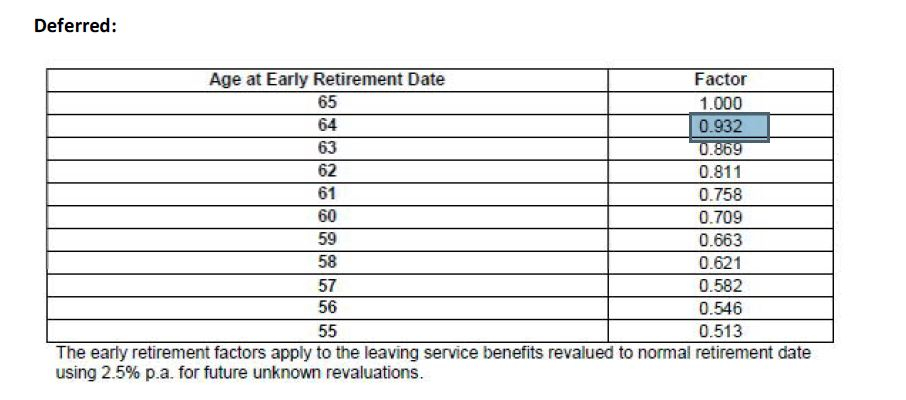
Edit - actually though - does the comment about revaluing forward using 2.5% first mean that actually the 6.8% number is not apples to apples in the context of this discussion?0 -
Remember commutation factors for lump sum are usually different to those for the pension bit.0
-
It’s 6.8% (more or less) every year but it’s compounded. So take 0.932 and multiply it by 0.932 and you get the next figure. Keep multiplying it by 0.932 and you get the figures posted.Pat38493 said:
That's what I thought too - but this is the table in the fact sheet.....Albermarle said:but for example it's a 6.8% deduction for retiring just 1 year
That's very high !
Edit - actually though - does the comment about revaluing forward using 2.5% first mean that actually the 6.8% number is not apples to apples in the context of this discussion?Most early reduction factors work this way.6.8% is very high!0 -
Yes it seems so.jimi_man said:
It’s 6.8% (more or less) every year but it’s compounded. So take 0.932 and multiply it by 0.932 and you get the next figure. Keep multiplying it by 0.932 and you get the figures posted.Pat38493 said:
That's what I thought too - but this is the table in the fact sheet.....Albermarle said:but for example it's a 6.8% deduction for retiring just 1 year
That's very high !
Edit - actually though - does the comment about revaluing forward using 2.5% first mean that actually the 6.8% number is not apples to apples in the context of this discussion?Most early reduction factors work this way.6.8% is very high!
Although, the small print below the table seems to imply that they calculate the pension value today using statutory adjustments, they then inflate the number forward to NRA using 2.5% compounded, and then they apply the ERFs.
I was previously assuming that they just apply the ERF directly to the number what my pension would be if I was already at NRA today.
Is this the normal way of doing it or is this unusual?
I just ran this in a spreadsheet - if I was at 65 today what would my pension be. If I was 64 today and taking benefits - inflate forward by one year, then apply the commutation to the new number and the annual reduction becomes 4.5 % which is more in the same ball park as other figures I regularly see quoted. This is why I always ask a lot of questions because the way pension actuaries work cannot seemingly just be assumed by looking at a table and thinking "how would I calculate this if I had to do it"!
Is this maybe why the commutation figures are so high - because they need to back out the 2.5% inflation that they already put into the number!
Edit: Also at first glance this approach seems to make little sense because applying 2.5% inflation forwards and then applying the retirement factors backwards is just a sequence of fixed calculations - they could have just calculated the correct values for the table and applied them directly to today's real terms revaluation unless I'm missing something.0













Confirm your email address to Create Threads and Reply

Categories
- All Categories
- 354K Banking & Borrowing
- 254.3K Reduce Debt & Boost Income
- 455.3K Spending & Discounts
- 247.1K Work, Benefits & Business
- 603.7K Mortgages, Homes & Bills
- 178.3K Life & Family
- 261.2K Travel & Transport
- 1.5M Hobbies & Leisure
- 16.1K Discuss & Feedback
- 37.7K Read-Only Boards