We’d like to remind Forumites to please avoid political debate on the Forum.
This is to keep it a safe and useful space for MoneySaving discussions. Threads that are – or become – political in nature may be removed in line with the Forum’s rules. Thank you for your understanding.
How much U.S. percentage?




Hi
My wife’s pension pot with her employer is currently £150k. She's contributing £20k pa. As best we can establish, it comprises the following mix:
- UK equities 26%
- US equities 25%
- European equities 9%
- Emerging markets equities 8%
- Japanese equities 6%
- Asia Pacific equities 3%
- Small cap equities 3%
- Emerging markets bonds 3%
- Global high yield bonds 2%
- Property 5%
- Cash 10%
We’re looking to simplify it down to a world tracker (ex-UK) plus a UK tracker. The low percentages of bonds, property and cash would go. But despite knowing less than the market, opting for a simple market cap approach with the US circa 60% feels uncomfortable. What US percentage do others have, and why? And if you have less than US market cap, where do you allocate the balance? UK, for example?
We are both aged 56, working full time, will retire at 60 – maybe a year or two earlier. We also have DB pensions at 60 which will cover our living expenses, plus £450k across S&S ISAs and cash.
Many thanks.
Comments
-
I recently changed my investments myself I wanted more in the UK a bit less in the US.
My ISA is lifestrategy 100.
I do also hold about 20k in Berkshire b shares, I won’t sell these they are outside an ISA though so something for me to think about.
My pension is 70% Aviva blackrock overseas index tracker.
30% UK index trackers.
I do think the UK is undervalued compared to many places, I feel we are due a good run at some point.0 -
MSCI puts a lot of effort into this. Here:
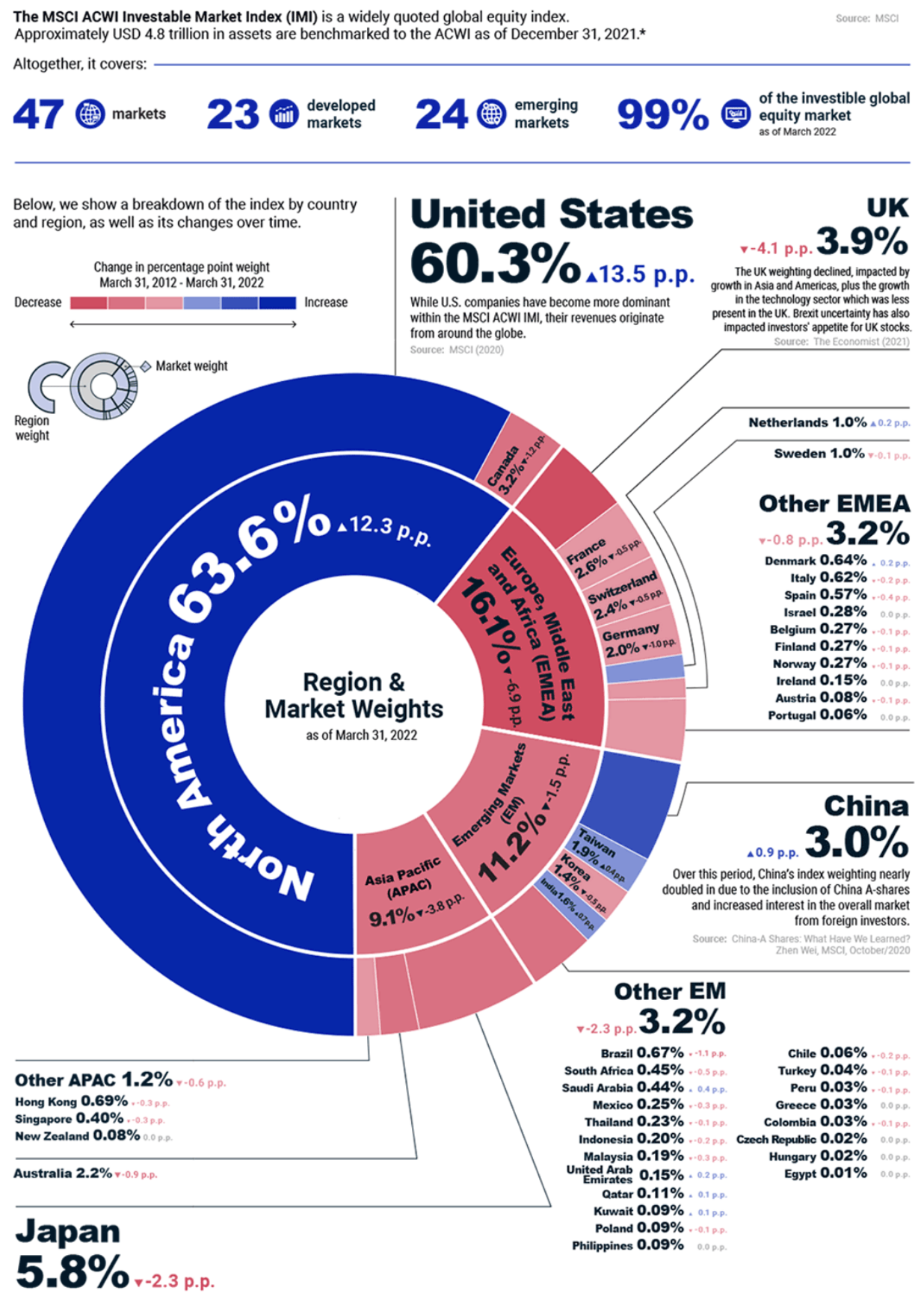
If you just want a diversified portfolio to match market performance, with moderate risk, buy an MSCI ACWI tracker and be done. So, 60% USA it is. If you choose to deviate from this you are seeking outperformance by taking increased risk. Is that what you want to do?3 -
How did the USA get to be such a large slice of the pie? Here are a couple of thoughts
First, we are talking equity markets here. Imagine a country with 1 million small corner shops. That has no impact on the stock market. Then a large company comes along, buys up all million corner shops and lists itself on the stock market. Suddenly that country’s stock market got bigger. And this is the way of things in the USA. Everybody wants to IPO and list themselves on the stock market. Every company is looking for mergers and acquisitions. It’s a society where everyone is borne looking to make it big.
Next, they provide such an encouraging regulatory environment that companies not borne in the USA choose to list on a US exchange. So that US proportion includes companies that should perhaps show up in another slice of the pie. Which leads to point 3
Just because a company is listed in the USA, doesn’t mean it makes all its profit in the USA. Apple, Google, Amazon, Microsoft make large profits in the UK. So if the UK does well, it helps those guys too. The currency issue is somewhat self correcting. If the pound is weak, those Apple profits look really good in pounds, as does its share price.
Finally, a good reason for the USA proportion being so large is that their companies have been monumentally successful for many decades. The USA market cap is huge because it deserves to be. But herein lies, if you want one, a possible justification for going underweight USA. The index contains a historically high percentage made up of just a few huge companies. These companies got there by delivering massive growth year after year. Again, they earned their stock price. But that exceptional growth is now stalled. Not a prediction: it’s already happening. This cohort might deliver only ‘normal’ returns in the coming years. Their values could decline back to normal multiples of their earnings, and that would have a disproportionate effect on the market, because of their size. So it’s possible the USA could do just fine in the coming years, but not offer anything special in terms of returns.
There is a lot of data available showing that a simple index investment handily outperforms inflation over a long period of time. If you choose to depart from the index, you’re not instantly wrong. It’s just that you have a lot more homework to do if you want to come up with any evidence for your choices. Nobody is going to publish the long term stats for an almost index, but with a bit less of this, and a bit more of that. The other data that is widely available says that, if an active manager picks an index then aims to beat it, that manager will almost certainly fail over any period longer than a few years.
https://www.spglobal.com/spdji/en/spiva/article/institutional-spiva-scorecard/
2 -
What proportion of an index tracker would Japan have been around 1990?Secret2ndAccount said:How did the USA get to be such a large slice of the pie? Here are a couple of thoughts
First, we are talking equity markets here. Imagine a country with 1 million small corner shops. That has no impact on the stock market. Then a large company comes along, buys up all million corner shops and lists itself on the stock market. Suddenly that country’s stock market got bigger. And this is the way of things in the USA. Everybody wants to IPO and list themselves on the stock market. Every company is looking for mergers and acquisitions. It’s a society where everyone is borne looking to make it big.
Next, they provide such an encouraging regulatory environment that companies not borne in the USA choose to list on a US exchange. So that US proportion includes companies that should perhaps show up in another slice of the pie. Which leads to point 3
Just because a company is listed in the USA, doesn’t mean it makes all its profit in the USA. Apple, Google, Amazon, Microsoft make large profits in the UK. So if the UK does well, it helps those guys too. The currency issue is somewhat self correcting. If the pound is weak, those Apple profits look really good in pounds, as does its share price.
Finally, a good reason for the USA proportion being so large is that their companies have been monumentally successful for many decades. The USA market cap is huge because it deserves to be. But herein lies, if you want one, a possible justification for going underweight USA. The index contains a historically high percentage made up of just a few huge companies. These companies got there by delivering massive growth year after year. Again, they earned their stock price. But that exceptional growth is now stalled. Not a prediction: it’s already happening. This cohort might deliver only ‘normal’ returns in the coming years. Their values could decline back to normal multiples of their earnings, and that would have a disproportionate effect on the market, because of their size. So it’s possible the USA could do just fine in the coming years, but not offer anything special in terms of returns.
There is a lot of data available showing that a simple index investment handily outperforms inflation over a long period of time. If you choose to depart from the index, you’re not instantly wrong. It’s just that you have a lot more homework to do if you want to come up with any evidence for your choices. Nobody is going to publish the long term stats for an almost index, but with a bit less of this, and a bit more of that. The other data that is widely available says that, if an active manager picks an index then aims to beat it, that manager will almost certainly fail over any period longer than a few years.
https://www.spglobal.com/spdji/en/spiva/article/institutional-spiva-scorecard/
0 -
It's a big responsibility, isn't it?
Around 20 months ago I found myself in a similar position. Due to retire, with £180k or so in cash, for the first time in my life. We roughly halved it, as we expected to need to top up my pension until state pension age.
I was taken with the tracker idea, but couldn't get my head round that 60% allocation to the US of A. We initially invested £80k, 4 full ISAs with £60k in global trackers and £10k each in active funds. To save me repeating myself, here's a recent post on how I got on.
https://forums.moneysavingexpert.com/discussion/comment/79636806#Comment_79636806
Of course, there's no guarantee the next 20 months, or 10 years will replicate the last 20 months. My ultimate turkey fund may burst into life and surprise me yet.....2 -
My thinking is similar to yours. Jurisdiction of headquarters does matter. HSBC is an international conglomerate but it follows UK’s regulations and was forced to stop paying dividends in 2020 (unlike banks in other countries). Don’t want more than half my money impacted by the same sudden changes in taxation, etc. I am 35% US and 20% home market (in my case - Canada). Allocations can deviate by up to 5%, so right now US stands at 38%.There is decent research from Vanguard suggesting that being overweight in home market is efficient in terms of risk-reward balance, as long as you are not too far out of whack. So anywhere between 10 and 30% should work for UK.0
-
ISTM that the benefit of reducing US allocation from around 60%-66% is not to achieve a higher long term return but rather to reduce medium term volatility with the same long term return.This comes about from having a broader spread of underlying assets in terms of sector allocation with less dependence on a very small number of high priced high growth companies and from greater exposure to the rest of the world. The dangers of high US allocations were clearly shown in the period 2000-2007.My target is 40% US allocation, or to look at it perhaps more positively 60% non US rather than 34%. For the whole of Europe and Asia to be squeezed into 34% seems ridiculous.1
-
What proportion of an index tracker would Japan have been around 1990?A bit over 40% from eye-balling the charts, and dropped to about 9% over 13 years. But before we jump to any conclusions that this means the USA market is going to fall, show us the post from 1990 which says Japan will fall badly; it’s so easy looking backwards.
A global fund, despite Japan’s calamity, grew by 5.5% compound annual growth during that time, inflation adjusted by 3.5%/year.1 -
You need to feel comfortable with your investing to have a steady nerve during the bad times, so if too much USA unnerves you get rid of it. Tossed around, chopping and changing, chasing trends and following another poster’s choice is what costs too many investors too much money unnecessarily. Think through your beliefs, WRITE DOWN what you decided, and why, so you have an anchor to refer to in a few years when your choices look questionable. You won’t badly disadvantage yourself by having 40% US instead of 60%, it might even be a winner, and you already know how hard it is to beat the market so you’re not trying to do that.
100% stocks. I’m pretty sure the long history has found that something like 60/40 stocks/bonds gives more spending or lasts longer as a retirement investment. You could read this up, and the rationalreminder podcast has a recent episode touching on this.
0 -
Yes but 1990-2000 includes the .com boom. Without that the returns in 1990-2000 would have been very different - in the subsequent crash global indexes dropped by about 50%. And of course 40% is significantly less than 60%.JohnWinder said:What proportion of an index tracker would Japan have been around 1990?A bit over 40% from eye-balling the charts, and dropped to about 9% over 13 years. But before we jump to any conclusions that this means the USA market is going to fall, show us the post from 1990 which says Japan will fall badly; it’s so easy looking backwards.
A global fund, despite Japan’s calamity, grew by 5.5% compound annual growth during that time, inflation adjusted by 3.5%/year.
No-one serious is predicting a massive US crash. What one is doing by reducing the 60+% allocation is lessening the effects should one occur whilst still retaining a substantial investment there.1








Confirm your email address to Create Threads and Reply

Categories
- All Categories
- 354.2K Banking & Borrowing
- 254.3K Reduce Debt & Boost Income
- 455.3K Spending & Discounts
- 247.1K Work, Benefits & Business
- 603.8K Mortgages, Homes & Bills
- 178.4K Life & Family
- 261.3K Travel & Transport
- 1.5M Hobbies & Leisure
- 16.1K Discuss & Feedback
- 37.7K Read-Only Boards