We’d like to remind Forumites to please avoid political debate on the Forum.
This is to keep it a safe and useful space for MoneySaving discussions. Threads that are – or become – political in nature may be removed in line with the Forum’s rules. Thank you for your understanding.
📨 Have you signed up to the Forum's new Email Digest yet? Get a selection of trending threads sent straight to your inbox daily, weekly or monthly!
The Forum now has a brand new text editor, adding a bunch of handy features to use when creating posts. Read more in our how-to guide
Financial value of a job with a Final Average pension
Comments
-
Hi Simon, I am in the same scheme. It's a good pension although will likely change in the not so distant future due to financial pressures on the industry.Simon11 said:Hello all,
Appreciate this isn't easy to answer, but seeking to check whether my maths is on the right path.
I currently have a job with a DC and currently fill this with £40k per year.
I am shortly going to be attending a second interview for a job which offers a final average pension and trying to calculate the benefit of their pension (although I am ignoring the aspect of the security of a DB pension).
The cost of this pension for me is 10%, thus £8.4k per year.
Using the formula below (assuming a salary of £85k), each year I pay into the scheme will mean I will receive £1.2k per year in today's money. The pension can be accessed at age 62 and assuming I live till 84, that is 22 years. Thus the benefit of this pension is £27k for each year I pay into this pension (ignoring the lump sum?)
Even doing this maths, I am struggling to compare financially between jobs!
Thanks for your advice in advance!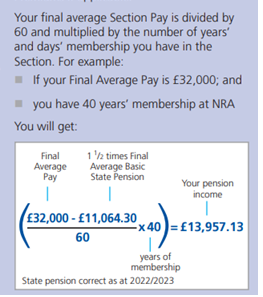
I'm in my mid 30s and my view is 'accrue DB whilst I can' on the assumption the opportunity to do so in the future may be limited.3 -
This is a very good question and there is no clear answer.Simon11 said:
I am shortly going to be attending a second interview for a job which offers a final average pension and trying to calculate the benefit of their pension (although I am ignoring the aspect of the security of a DB pension).
Obviously, comparing two jobs with DC pension where company A makes employer contributions 6% and employer B makes employer contributions 8% is very easy to compare the two. You might also consider what your employee contributions need to be gain those employer contributions and factors such as whether SS is available. It does all boil down to something that is relatively easy to compare.
I recently asked my Accountant pretty much the same question (but for a slightly different reason) and he simply said there was no rule of thumb to use.
My IFA suggested that the best guide to use was "in 2018 the average cost of an occupational DB scheme was 25.6% (split between members and employers) according to the Occupational Pension Schemes Survey 2018 (ONS), so I suppose that’s a good a rule of thumb as any, so on an 8% contributory basis the employer might be paying in over 17%."
At least that was referenced back to a source and the ONS should be producing reliable data and estimates.
You can make of that what you will but hope it helps a little.2 -
Nah. A former Chancellor told me marrying a billionaire is the sweet spot.Albermarle said:
Agreed, as we often say on this forum, having a DB and a DC pension is the 'sweet spot'Brie said:And it's good to have the 2 types of pension schemes in your pocket so that you can deal with things in 2 different ways/times when you look to retire. Having a DB scheme was simple for me to sort while having DC schemes are more complicated but has given me the flexibility to wait out the current low market value of these."Real knowledge is to know the extent of one's ignorance" - Confucius2 -
And marrying a billionaire with a prenup in place is the sweetest spot 😃kinger101 said:
Nah. A former Chancellor told me marrying a billionaire is the sweet spot.Albermarle said:
Agreed, as we often say on this forum, having a DB and a DC pension is the 'sweet spot'Brie said:And it's good to have the 2 types of pension schemes in your pocket so that you can deal with things in 2 different ways/times when you look to retire. Having a DB scheme was simple for me to sort while having DC schemes are more complicated but has given me the flexibility to wait out the current low market value of these.1 -
Is this the same scheme the train drivers who are striking over pay, benefit from?0
-
A - So I recently changed to a public sector job and this is how I valued the DB
1) Get cost of an equivalent annuity (starting age, spousal benefit, inflation uplift) from a comparison site for the annual amount of pension I would earn in year 1. eg £1000 at age 67 (my scheme retirement age), cpi uplift, 1/3 spousal benefit would currently cost about £30k.
2) Make an assumption on how much an investment at my risk level will grow on average per year in REAL terms over the period until the scheme retirement date (my assumption 2% above inflation, others maybe more optimistic)
3) Discount the cost of the annuity back to today using the 2% discount rate for the number of years between now and the retirement date (eg 15 years): 30k * (1-0.02)^15 = 22.2k
And that 22.2k would be the value of DC contribution that would be equal to £1k of DB accrual.
Perhaps I might add in something for the value of certainty with the DB - I could instead look at using govt index lined bonds and see how much it would cost to purchase 30k index linked in 15 years time to remove the investment risk but this would likely see me assuming a 1-2% pa real terms loss over the period rather than a gain (so that 30k to buy the annuity would require a 34.8k contribution now if it were invested into linkers yielding 1% below CPI)
B - On top of this, I already have a decent DC provision which under my scheme rules I could transfer in at a seemingly beneficial rate - basically for each 10k of DC I transfer in I could get a DB equivalent to an annuity costing 16k. My scheme rules this had to be done in the first 12 months. I moved about 1/4 of my DC pot which, with SP will give my wife and I a reasonable base of 'guaranteed' income.
C - There are also Lifetime Allowance advantages as the DB pension is generally calculated more favourably than DC in this respect.
D - Also I believe you can start taking DB without triggering the MPAA which might be useful for early/partial retirementI think....3 -
Not at all as its not a benefit.UrbanAchiever said:Is this the same scheme the train drivers who are striking over pay, benefit from?
This is the scheme train drivers defer part of their monthly salary for so it can be paid back to them after retirement.1 -
So it's not a DB scheme?daveyjp said:
Not at all as its not a benefit.UrbanAchiever said:Is this the same scheme the train drivers who are striking over pay, benefit from?
This is the scheme train drivers defer part of their monthly salary for so it can be paid back to them after retirement.0 -
I should add that my understanding of the RPS is that if you pay AVCs (BRASS) there are some benefits of taking this as part of the 25% tax free amount alongside the DB. However, I haven't quite got my head around this or how it works, I've just read that it is a positive feature of the scheme!gtat said:
Hi Simon, I am in the same scheme. It's a good pension although will likely change in the not so distant future due to financial pressures on the industry.Simon11 said:Hello all,
Appreciate this isn't easy to answer, but seeking to check whether my maths is on the right path.
I currently have a job with a DC and currently fill this with £40k per year.
I am shortly going to be attending a second interview for a job which offers a final average pension and trying to calculate the benefit of their pension (although I am ignoring the aspect of the security of a DB pension).
The cost of this pension for me is 10%, thus £8.4k per year.
Using the formula below (assuming a salary of £85k), each year I pay into the scheme will mean I will receive £1.2k per year in today's money. The pension can be accessed at age 62 and assuming I live till 84, that is 22 years. Thus the benefit of this pension is £27k for each year I pay into this pension (ignoring the lump sum?)
Even doing this maths, I am struggling to compare financially between jobs!
Thanks for your advice in advance!
I'm in my mid 30s and my view is 'accrue DB whilst I can' on the assumption the opportunity to do so in the future may be limited.0











Confirm your email address to Create Threads and Reply

Categories
- All Categories
- 354.6K Banking & Borrowing
- 254.5K Reduce Debt & Boost Income
- 455.5K Spending & Discounts
- 247.5K Work, Benefits & Business
- 604.3K Mortgages, Homes & Bills
- 178.5K Life & Family
- 261.9K Travel & Transport
- 1.5M Hobbies & Leisure
- 16.1K Discuss & Feedback
- 37.7K Read-Only Boards