Ready, steady… save!
You don’t need a chart to join in. Here are 2 ways to record your savings:
1. Cross it off
Pop a chart into your first post. Saved an amount? Cross it out! Read more »
£0.01 £0.02 £0.03
2. Write it down
Skip the chart and add updates to your first post. Read more »
“Another +£3 saved today. Go me!”
Use +£ before each new saving so it counts towards your total.
📨 Have you signed up to the Forum's new Email Digest yet? Get a selection of trending threads sent straight to your inbox daily, weekly or monthly!
Deleted
Comments
-
HiDon't worry about panel or cell efficiency, it only applies to output per unit area .... just take the nominal output.
HTH - Z"We are what we repeatedly do, excellence then is not an act, but a habit. " ...... Aristotle 2
-
Deleted_User said:Does you reply still stand in this context?Yes, it does.
I've been wondering this. Nobody else seems to work in "peak sun hours", we/they all use more spohisticated models.Deleted_User said:Cheers, I'm interested in this in terms of trying to get the most reliable calculation I can starting from 'Peak Sun Hours'I'm going to go back to my Oban example.Using the same calculator as you https://footprinthero.com/peak-sun-hours-calculator and using Oban as a location, with a tilt of 10 and an azimuth of 225, I get: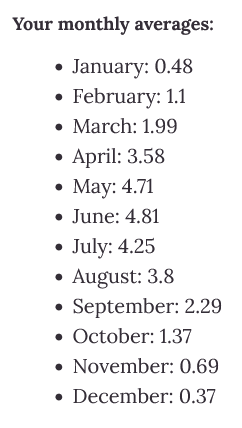 Those aren't a million miles from yours, as you've posted here.Putting the same info into PVGIS with system losses set to zero, I get:
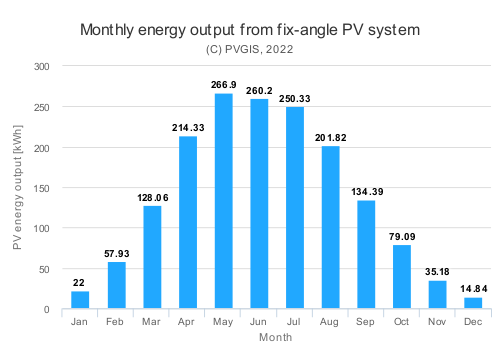 Now those are kWh per month for a 2kWp system, so we need to do some division to get kWh/day/kWp.
- Jan -709 Wh/day, 0.355 Wh/day/Wp (ie. "peak sun hours")
- Feb - 2070 Wh/day, 1.034 Wh/day/Wp
- Mar - 4131 Wh/day, 2.065 Wh/day/Wp
- Apr - 7144 Wh/day, 3.572 Wh/day/Wp
- May - 8610 Wh/day, 4.305 Wh/day/Wp
- Jun - 8673 Wh/day, 4.367 Wh/day/Wp
- Jul - 8075 Wh/day, 4.038 Wh/day.Wp
- Aug - 6510 Wh/day, 3.255 Wh/day/Wp
- Sep - 4480 Wh/day, 2.240 Wh/day/Wp
- Oct - 2551 Wh/day, 1.276 Wh/day/Wp
- Nov - 1173 Wh/day, 0.586 Wh/day/Wp
- Dec - 479 Wh/day, 0.239 Wh/day/Wp
From this it looks as though the "full sun hours per day" (FSH) method is generally more optimistic regarding generation potential than PVGIS is (although March is an exception). The differences aren't generally huge but PSH totals about 1800kWh/yr for our 2kWp array while PVGIS comes in at 1665kWh/yr - 7.5% less.I'm wondering whether your persistence with the PSH approach is leading you to some deceptive conclusions.(PS an azimuth of 225 degrees is south-west, not south-south-west. SSW would be 202.5 degrees.)N. Hampshire, he/him. Octopus Intelligent Go elec / Fuse gas / Vodafone BB / iD mobile. Kirk Hill Co-op member.Economy 7 cap explainer. Gas vs E7 vs peak elec heating costs, Ecoflow Stream, Best kettle :-)
2.72kWp PV facing SSW installed Jan 2012. 11 x 247w panels, 3.6kw inverter. 37 MWh generated, long-term average 2.6 Os.3 -
Don't know if this has been asked / discussed (or if it makes a difference), how are your panels connected to your 'generators'? What I mean is we know you have 5 'generators', how many panels do you have? How are they connected 2/3 panels each or a number connected together charging each sequentially. What size (gauge / mm2) and how long are the solar cables.
Some of your 'generators' are capable of slightly higher voltages that would possibly reduce your cable losses with more panels in series.Living the dream in the Austrian Alps.0









Confirm your email address to Create Threads and Reply

Categories
- All Categories
- 355.9K Banking & Borrowing
- 255K Reduce Debt & Boost Income
- 456.2K Spending & Discounts
- 248.4K Work, Benefits & Business
- 606.1K Mortgages, Homes & Bills
- 179K Life & Family
- 263.9K Travel & Transport
- 1.5M Hobbies & Leisure
- 16.2K Discuss & Feedback
- 37.7K Read-Only Boards