We’d like to remind Forumites to please avoid political debate on the Forum.
This is to keep it a safe and useful space for MoneySaving discussions. Threads that are – or become – political in nature may be removed in line with the Forum’s rules. Thank you for your understanding.
📨 Have you signed up to the Forum's new Email Digest yet? Get a selection of trending threads sent straight to your inbox daily, weekly or monthly!
The Forum now has a brand new text editor, adding a bunch of handy features to use when creating posts. Read more in our how-to guide
Dollar Hedging pension....Good idea ?

Ciprico
Posts: 675 Forumite



What is the collective wisdom of the forum on swapping the bulk of a pension currently in a global Index fund (HMWO) for a dollar hedged global index fund.
I appreciate betting on currency fluctuations is risky, but it seems the probability is the dollar can't get much stronger and the pound much weaker so over the longer term both should recert back to more "normal" levels
Has anyone else been considering this - or is it generally seen as complicated/expensive/risky excercise...?
0
Comments
-
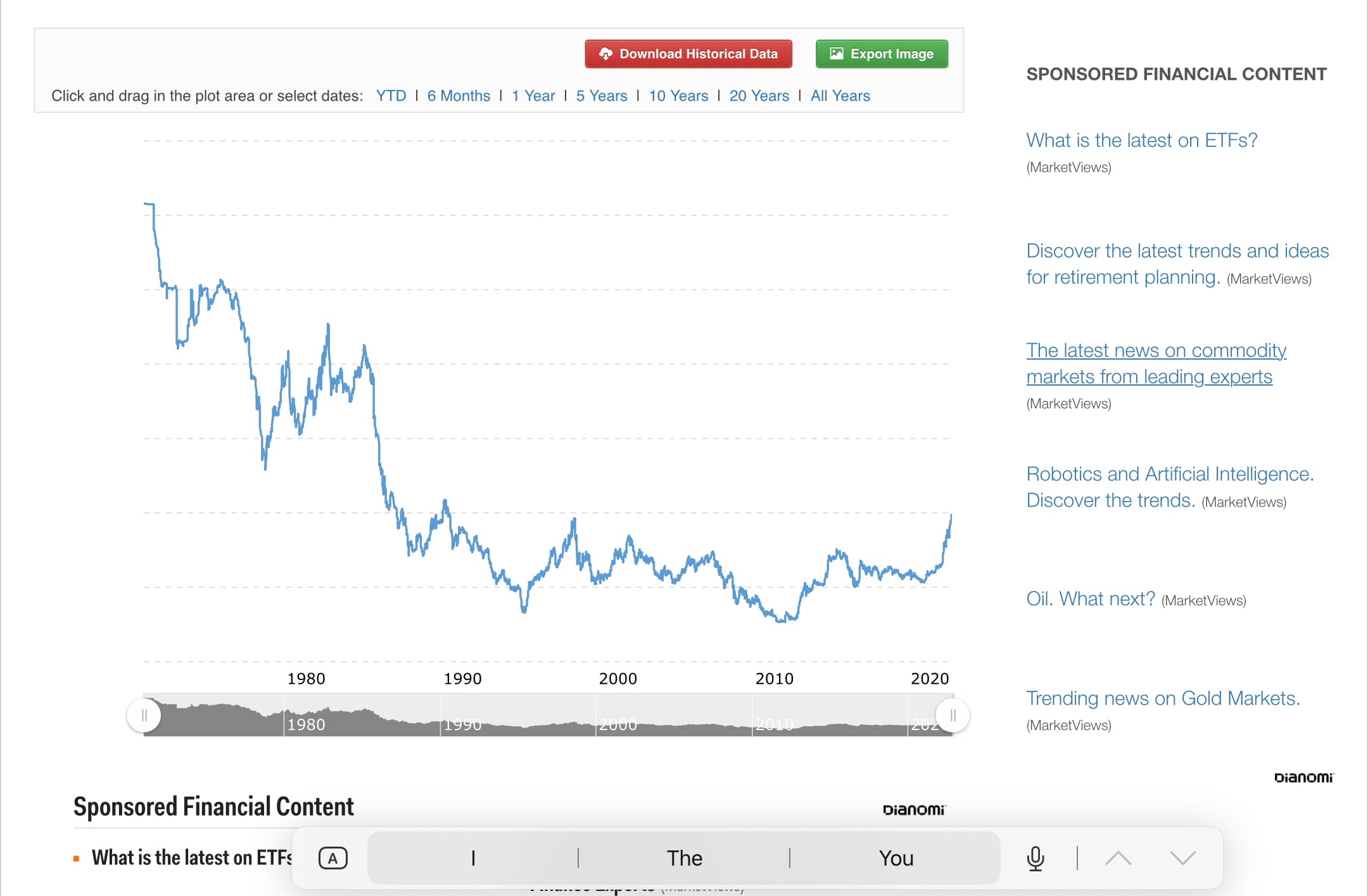
but it seems the probability is the dollar can't get much stronger and the pound much weakerHave a look at this chart of $US vs yen covering 50 years. In the late 70’s would you have said ‘probably the yen can’t get much stronger and should revert back to normal’?
1 -
Being unhedged is betting on currency. Currency hedging removes a lot of the exchange rate movement effects on your investments. Not sure what’s better? Have half and half to minimise your regret?1
-
In the absence of essential information such as your risk appetite, whether you have other pension provision, how old you are/your investment horizon, I hope the collective wisdom will be that nobody can answer that in anything other than a purely speculative way (which in truth is what any answer will be, although the two posts above have done a commendably sensible job.Ciprico said:
What is the collective wisdom of the forum on swapping the bulk of a pension currently in a global Index fund (HMWO) for a dollar hedged global index fund.
I appreciate betting on currency fluctuations is risky, but it seems the probability is the dollar can't get much stronger and the pound much weaker so over the longer term both should recert back to more "normal" levels
Has anyone else been considering this - or is it generally seen as complicated/expensive/risky excercise...?Googling on your question might have been both quicker and easier, if you're only after simple facts rather than opinions!1 -
My view is don't do it - for a number of reasons:
Hedged funds have higher transaction costs than unhedged funds.
I recall reading somewhere that something like half of S&P500 company earnings are not in USD and they may or may not hedge their exposure. FX exposure is an inevitable feature of multinational companies - you can't get anywhere near a perfect hedge.
To paraphrase Gordon Brown, a weak £ is a sign of a weak economy, at least in relation to $. I like the fact that problems at home (increased cost of living and tax rises) are partially offset by my fund's exposure to $ based assets.
Of course, the opposite could be true and I could miss out on some gains if the £ strengthens but if that were to happen, then it would probably be accompanied by a reduced cost of living and taxes in the UK.
I've seen no evidence that hedging produces better returns over the kind of long periods that most would invest in an equity index fund.
Lastly, you are invested in a passive index fund. Why would you then make an active choice about the directions of a certain asset class (currencies)?
2 -
I like a lot of that thinking, but here’s some ‘on the other hand…..’
They say hedging doesn’t help or harm returns over the longer term as currency fluctuations keep reverting back to ‘normal’ or where they were. Firstly, in the case of Japan, you had to get to close to 50 years before it became long term and currency movement changed direction. A lot of us don’t have ‘long term’. Secondly, if currency movements even out eventually, producing no benefit or detriment to returns, and hedging can iron out the volatility due to currency movements, then hedging should give you the same returns with less volatility, ie better risk adjusted returns, the holy grail of investing. Of course when the currency moves in a particular direction there’s a cost to that for the hedging insurance.0 -
What is the collective wisdom of the forum on swapping the bulk of a pension currently in a global Index fund (HMWO) for a dollar hedged global index fund.A year or two back hedging using the dollar would have turned out well. You are now considering it after the event when its more likely to go the other way.Has anyone else been considering this - or is it generally seen as complicated/expensive/risky excercise...?No. Although I have added US equity currency hedged for some of the US allocations to avoid the drag that will occur when it moves back again.
I am an Independent Financial Adviser (IFA). The comments I make are just my opinion and are for discussion purposes only. They are not financial advice and you should not treat them as such. If you feel an area discussed may be relevant to you, then please seek advice from an Independent Financial Adviser local to you.0 -
I do not see that hedging provides any net benefits over the range of possible currency values and behaviour of the underlying investments. It is as likely to decrease returns as increase them and could add to volatility as much as reducing it.
Now consider the link between inflation and currency valuation. Rising £ inflation is linked to decreasing £ valuation against other currencies. But hedged lower currency values imply lower returns of foreign investments in £ terms compared with unhedged. So we have goods increasing in price in £ terms coupled with lower investment returns in £ terms. Surely one would want the reverse.
Am I confused?0 -
1. “Dollar hedged”? And you are in the UK, investing in international stocks and bonds? How would you hedge USD? Would it be more accurate to say that you are betting on sterling’s strength and are planning to hedge GBP against all foreign currencies?Ciprico said:
What is the collective wisdom of the forum on swapping the bulk of a pension currently in a global Index fund (HMWO) for a dollar hedged global index fund.
I appreciate betting on currency fluctuations is risky, but it seems the probability is the dollar can't get much stronger and the pound much weaker so over the longer term both should recert back to more "normal" levels
Has anyone else been considering this - or is it generally seen as complicated/expensive/risky excercise...?2. Dollar totally can get much stronger vs European currencies, including GBP. One scenario is that commodity inflation continues. Europe has a shortage of major commodities. US is self-sufficient. That impacts the future of trade balance. Does this scenario seem implausible to you?3. There are different cases for and against hedging stocks and bonds.For stocks its a pure bet, and it will cost you to bet. You own real assets, companies and future profits. Unless GBP will massively strengthen and the real price of assets will drop, you’ll be on the losing side of this bet. There is a small probability that you will win and a very large probability that you will lose out. You will also increase your risk by hedging while lowering expected return. Don’t do it.For bonds, people use different arguments. Some don’t invest in foreign bonds on the basis that their expenditure is in the native currency. The argument goes: Bonds are to reduce portfolio volatility so why have any foreign bonds? The other line of argument is that you should have international diversification of bonds to reduce nation specific shocks (Brits know all about that). And to hedge so that short term currency risk is removed from the equation. Thats what very clever people at Vanguard are doing with VLS. Personally, I hold bonds in 2 currencies without hedging: native currency and USD. My logic is that during major bears everyone runs for the safety of the world currency, aka USD. As a result during major trouble USD tends to be very strong. That softens the blow. So far this thinking has worked pretty well, but no idea what happens next.0 -
I do not see that hedging provides any net benefits over the range of possible currency values and behaviour of the underlying investmentsThen ask yourself if a Japanese investor, investing in global stocks 40 years ago would have been better off hedged or not hedged.0
-
There are around 200 countries and a very large number of time periods to pick out from. The future is a probability, not a certainty. Picking something very special out of all the choices you have tells me little about the probability of benefiting from hedging stocks. Looking at the history across nations and time periods, tells one your odds of winning the hedging bet are really poor.JohnWinder said:I do not see that hedging provides any net benefits over the range of possible currency values and behaviour of the underlying investmentsThen ask yourself if a Japanese investor, investing in global stocks 40 years ago would have been better off hedged or not hedged.1







Confirm your email address to Create Threads and Reply

Categories
- All Categories
- 354.2K Banking & Borrowing
- 254.3K Reduce Debt & Boost Income
- 455.3K Spending & Discounts
- 247.1K Work, Benefits & Business
- 603.8K Mortgages, Homes & Bills
- 178.4K Life & Family
- 261.3K Travel & Transport
- 1.5M Hobbies & Leisure
- 16.1K Discuss & Feedback
- 37.7K Read-Only Boards