We’d like to remind Forumites to please avoid political debate on the Forum.
This is to keep it a safe and useful space for MoneySaving discussions. Threads that are – or become – political in nature may be removed in line with the Forum’s rules. Thank you for your understanding.
📨 Have you signed up to the Forum's new Email Digest yet? Get a selection of trending threads sent straight to your inbox daily, weekly or monthly!
The Forum now has a brand new text editor, adding a bunch of handy features to use when creating posts. Read more in our how-to guide
Portfolio
Comments
-
Then a single multi-asset fund would be fine.Jaguar_Skills said:
I think that would be all well and good if I knew anything about companies and who to invest in lolLinton said:I see no problem with holding both passive and active funds. A fund is simply an efficient mans of holding a large number of individual shares that meet some criterion. What is important is the overall portfolio allocation. One chooses funds to achieve an overall alocation. Whether they are active or passive is a secondary concern.
If you invest in a global tracker you will probably be entirely or almost entirely investing in larger companies from the main developed nations. You may wish something different. For example some people are concerned about the 60% allocation to US companies in global index funds. Sadly there are no global Ex-US funds available to create the balance you may want so you will have to set up a portfolio with individual funds to meet your wishes.
Similarly you may want to spice things up a bit with Small Companies or Far East. Another factor you may want some control over is Value vs Growth. In the recent equity turbulence growth companies have fared badly whilst the more stable value companies have been far less affected.1 -
In my opinion - yes.Jaguar_Skills said:
Thanks for this. So would it make sense to pull money from some of these funds and just pool it all into the VLS? I'm happy to take the money out of the other funds although it just feels a bit like a loss. But I could just not put any more into them.Deleted_User said:In my opinion:
1. Holding less than 5% in any fund is pointless. Just adds completely at no benefit.
2. You are mixing passive and active approaches. The first two funds are generally passive. The rest are active. We now have many decades of data from almost every country on the globe showing that less than half active funds outperform and that we can’t predict which ones would do so next. And that when active funds outperform its not by much. When they underperform, its by a lot. Pick an approach and stick with it.
3. There is no point having both Vanguard and Blackrock funds. This approach introduces overlaps, duplication in certain stocks while being underweight in others.Pick desired asset allocation and then select one of the two based on cost and other factors as you see fit. These funds are built using similar ideology. Each owns “the world”, so you can’t get any more diversified by having two instead of one.If you want 90% equity and there isn’t a single multi-asset fund doing what you want, get two from the same provider (eg VLS 100 and 80) or something thats close enough (Blackrock consensus 85).
So I could put all my bonus into VLS and then pull Blackrock and transfer the funds. I am not 100% sure about how I feel having 100% equities so 80% might be a better fit.
Sorry for all the probably naive points. I don't know huge amounts about investing, clearly!Simplicity has a huge, underestimated value. There is no disadvantage in using this approach for someone who does not want to spend a lot of time on research. The advantages are obvious: you don’t need to think where to invest future contributions. You are less tempted to start buying or selling this or other fund which has been on the news. It tends to improve performance.Full disclosure: I do have multiple funds. Partly for historic reasons: “all in one products” were not available at the time I designed my portfolio. I also spent a lot of time on research and I do some of the “factor investing” tilting which Linton is talking about. Questionable whether it adds any value but once a strategy is well thought through its best to stick with it. My portfolio is also designed to minimize costs compared to “all in one” products but the saving is less than 0.2% a year while requiring more research and “hands on” management.0 -
That is misleading.Deleted_User said:
This is designed to mislead.dunstonh said:A portfolio is a sum of its parts, and it will have many underlying holdings of less than 5%. Indeed, most will be less than 1%.Its the fund manager’s role to deal with multiple tiny holdings of stocks and bonds using the appropriate sophisticated software and the strategies they learned at Cambridge or Princeton.Individual investors, unless they are well qualified to compete with the experts and buy separate stocks, are already paying to the fund managers for this service. There is zero need or indeed advantage in them buying numerous funds with less than 5% weight. The complexity and psychological temptation to mess are massive disadvantages at no meaningful impact in performance.
If you take the most popular multi-asset funds, they will have allocations of less than 5% to various areas. Here is VLS 60, for example: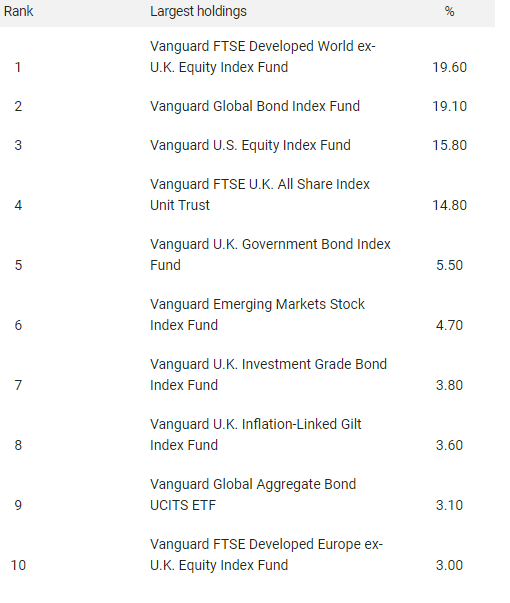
So, half of the top 10 holdings are under 5%.
I am an Independent Financial Adviser (IFA). The comments I make are just my opinion and are for discussion purposes only. They are not financial advice and you should not treat them as such. If you feel an area discussed may be relevant to you, then please seek advice from an Independent Financial Adviser local to you.0 -
If it was me I would want to avoid all managed funds at all costs if possible.
3/4 of all funds do not even match market returns.
I would suggest putting it all into low-cost trackers if possible would be far better.
If you want a good sugegstion of something to read try “Money - Master the game” by Tony Robbins.1 -
ader42 said:If it was me I would want to avoid all managed funds at all costs if possible.
3/4 of all funds do not even match market returns.
I would suggest putting it all into low-cost trackers if possible would be far better.
If you want a good sugegstion of something to read try “Money - Master the game” by Tony Robbins.
What low cost trackers are there?0 -
https://monevator.com/best-global-tracker-funds/Jaguar_Skills said:ader42 said:If it was me I would want to avoid all managed funds at all costs if possible.
3/4 of all funds do not even match market returns.
I would suggest putting it all into low-cost trackers if possible would be far better.
If you want a good sugegstion of something to read try “Money - Master the game” by Tony Robbins.
What low cost trackers are there?And why do it https://youtu.be/16bauiT1F203 -
I do not believe you are unable to understand basic points. But let’s try again anyway: “ Its the fund manager’s role to deal with multiple tiny holdings of stocks and bonds using the appropriate sophisticated software and the strategies they learned at Cambridge or Princeton.”dunstonh said:
That is misleading.Deleted_User said:
This is designed to mislead.dunstonh said:A portfolio is a sum of its parts, and it will have many underlying holdings of less than 5%. Indeed, most will be less than 1%.Its the fund manager’s role to deal with multiple tiny holdings of stocks and bonds using the appropriate sophisticated software and the strategies they learned at Cambridge or Princeton.Individual investors, unless they are well qualified to compete with the experts and buy separate stocks, are already paying to the fund managers for this service. There is zero need or indeed advantage in them buying numerous funds with less than 5% weight. The complexity and psychological temptation to mess are massive disadvantages at no meaningful impact in performance.
If you take the most popular multi-asset funds, they will have allocations of less than 5% to various areas. Here is VLS 60, for example:
So, half of the top 10 holdings are under 5%.VLS funds are being managed by professionals. They designed allocations based on sound research. How allocations to regions, industry sectors, bonds, etc are implemented is Vanguard’s job. Or Blackrock’s. They can either buy stocks directly or via other funds. Its immaterial. In doing this the costs are not duplicated and they ensure that the whole market is covered without overlaps. There is zero need for individual investors to try and duplicate fund manager’s role.0 -
Nice little article, sums it up quite well.MX5huggy said:
https://monevator.com/best-global-tracker-funds/Jaguar_Skills said:ader42 said:If it was me I would want to avoid all managed funds at all costs if possible.
3/4 of all funds do not even match market returns.
I would suggest putting it all into low-cost trackers if possible would be far better.
If you want a good sugegstion of something to read try “Money - Master the game” by Tony Robbins.
What low cost trackers are there?And why do it https://youtu.be/16bauiT1F201 -
All funds are “managed”. Humans select stocks which are then included within indices. Tracker funds then select methodology to reproduce the index, often without buying every stock. “Funds of funds” like the Vanguard, Blackrock and HSBC examples combine several of such trackers into a single product for convenience.ader42 said:If it was me I would want to avoid all managed funds at all costs if possible.
3/4 of all funds do not even match market returns.
I would suggest putting it all into low-cost trackers if possible would be far better.
If you want a good sugegstion of something to read try “Money - Master the game” by Tony Robbins.When you refer to most “managed funds” not matching market returns, you are really referring to actively managed funds, which is true.0 -
I do not believe you are unable to understand basic points.Same back at you.
One minute you are saying "Holding less than 5% in any fund is pointless. Just adds completely at no benefit."
Next minute you are saying it's ok if a fund house does it.There is zero need for individual investors to try and duplicate fund manager’s role.Using a multi-asset fund adds a layer of charges. In the case of Vanguard, around 0.1% p.a. It is very sensible for someone that doesn't know what they are doing to use the multi-asset fund. However, there are plenty of people that can build a portfolio of funds matching their preferred asset model and avoid that extra charge.VLS funds are being managed by professionals. They designed allocations based on sound researchBut it still leads to half the top 10 funds holding less than 5% each which you said is pointless.
The OPs less than 5% holdings are pointless. They achieve nothing but that doesn't mean a portfolio of single sector funds with structure and process, whether fund house or investor researched, with some holding less than 5% is pointless.
I am an Independent Financial Adviser (IFA). The comments I make are just my opinion and are for discussion purposes only. They are not financial advice and you should not treat them as such. If you feel an area discussed may be relevant to you, then please seek advice from an Independent Financial Adviser local to you.0









Confirm your email address to Create Threads and Reply

Categories
- All Categories
- 354.2K Banking & Borrowing
- 254.3K Reduce Debt & Boost Income
- 455.3K Spending & Discounts
- 247.2K Work, Benefits & Business
- 603.8K Mortgages, Homes & Bills
- 178.4K Life & Family
- 261.3K Travel & Transport
- 1.5M Hobbies & Leisure
- 16.1K Discuss & Feedback
- 37.7K Read-Only Boards