We’d like to remind Forumites to please avoid political debate on the Forum.
This is to keep it a safe and useful space for MoneySaving discussions. Threads that are – or become – political in nature may be removed in line with the Forum’s rules. Thank you for your understanding.
📨 Have you signed up to the Forum's new Email Digest yet? Get a selection of trending threads sent straight to your inbox daily, weekly or monthly!
The Forum now has a brand new text editor, adding a bunch of handy features to use when creating posts. Read more in our how-to guide
When do fixed rates get too high?
Comments
-
I don't think the point is to compare, but to just bear in mind that those kind of figures are real levels that interest rates can reach. You know, just as flares and mullets are coming back, so could an 18% mortgage rate. And last time those rates happened it was brutal for people - the property market plummeted because there were so many repossessions and loads of people even if they didn't lose their homes were stuck in negative equity for many years. As people have pointed out, with the income multiples now, the affordability of those rates would be much worse, so the damage now could be even worse.
6% is understandably shocking for people who have spent their entire adult lives in an environment with these incredibly low rates. It's really hard to comprehend that we might never in our lifetimes see rates back down at the levels they've been. When you make the decision whether to fix or not now at a rate that feels nuts, you have to be honest with yourself about whether you could still pay if you don't fix and the rates keep going up. They say don't invest money you can't afford to lose, and I think that's good advice with fixing mortgages. It's always a gamble. If you can still afford to pay your mortgage at rates of 10%+ then you're gambling just with money and that's your call to make. If at rates of 10%+ you couldn't pay, then it's save a few pounds if you win, lose your house if you lose.
0 -
Id rather have an 18% mortgage than a mulletdander said:I don't think the point is to compare, but to just bear in mind that those kind of figures are real levels that interest rates can reach. You know, just as flares and mullets are coming back, so could an 18% mortgage rate. And last time those rates happened it was brutal for people - the property market plummeted because there were so many repossessions and loads of people even if they didn't lose their homes were stuck in negative equity for many years. As people have pointed out, with the income multiples now, the affordability of those rates would be much worse, so the damage now could be even worse.
6% is understandably shocking for people who have spent their entire adult lives in an environment with these incredibly low rates. It's really hard to comprehend that we might never in our lifetimes see rates back down at the levels they've been. When you make the decision whether to fix or not now at a rate that feels nuts, you have to be honest with yourself about whether you could still pay if you don't fix and the rates keep going up. They say don't invest money you can't afford to lose, and I think that's good advice with fixing mortgages. It's always a gamble. If you can still afford to pay your mortgage at rates of 10%+ then you're gambling just with money and that's your call to make. If at rates of 10%+ you couldn't pay, then it's save a few pounds if you win, lose your house if you lose. I am a Mortgage AdviserYou should note that this site doesn't check my status as a mortgage adviser, so you need to take my word for it. This signature is here as I follow MSE's Mortgage Adviser Code of Conduct. Any posts on here are for information and discussion purposes only and shouldn't be seen as financial advice.0
 -
dander said:I don't think the point is to compare, but to just bear in mind that those kind of figures are real levels that interest rates can reach. You know, just as flares and mullets are coming back, so could an 18% mortgage rate. And last time those rates happened it was brutal for people - the property market plummeted because there were so many repossessions and loads of people even if they didn't lose their homes were stuck in negative equity for many years. As people have pointed out, with the income multiples now, the affordability of those rates would be much worse, so the damage now could be even worse.
6% is understandably shocking for people who have spent their entire adult lives in an environment with these incredibly low rates. It's really hard to comprehend that we might never in our lifetimes see rates back down at the levels they've been. When you make the decision whether to fix or not now at a rate that feels nuts, you have to be honest with yourself about whether you could still pay if you don't fix and the rates keep going up. They say don't invest money you can't afford to lose, and I think that's good advice with fixing mortgages. It's always a gamble. If you can still afford to pay your mortgage at rates of 10%+ then you're gambling just with money and that's your call to make. If at rates of 10%+ you couldn't pay, then it's save a few pounds if you win, lose your house if you lose.It’s not just a young people versus “in my day” thing though, at least not from my perspective. What shocks me is how far our money goes now even compared with just a couple of years ago when my salary was significantly less. I don’t think I’m quite at “might lose house” level of worries yet (would sell my car and navigate public transport for the times I need to work away first, other things like that) but I earn a good wage for what I do and I’m here thinking, if that’s the case for us, there’s plenty of other folk in worse circumstances. So something will surely change to tip the scales again, by comparison the energy prices intervention from the government seems almost small potatoes now!0 -
Word for word that post could've been from myself.dander said:For me fixing isn't just about locking in "the best" rate, it's about risk appetite and predictable payments. I bought my house in 2006 and fixed at 3.99% for 5 years and variable rates went lower than my fix for a huge amount of that period. But I still moved to another fix as soon as that expired because what's important to me is getting the mortgage agreed at a price I know I can afford and knowing that it won't change so I can budget everything else in my life around meeting that payment.
It's only really now that I'm at a point where it's beneficial in terms of what that payment is. I've also always fixed at 5 years because that is the right balance for me about having that security and keeping my options reasonably open. For me to choose not to fix it wouldn't be about interest rates alone, I might not fix for the final few years of the mortgage because by that point the interest will be a very small part of the payment and so payments are much more stable anyway. I might risk not fixing if it was at a time when it looked like interest rates were heading down in a big way (but how can you ever tell for sure?).
Upshot of all this is personally if I was remortgaging now I'd fix, regardless of interest rate, I'd just fix to get in a place where I couldn't be taken by surprise. But that's me - I have very low risk appetite when it comes to being safe in my home!
Well, not really. You put it better than I could but your post certainly applies to me.
Need to hop out this morning, then get some shopping, run the monthly Bank cycle but then it's time to look at whether it's worth paying this ERC to lock in before it gets real silly or whether it's worth riding it out.0 -
@K_S Not straight-forward as I said, and that's a great graph. It has bearing on what I meant, but did not express very well, about only taking a man's income into account when my parents first bought a house in the 1970s.K_S said:
@YBR It's not that straightforward a comparison. From the point of view of affordability (monthly repayments), repayments at a rate of 14% in the 80s are equivalent to repayments at 3% now. When looking at the 90s, a 15% rate is equivalent to 6-7% now, which we're almost at.YBR said:Remember Mortgage rates were above 12% during the 1980s and 90s.
My mother is one of those remembering how their mortgage rate was that high for well over 10 years, and at their peak they were paying 18%. It was a different mortgage market then, no comparison websites, not much re-mortgaging and they ignored a wife's income, so definitely not a straight-forward comparison.
5% may seem a lot for those of us who've been paying a lot less for the last decade, but it's well below the long-term norms and we might all view it differently in a year's time.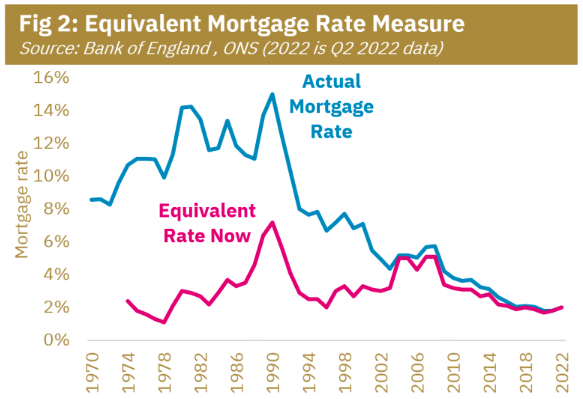
https://builtplace.com/market-commentary-august-2022/
I partially made my comment because some work colleagues were treating it as fake news that mortgage interest rates had been over 12%. Then they thought it might only have been for 6 months to a year.
Others have responded to your points better that I could, but fundamentally it could happen again.Decluttering awards 2025: 🏅🏅🏅🏅⭐️⭐️⭐️ ⭐️⭐️, DH: 🏅🏅⭐️, DD1: 🏅 and one for Mum: 🏅1 -
@YBR Absolutely, not arguing that rates couldn't rise further.
My point was merely that if that happens, during the extended transition period (when house prices adjust to the new interest rate levels) the same rate will be many times more painful for the average mortgage holder (and by extension the economy) than it would have been back in the 80s / 90s, simply because of the much higher mortgage sizes, house prices and LTIs compared to back then.
So the ramifications of policy-makers/rate-setters increasing rates to 10%+ levels is very different to what they would have been back then. It might well come down to choosing your poison - the BoE raising rates vs letting the pound depreciate (stoking inflation).
I am a Mortgage Adviser - You should note that this site doesn't check my status as a mortgage adviser, so you need to take my word for it. This signature is here as I follow MSE's Mortgage Adviser Code of Conduct. Any posts on here are for information and discussion purposes only and shouldn't be seen as financial advice.
PLEASE DO NOT SEND PMs asking for one-to-one-advice, or representation.
2 -
I remember my parents had an interest only mortgage and could get a tax break on the mortgage interest. This was in the early 90s. We joke that the house was by far the most hard-working member of the family and earned much more than my parents ever did simply because of how house prices in London have rocketed over the decades.
0 -
But are they high or just higher? Absolute or Comparative?newfoundglory said:The markets have been expecting a 2% increase in the BOE base rate in November, which could take us to 4.25%. If that happens that would take most tracker mortgages above 5%. I dont speculate but given the economic issues and pound against dollar, somewhere between a 1% and 2% base rate increase in Nov does not seem that implausible. Some have been predicting a base rate above 5% next year. Perhaps the question isnt how high rates might go, not what is too high, but simply how long will high rates last for?
Your life is too short to be unhappy 5 days a week in exchange for 2 days of freedom!0 -
At the risk of entering into banned territory, this to me is the significant issue, everyone was happy to see house rices increase but didn't seem to realise that the system was rigged, artificially suppressed interest, massive price increase, extended liability, now up to 40 years, longer obligation to work, increased tax, banks and governments enjoying long term steady stream cash flow.simon_or said:I remember my parents had an interest only mortgage and could get a tax break on the mortgage interest. This was in the early 90s. We joke that the house was by far the most hard-working member of the family and earned much more than my parents ever did simply because of how house prices in London have rocketed over the decades.
We are the gerbils running round the wheel see Black Mirror -Fifteen Million Merits
Perhaps the doctor didn't issue the medicine early enough.
Emperor's new clothes?Your life is too short to be unhappy 5 days a week in exchange for 2 days of freedom!1 -
And the bit that some did not want to hear "Mortgages are now at much higher multiples of income, MIRAS is no longer available, and most are on a repayment basis. This leaves current borrowers very exposed to even slightly higher rates let alone those at 4% plus."K_S said:
@YBR It's not that straightforward a comparison. From the point of view of affordability (monthly repayments), repayments at a rate of 14% in the 80s are equivalent to repayments at 3% now. When looking at the 90s, a 15% rate is equivalent to 6-7% now, which we're almost at.YBR said:Remember Mortgage rates were above 12% during the 1980s and 90s.
My mother is one of those remembering how their mortgage rate was that high for well over 10 years, and at their peak they were paying 18%. It was a different mortgage market then, no comparison websites, not much re-mortgaging and they ignored a wife's income, so definitely not a straight-forward comparison.
5% may seem a lot for those of us who've been paying a lot less for the last decade, but it's well below the long-term norms and we might all view it differently in a year's time.
https://builtplace.com/market-commentary-august-2022/
To mention those issues and suggest housing is unaffordable has been heresy for quite a few years now.Your life is too short to be unhappy 5 days a week in exchange for 2 days of freedom!0
















Confirm your email address to Create Threads and Reply

Categories
- All Categories
- 353.6K Banking & Borrowing
- 254.2K Reduce Debt & Boost Income
- 455.1K Spending & Discounts
- 246.7K Work, Benefits & Business
- 603K Mortgages, Homes & Bills
- 178.1K Life & Family
- 260.7K Travel & Transport
- 1.5M Hobbies & Leisure
- 16K Discuss & Feedback
- 37.7K Read-Only Boards