We’d like to remind Forumites to please avoid political debate on the Forum.
This is to keep it a safe and useful space for MoneySaving discussions. Threads that are – or become – political in nature may be removed in line with the Forum’s rules. Thank you for your understanding.
📨 Have you signed up to the Forum's new Email Digest yet? Get a selection of trending threads sent straight to your inbox daily, weekly or monthly!
The Forum now has a brand new text editor, adding a bunch of handy features to use when creating posts. Read more in our how-to guide
State Pension - Am I Being "Stiffed"?
![[Deleted User]](https://us-noi.v-cdn.net/6031891/uploads/defaultavatar/nFA7H6UNOO0N5.jpg)
[Deleted User]
Posts: 0 Newbie



According to the government's website, I've paid 46 years of full contributions up to 2018, but I haven't paid contributions since then as I ran my own business and didn't take a salary (although I did take dividends).
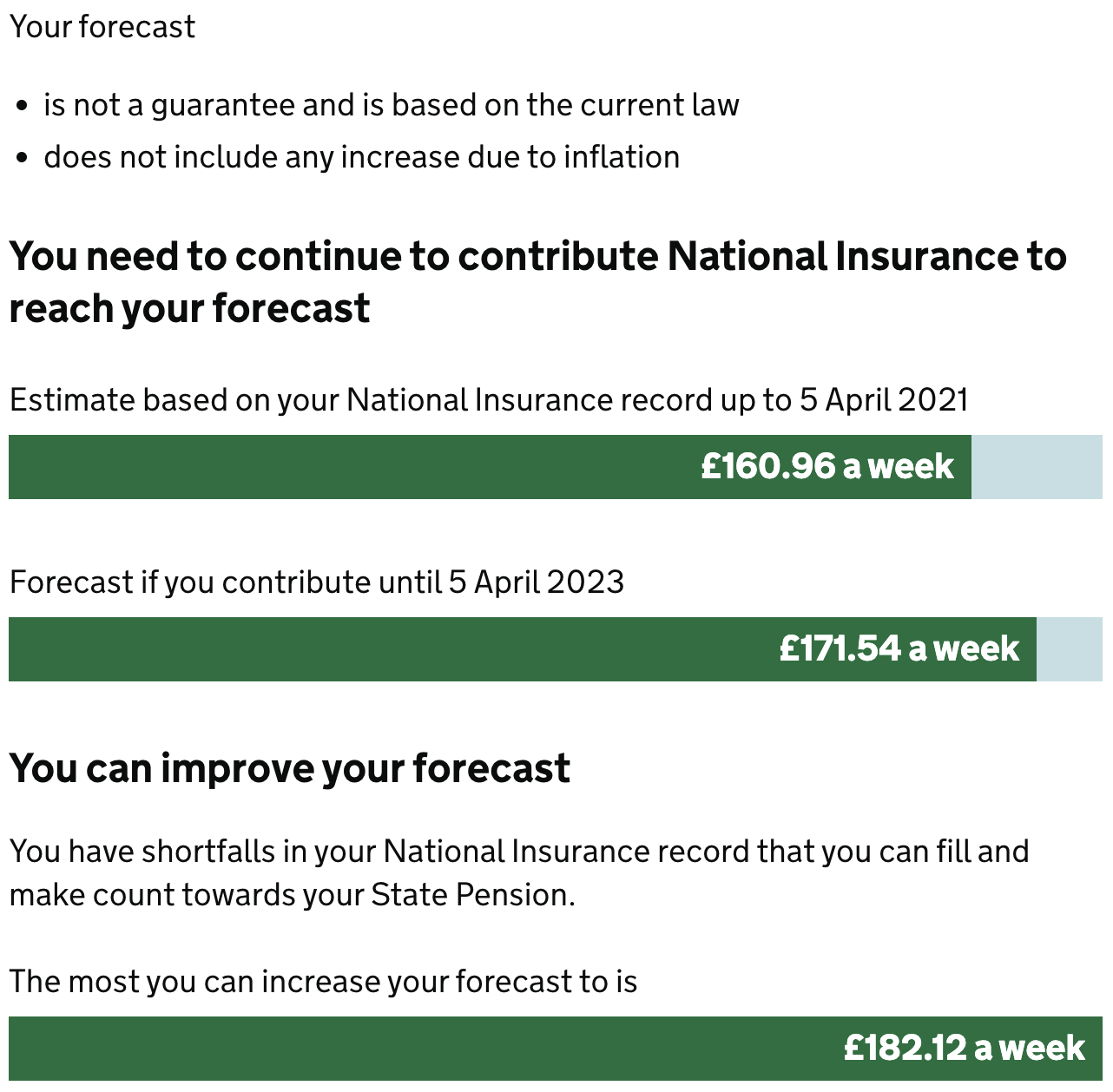
As my state retirement age is 66, which I (hope to!) reach in June next year, this appears to have has left me "short" of NI contributions and, as a result, reduced my projected state pension from just over £182 a week by £23 - unless I pay additional contributions of just under £1,620 for the two years of not paying NI contributions (2020/21 and 2021/22) and whatever else they think I should pay for the remaining period until I reach retirement age.
As I haven't been employed since 2018, is it correct that I need to make these additional payments?
I already receive a works pension, which is why I don't have to work until I retire, but NI contributions aren't required from a pension, so how does the government's calculation work, please?
Thank you.
As my state retirement age is 66, which I (hope to!) reach in June next year, this appears to have has left me "short" of NI contributions and, as a result, reduced my projected state pension from just over £182 a week by £23 - unless I pay additional contributions of just under £1,620 for the two years of not paying NI contributions (2020/21 and 2021/22) and whatever else they think I should pay for the remaining period until I reach retirement age.
As I haven't been employed since 2018, is it correct that I need to make these additional payments?
I already receive a works pension, which is why I don't have to work until I retire, but NI contributions aren't required from a pension, so how does the government's calculation work, please?
Thank you.
0
Comments
-
You are under transitional rules so you are highly likely to need to pay for additional years but what exactly does your forecast say?
And going back to 2006/07 which years are incomplete and how much does each incomplete year cost?
Rather than being stiffed you are likely to find its the best investment you could make as far as return on your money is concerned.0 -
To put the £1620 in context, it would cost you at least ten times that amount to buy the same amount of pension as an annuity. Six months ago it would have cost more like fifteen times.
In other words it is a bargain.3 -
https://www.gov.uk/new-state-pension/how-its-calculated[Deleted User] said:how does the government's calculation work, please?
Information I post is for England unless otherwise stated. Some rules may be different in other parts of UK.1 -
You chose to save tax by not taking a salary.
Now time to pay the Piper.
Didn't you ever see the endless advice on taking a salary to earn NI stamps each year?
No time machine so it's up to you to decide on whether you pay upfront to get that £23 or not.5 -
The years are 2019/20 and 2020/21 (sorry about that). Up until that point I've made full contributions, as an employee.Dazed_and_C0nfused said:You are under transitional rules so you are highly likely to need to pay for additional years but what exactly does your forecast say?
And going back to 2006/07 which years are incomplete and how much does each incomplete year cost?
Rather than being stiffed you are likely to find its the best investment you could make as far as return on your money is concerned.
I quoted the government's figures almost verbatim, apart from a little rounding up/down.
Here's a screenshot, if that helps: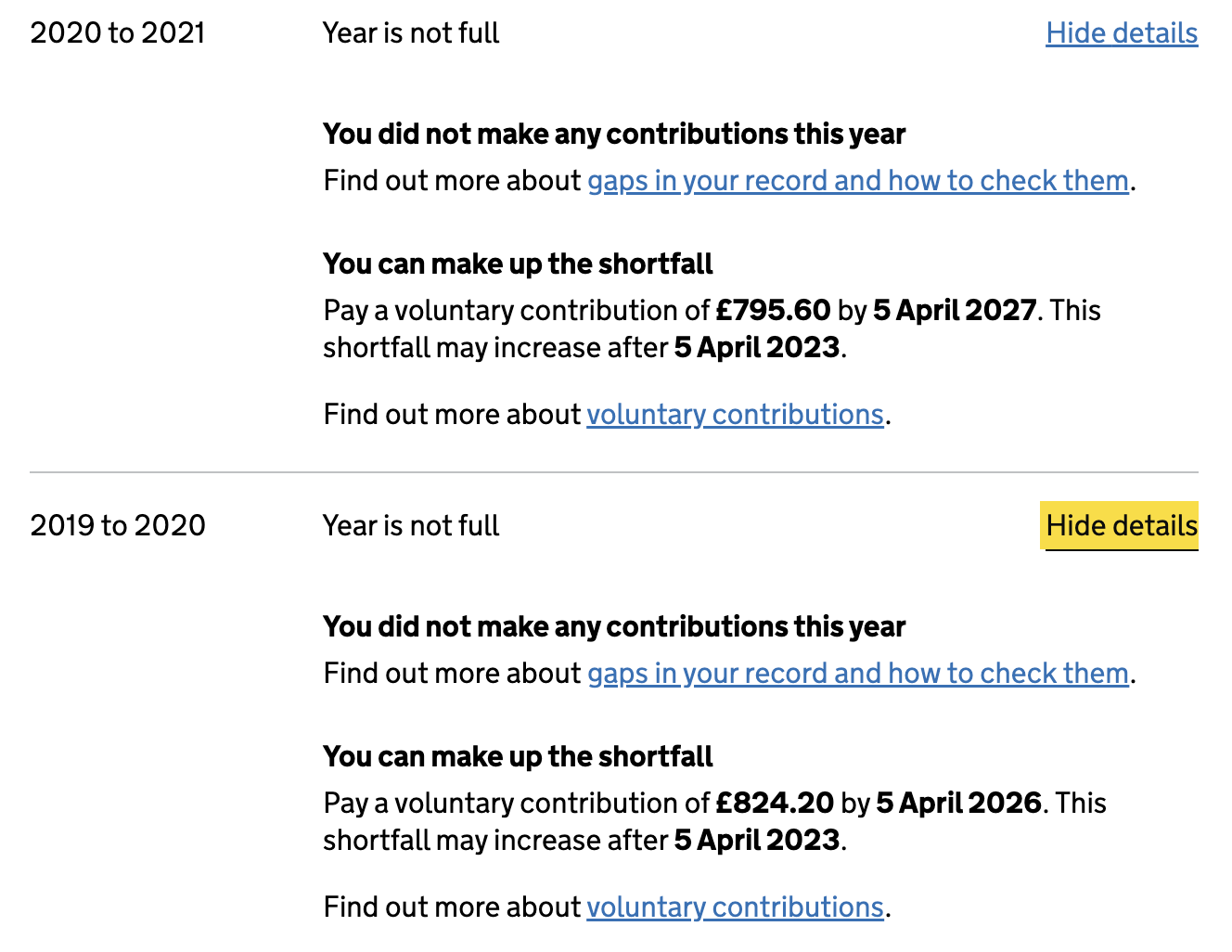
0 -
If you are taking dividends you must have a ltd company so you are an employee. Most Ltd companies I used to deal with the directors paid themselves the minimum amount as a wage that took them into N I territory. Maybe talk it through with your accountant to see if the extra tax you will pay will be better than paying the yearly NI additional contributions.0
-
Here's the summary:
0 -
It was a limited company, but I didn't take a salary - even the minimum - to take me into NI territory.comeandgo said:If you are taking dividends you must have a ltd company so you are an employee. Most Ltd companies I used to deal with the directors paid themselves the minimum amount as a wage that took them into N I territory. Maybe talk it through with your accountant to see if the extra tax you will pay will be better than paying the yearly NI additional contributions.
I'll definitely talk to my accountant, though...
Thank you.0 -
No, I get that. I did look at the way the government calculates the state pension and it seems (although I'll need to read it again) that I need 35 qualifying years to get the full new State Pension, which I have, and is the reason for my question.Albermarle said:To put the £1620 in context, it would cost you at least ten times that amount to buy the same amount of pension as an annuity. Six months ago it would have cost more like fifteen times.
In other words it is a bargain.0 -
35 years only applies to those starting out from April 2016, as mentioned earlier you are on a transitional scheme. As you are currently receiving a work pension it is likely that you were contracted out so had a reduction made to the 2016 new pension starting amount leaving you with the old style pension amount you had already accrued and can make that up with post 2016 contributions. You need to purchase 4 more years - 19-20, 20-21, 21-22 & 22-23, to take you to the maximum £182.12 you can achieve. Well worth the outlay, £3244.80 will give you an extra £21.16 per week so paid back gross in 152 weeks..Nightowl4933 said:
No, I get that. I did look at the way the government calculates the state pension and it seems (although I'll need to read it again) that I need 35 qualifying years to get the full new State Pension, which I have, and is the reason for my question.Albermarle said:To put the £1620 in context, it would cost you at least ten times that amount to buy the same amount of pension as an annuity. Six months ago it would have cost more like fifteen times.
In other words it is a bargain.
0






Confirm your email address to Create Threads and Reply

Categories
- All Categories
- 354.2K Banking & Borrowing
- 254.3K Reduce Debt & Boost Income
- 455.3K Spending & Discounts
- 247.2K Work, Benefits & Business
- 603.8K Mortgages, Homes & Bills
- 178.4K Life & Family
- 261.3K Travel & Transport
- 1.5M Hobbies & Leisure
- 16.1K Discuss & Feedback
- 37.7K Read-Only Boards