We’d like to remind Forumites to please avoid political debate on the Forum.
This is to keep it a safe and useful space for MoneySaving discussions. Threads that are – or become – political in nature may be removed in line with the Forum’s rules. Thank you for your understanding.
📨 Have you signed up to the Forum's new Email Digest yet? Get a selection of trending threads sent straight to your inbox daily, weekly or monthly!
The Forum now has a brand new text editor, adding a bunch of handy features to use when creating posts. Read more in our how-to guide
Returning to basic tax rate via pension contributions, using specific numbers

Zuzi
Posts: 247 Forumite




in Cutting tax
Hi all,
I am hopeful someone can confirm my understanding of this, using my specific numbers. My only income is one salary (and interest on savings, not sure how exactly that comes in), I have the standard tax code 1257L. My gross annual income is just short of 66K, and - crucially - I pay my pension contributions via salary sacrifice.
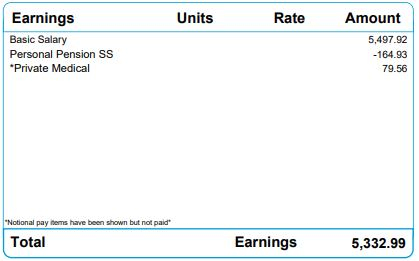
This is what is on my payslip. I can see that both tax and NI are being deducted from the "Earnings" amount rather than the basic salary, which I guess is the advantage of pension contributions via SS. I understand the "Earnings" figure to be my monthly taxable income.
I am a higher rate tax payer and would like to lower my tax burden and return to basic rate. Am I correct in thinking that I would need to get my monthly Earnings to below 50,000/12 (rounded down a bit) so let's say 4,150GBP for that to happen?
I would increase the "Personal Pension SS" figure accordingly for that to happen. My company contributes 7% as soon as I contribute 4% or more, so that would be even more money going into the pension overall. If I understand it correctly, the company contributions appear nowhere on my payslips, the 164.93 seen above are my current 3% I am contributing myself. Yes I know I should be paying in the 4% to get the maximum employer contribution but I thought I might as well calculate my ideal percentage (which will probably end up being more like 15-25%) and then submit that as a change to my company benefits/payroll teams all at once.
I would very much appreciate if someone could check this for me, thanks a lot in advance!
I am hopeful someone can confirm my understanding of this, using my specific numbers. My only income is one salary (and interest on savings, not sure how exactly that comes in), I have the standard tax code 1257L. My gross annual income is just short of 66K, and - crucially - I pay my pension contributions via salary sacrifice.
This is what is on my payslip. I can see that both tax and NI are being deducted from the "Earnings" amount rather than the basic salary, which I guess is the advantage of pension contributions via SS. I understand the "Earnings" figure to be my monthly taxable income.
I am a higher rate tax payer and would like to lower my tax burden and return to basic rate. Am I correct in thinking that I would need to get my monthly Earnings to below 50,000/12 (rounded down a bit) so let's say 4,150GBP for that to happen?
I would increase the "Personal Pension SS" figure accordingly for that to happen. My company contributes 7% as soon as I contribute 4% or more, so that would be even more money going into the pension overall. If I understand it correctly, the company contributions appear nowhere on my payslips, the 164.93 seen above are my current 3% I am contributing myself. Yes I know I should be paying in the 4% to get the maximum employer contribution but I thought I might as well calculate my ideal percentage (which will probably end up being more like 15-25%) and then submit that as a change to my company benefits/payroll teams all at once.
I would very much appreciate if someone could check this for me, thanks a lot in advance!
0
Comments
-
In round figures, from £66k, to get back to basic rate, you need to contribute £16k into the pension through SS, equals 24% of basic.
1 -
Grumpy Chap is correct, but start from £67k as the PMI is also taxable.
I also presume that because we are almost 50% into the tax year, you may need to put in more than the calculation implies to get down to 50k earnings for the year?
Some employers put restrictions on when you can change the salary sacrifice amount, due to historical HMRC guidance. e.g. annual renewal, new tax year, 'life event'.Pensions actuary, Runner, Dog parent, Homeowner3 -
Do you know that being a higher rate tax payer doesn't mean you pay the higher rate on all your earnings above the personal allowance? It's just on the earnings above the higher rate threshold. You pay basic rate, the same as everyone else, on the amount below it.
Your post read to me that you think you're paying 40% on everything.1 -
Apart from the direct taxation question, it is worth noting that your current level of contributions ( 3% + ?%) are really inadequate for building up a decent sized pension pot, even though they are percentages of a well above average salary.
Maybe if you are still below 30 they could be OK, but if you are any older than your plan to increase contributions is a good one, especially as you will get higher rate tax relief on them.1 -
Thanks for the replies.
@liz_bartun I know that only part of my salary is taxed at 40%, and I'm not too bothered about that as such, however as far as I understand then even a small amount subject to 40% automatically makes me a higher rate payer and I am concerned about the tax on my savings interest and the lower personal savings allowance this brings.
I have not realised the impact of being mid-financial year already, I will increase my pension contributions but it's probably too late to return back to basic rate this year. I will make it my plan for next year then Thinking about where my savings are, the biggest chunk of it is in a fixed year bond and won't mature until next fin year so it should be higher priority then anyway.
And yes, I know I am a bit late (and low) on the pension front, I did not understand the matching concept with my last employer and I only started contributing in my current job. However my situation is a bit complex since I worked in other EU countries before, and I don't really know how much longer I will remain working in UK.0 -
I am adding to my existing thread in the hope to get some feedback or sanity check if my plan - to only pay basic rate tax in year 23/24 - is workable.
Picture shows my numbers entered into the table on listentotaxman. My salary will increase a bit from April so that figure is new. HMRC told me they'll be wanting some tax back via code so that is updated, also for my private medical insurance I put the 100 in Allowances (I think that is where it belongs? There's a screenshot of my payslip further up the thread how it shows there. I don't pay it but it's a taxable benefit afaik)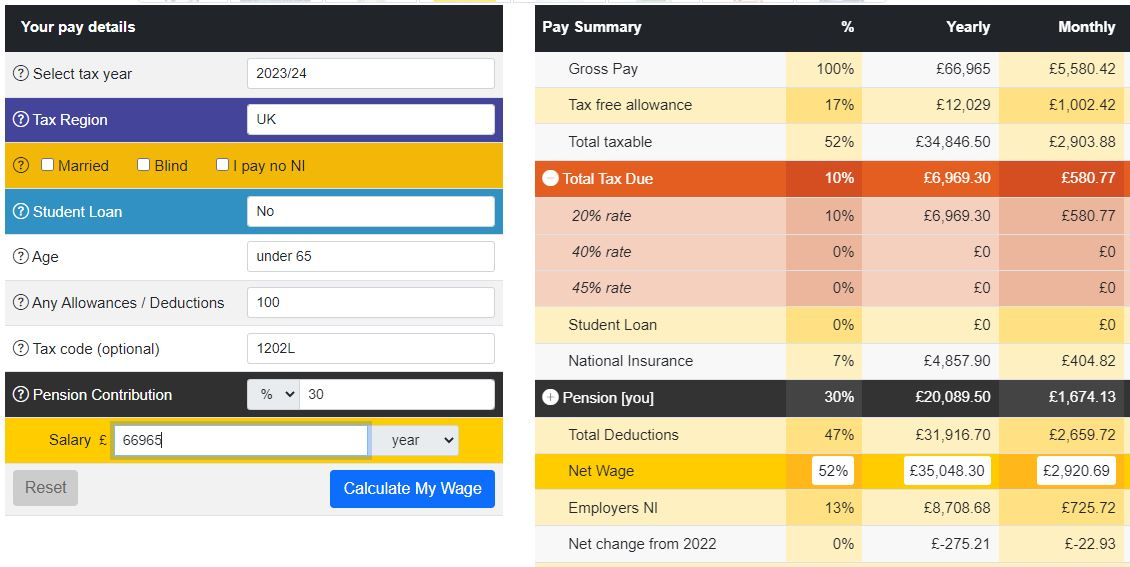
My plan is to increase my pension contribution to 30% (I played with the numbers and this is a net monthly income that I can happily live with, and it's one of the first figures where the "taxed at 40% rate" line had a zero )
)
I contribute via SS and my employer adds another 7% so that should be a nice monthly income diversion into the pension, plus I will save some tax on my savings interest, which will probably be several thousands next year.
Does this look right, have I missed anything? Thanks in advance.0 -
Presumably UK in the region box is shorthand for England, Wales or Northern Ireland (not Scotland)? Your gross is £66,965. You add to that the private medical benefit. I assume the £100 is a monthly figure? If it is, add £1,200 to the £66,965, giving £68,165. Deduct the pension figure of £20,089 leaves adjusted net income of £48,076 (I assume the pension figure is the gross salary sacrifice plus the grossed up amount of any contributions made with relief at source). If your interest exceeds £50,270 - £48,076 = £2,194, your personal savings allowance drops to £500, and if it exceeds £2,694, you will pay some tax at 40%. No doubt someone will check my figures, as I don't normally do these calculations.
The national insurance calculation assumes that the entire pension contribution is made up of contributions by you, rather than by your employer (by salary sacrifice).1 -
Can I just ask what is the reason is to reduce your monthly earnings quite so much (unless you are concerned about your retirement pot size - which is of course valid!)? I understand it you are looking to avoid paying back Child Benefit, or you are very close to the threshold for things like Marriage Allowance, etc. that you lose if you are a higher rate taxpayers. Or if you were on just above 100k and you would lose Tax Free Childcare, etc so it makes sense to reduce your income.
But if none of those apply, the personal income tax rate is tiered so it seems overkill to reduce a 66k income to below 50k just for that reason?
1 -
Tax is only payable at 40% if you exceed the allowance at the end of the financial year, so is it the average you take home each month which is important, however we are not mid-financial year now, we are almost right at the end, so you have 1-2 months tops to get your average down.Zuzi said:Thanks for the replies.
@liz_bartun I know that only part of my salary is taxed at 40%, and I'm not too bothered about that as such, however as far as I understand then even a small amount subject to 40% automatically makes me a higher rate payer and I am concerned about the tax on my savings interest and the lower personal savings allowance this brings.
I have not realised the impact of being mid-financial year already, I will increase my pension contributions but it's probably too late to return back to basic rate this year. I will make it my plan for next year then Thinking about where my savings are, the biggest chunk of it is in a fixed year bond and won't mature until next fin year so it should be higher priority then anyway.
And yes, I know I am a bit late (and low) on the pension front, I did not understand the matching concept with my last employer and I only started contributing in my current job. However my situation is a bit complex since I worked in other EU countries before, and I don't really know how much longer I will remain working in UK.
As it is not legal for an employer to reduce your salary by salary sacrifice to below minium wage, you are probably out of luck for the 22/23 tax year, but you can do it that way in future years providing you have other savings to subisdise your living costs during those months. It's the number on your P60 at the end of the financial year that matters for tax / child benefit / tax free savings interest etc, not what you earn each month. • The rich buy assets.
• The poor only have expenses.
• The middle class buy liabilities they think are assets.1 -
@vacheron the thread is older (as well as the post you quoted), but my most recent post with the picture is my plan for the next year - 23/24
I left it last year since it was too late to make a significant impact, but for next year - even if it ends up just an experiment and I don't continue it, for whatever reason - I want to try to get below the threshold. My salary only went up significantly within the last 18 months and I was perfectly content with <40K before that, so it should be relatively easy to adjust, with the positive side-effects on due taxes and pension pot...0






Confirm your email address to Create Threads and Reply

Categories
- All Categories
- 353.6K Banking & Borrowing
- 254.2K Reduce Debt & Boost Income
- 455.1K Spending & Discounts
- 246.7K Work, Benefits & Business
- 603K Mortgages, Homes & Bills
- 178.1K Life & Family
- 260.7K Travel & Transport
- 1.5M Hobbies & Leisure
- 16K Discuss & Feedback
- 37.7K Read-Only Boards