We’d like to remind Forumites to please avoid political debate on the Forum.
This is to keep it a safe and useful space for MoneySaving discussions. Threads that are – or become – political in nature may be removed in line with the Forum’s rules. Thank you for your understanding.
📨 Have you signed up to the Forum's new Email Digest yet? Get a selection of trending threads sent straight to your inbox daily, weekly or monthly!
USS - General discussion
Comments
-
@kermchem here is the link again. I think the bracket is included in the link above so it didn't work. https://www.sjp.co.uk/individuals/news/salary-sacrifice-tax-break-on-workplace-pensions-cutI don't think we can see how much NI the EMPLOYER pays from our payslip. I can see my own (employee's) contribution, and yes it is 8% over the adjusted taxable income (after pension contribution).In the exisiting scheme of salary sacrifice, I understand that both the employer and employee have NI exemption over the amount of (gross) salary that we salary sacrifice into pension contribution.The employer pays more NI percentage than us so I suppose in the new scheme from Apr 2029 any contribution over that £2,000/year threshold there's no NI exemption, which means this additional NI will be taken from "our money" (employee's), leading to less take-home money. What I don't know is whether the employer has to pay additonal NI too for our additional volunteer contribution, and thus has no reason to encourage us to put more money into our pension pot.
0 -
@ussdave it is always a factor of relief to see you here and explain what you know.I put in voluteer contribution of over 13K last year and will have enough time to put in what I consider the ideal size of my DC pot (about 3.667 times my projected annual DB at retirement so I can take it all out tax free - if it's more than that size because of tax efficiency then fine but I don't aim to just save money in work pension).Any how, I see your point and it does seem like I should just continue with the plan even though there will be less perk (NI exemption) for salary sacrifice over 2k/year into pension.What I am thinking now is when Apr 2029 comes, I don't need more volunteer contribution (VC), but there's still tax efficiency with contribution - so should I just have a standard contribution (6.1% current rate) or still doing VC. Maybe I don't think about what to do beyond Apr 29 just yet.
Thanks again for your response.0 -
Hi it is me again. I remember in the past year or so we kept on having discussions on USS pension related threads with a kind of a conclusion that: "as you retire, ask to get maximum TFLS without commuting the remainder of your DC".However, more recently I also saw some discussions that "The USS commutation ratio around 18 is a lot better than civil service / teachers around 12.".May I ask where I can get the info of USS commutation ratio and how do we know whether it's worth taking or not?Just to give the context, I am working towards retiring at 60 (60 year + 1 month to be exact so I can retire before Christmas of that year
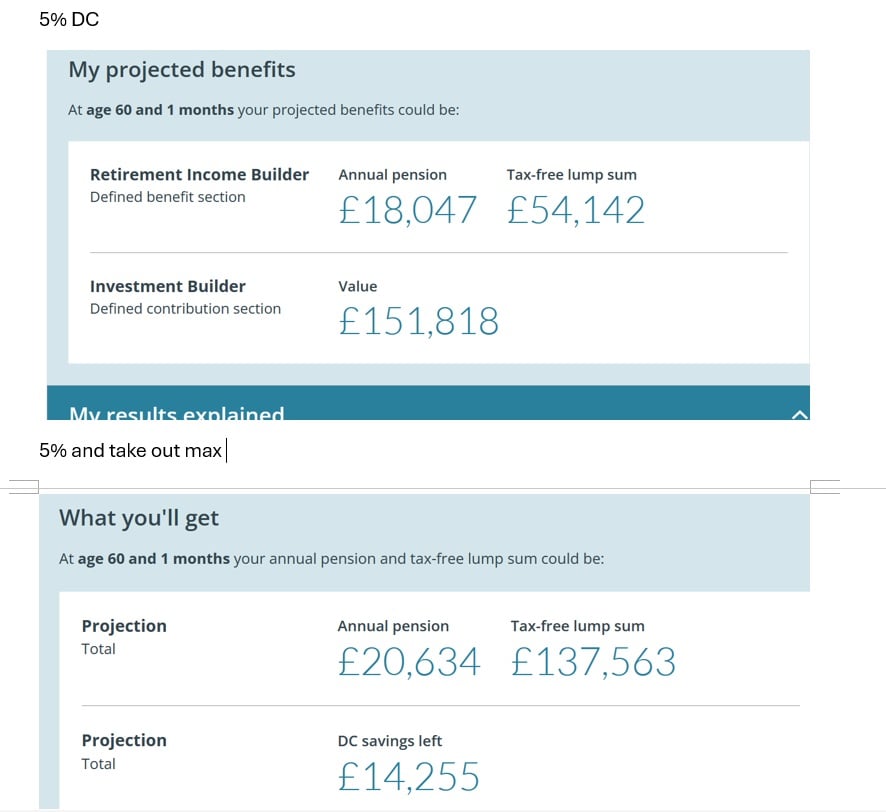
 ). My forecast: annual pension of just over 18K, and DC of about 152K if contributing 5% from now (I have been contributing quite heavily especially the past few years, and I have reached about half of that DC pot size already, so it's not a problem to fill the other half, I think. I've played with some numbers to see putting more VC in would still yield the same annual pension, just more to remain in the DC pot). If I max TFLS in this scenario AND use commutation, my annual pension would increase to 20.6K and DC leftover is about 14K, which seems quite a good to me. I'd only have 32 years in NI contribution by then, so 32/35 times current max £230/week would give me £10,920 SP as I turn 68, 8 years after retirement.
Before SPA income after tax is about just under £1,500/month and later, with SP, it would be about £2,300/m.I feel I can survive with £1,500/m living in a quite a cheap city (no rent, no car, quite simple needs). When downsize back to my flat, bills as i can see in today's money term (including service charges) are around 600/m, food 200/m, others 200, holiday 200. I still have leftover even before SP. And as I am going to give away quite considerable amounts to my two children in the next 3-5 years, I hope they can treat me here and there during my retirement too . I also should have buffer from my ISAs/ LISAs (over 100K at the moment and I still add more when I still work)So I feel commuting the remainder of my DC pot to bring up my annual pension to a more suitable level seems to be a fine choice. I am still having that note at the back of my mind about "not to commute the DC" though - any advice?Thank you very much in advance.0
 -
USS commutation rates may be found on this web page: https://www.uss.co.uk/for-members/calculate-your-benefits/factors-used-by-uss1
-
If you are talking about reverse commutation which is buying additional pension with your lump sum then the higher the number the worse it is. So a reverse commutation of 12 means it costs you £12 of lump sum to buy £1 of extra annual pension. A factor of 18 means it costs you £6 more for that extra £1 of pension. You also cannot use your DC pot to buy extra annual pension, you can only use the DB lump sum for this. This is a change that was made a few years ago.2
-
@guymo thank you, I'll read this carefully.@swindiff thanks - so when I played with the benefit calculator yesterday (results in the last post of mine), the option where the annual pension increased from 18K to 20.6K, the TFLS does look like it's bigger in the case of DB 20.6K/year, whilst the DC pot became smaller - so I thought that means the commutation of the DC happened, did it not? I may get the terms wrong - will need to read the link from USS again.
0 -
What's happening there is all of your DB tax free lump sum of £54,142 (3x annual pension) is being reverse commuted to give you the additional annual pension. Your tax free lump sum of £137,563 is then all being taken from your DC pot, leaving the remainder of £14,255. £137,563 + £14,255 = £151,818. It is not possible to reverse commute DC pot to additional pension. That £54,142 DB Tax free lump sum is buying you an extra annual pension of £2587. That is a reverse commutation rate of 20.93, much worse than the 12 you quoted for civil service. Every extra £1 of annual pension will have cost you £20.93, which will then also be subject to income tax.2
-
The above is correct, but at the end of the day it doesn’t really matter in this case. In one scenario the gross cash/IB is around £205,000 and in the other it’s around £152,000. The extra ~£2,600 in pension has cost, in gross terms, approx £53,000. You could consider the different tax implications maybe before deciding. Also, check your SP value as you will probably have been contracted out given you were in USS so the full SP may well be more than 35 years.1
-
@swindiff Thank you soooooooooooooooooooooooo much. I can see now where all the numbers above fit (and the reversed commutation for 60y about the same as in the factors listed by USS). Brilliant. I did not like it very much that I was completed ignorant of those "factors" and how they link to "my numbers" as in the forecast.@Barralad77 and @swindiff thank you for the note regarding tax implication for increased annual pension. I will look at this again more carefully. My current thought, after your note, is that I am contributing anything over to the 40% tax threshold into my DC (plus benefitting from the NI exemption for that whole amount for now), so when I take the pension out and pay 20% tax it is fine. Together with SP it won't reach the 40% tax band anyway. I currently do priotise putting any unspent money from my take-home income into ISAs.I will look more into whether it's silly to "buy £2,587/year DB using £54,142". Do you mean if it's too expensive then I should try to just take DB=18K and there's another method to get more from this 54K , like just keep it in DC to invest? £54,142 invested at 5% yields £2,707/year.Regarding my number of years for NI contribution, it is taken from my NI record on the Gov gateway and I suppose I can only count "full years":
 I did study for too long, only working full time from 2008, first for a new university (TPS) then a red brick one (with USS pension). I think this record is right and I can only count my NI years from 2008.
0 -
In response to a couple of points:
(1) My SP record shows ‘full year’ contributions but that doesn’t reflect the fact that, courtesy of being in USS, I paid lower NI contributions in certain years and so the benefits are not ‘full’ as would otherwise be the case. For example, in my case, I now have 35 ‘full’ years but require 38 years in order to get the ‘full’ SP. This is due to being in USS from 2003 until they revised this point (not sure when, exactly - 2016?).
(2) I was thinking more of the tax implications after retirement. £2,500 in gross pension will be £2,000 after 20% tax. Whatever is left in the IB will be subject to a net tax rate of 15%. From that, it follows that one will probably be more advantageous than the other from tax angle, depending on what the IB remaining turns out to be. But even then there are other factors at play: for example, ‘fixed’ (in terms of extra pension) vs ‘flexible’ (in terms of having more IB left). And so on…..
1











Confirm your email address to Create Threads and Reply

Categories
- All Categories
- 355.8K Banking & Borrowing
- 254.9K Reduce Debt & Boost Income
- 456.2K Spending & Discounts
- 248.3K Work, Benefits & Business
- 605.9K Mortgages, Homes & Bills
- 179K Life & Family
- 263.8K Travel & Transport
- 1.5M Hobbies & Leisure
- 16.2K Discuss & Feedback
- 37.7K Read-Only Boards