We’d like to remind Forumites to please avoid political debate on the Forum.
This is to keep it a safe and useful space for MoneySaving discussions. Threads that are – or become – political in nature may be removed in line with the Forum’s rules. Thank you for your understanding.
📨 Have you signed up to the Forum's new Email Digest yet? Get a selection of trending threads sent straight to your inbox daily, weekly or monthly!
The Forum now has a brand new text editor, adding a bunch of handy features to use when creating posts. Read more in our how-to guide
Where to start for pension.
Comments
-
You could consult an independent financial adviser for advice about your specific situation?
https://adviserbook.co.uk/ When the menu comes up on left hand side, tick "confirmed independent" and such other specialisms as required.
You could then ring round and check on terms of business.1 -
I set up this for my husband who has a limited company https://www.vanguardinvestor.co.uk/investing-explained/what-are-target-retirement-fundsNurse striving for financial freedom1
-
If your company made 100k, you should be putting more than 6k into a pension. You have enough savings to see you through any difficulties, and money retained in the business. I would suggest you put in 20k. Why 20k? Let's look at the lifetime allowance. This is currently set at £1.07million. It's supposed to grow annually with inflation, but it has mostly fallen over the years, and look for Rishi Sunak to freeze it again in the budget on Wednesday. Once your pension savings exceed the LTA there are hefty extra taxes that kick in on withdrawal, so saving more into your pension becomes pretty pointless. If you put in 20k per year for the next 25 or so years, add in decent growth, you should be somewhere around the LTA.Note that you can pay income into a SIPP too. Whatever salary you pay yourself, you can put 80% of it into the SIPP, and get a 25% freebie from the taxman - much more tax back than the tax/NI you actually paid. The LTA applies to all of your pension pots added together. If you want pay salary into a SIPP, maybe get a payment in before April, as the contribution limit runs tax year to tax year.Move your savings into ISA's 20k each year. Then switch the money into investments. You can pick one or two simple funds and just leave the money alone. It will grow over the long term, tax free. Even if you need some time to study investing, get the first 20k into a cash ISA before April or you miss the chance. It's easy to move from a cash ISA into a stocks and shares ISA in the future.
0 -
You mean £20k from the business profits retained yes?Secret2ndAccount said:
If I setup a SIPP with any of these companies and then setup a monthly DD from the business account of say £500-700 to begin with how is that recorded differently to if I put money from my personal account into the SIPP (in terms of the taxman etc)? And is there a limit?
Can I ask why Vanguard seems to be the most popular mentioned on here?
I have thought of ISA's before, but then when I did the caluclations between how much an ISA would gain compared to a standard savings account it wasn't really worth it. But I guess you idea would be to build it up and then switch it to a S&S ISA. Which I understand would be a better option.
Thanks for your advice, really helpful.0 -
Well, if you take 20k from the business and pay it into your SIPP, you save 20k*19% = 3800 tax, right?But I presume you are paying yourself about 12k every year anyway. Put 9600 of this into the SIPP, and you get 2400 uplift. So a bit better, but it doesn't allow you to get money out of the business. You might choose to get the money out of the business tax free. Your call.Your personal contribution, including the tax back, is limited to your earnings. However, your company's contribution is not limited in that way. There is a limit of 40k per year for all contribs to your pension, whatever the source. This limit can be carried forward 3 yrs, so your company could make quite a large one-off payment using several year's annual allowance.With my SIPP, whenever a contribution goes in, I get asked if I expect to get the tax back or not. Depends on which platform you use to hold your SIPP.Vanguard is an easy one-stop shop. It provides a widely diversified range of stocks and bonds, together with very low annual charges. Maybe you can do better if you spend time and do your homework, but you could do a lot worse than just stick the whole lot in a Vanguard fund. At your age, most people would suggest you have most or all of your investment in equities. So that would be VLS100 (100% equity). If you have some bonds, the theory is that they hold their value during a market crash. On the downside, they don't grow as fast as the equities. Given that your money will be invested for several decades, the law of averages will favour you if you go with the equities.Yes, get the money into ISA then invest it. I put 3600 into an ISA years ago. Still have the same fund, and now it's grown to 22k. If it wasn't in an ISA I would be worrying about capital gains tax. You are right that if all you do is leave the money in cash, earning 0.5% for 5 years, then an ISA doesn't serve any purpose. If you hope to continue earning enough to put 10 or 20k in each year, you will soon start benefiting from the tax protection. You can always take the money out if you need it.0
-
Thanks for the advice.Secret2ndAccount said:
Another question is, are pension pots protected? I know banks cover you upto £85k, but what about pensions? For example if I have a pot worth £500k with Vanguard, is it all protected, and if not is there even an option for this for anyone?
In terms of a ISA, where do you suggest? I guess a cash ISA is a cash ISA wherever you choose to do it? A S&S ISA may differ from company to company?
For example, I bank with Santander, which is where my personal savings of £100kish are held. Should I get an ISA with them, or should I open a Cash ISA with Vanguard as well as the SIPP?
With a Cash ISA, I could put £20k personal savings in it now, and £20k in April right? Then at what point would I convert it to a S&S ISA and what are the risks? Do I get to choose how risk-averse I want to be?0 -
Sorry, another question. What stops people opening multiple ISAs with different providers and going over the £20k per year limit? How is it policed?0
-
Cheillie2020 said:Sorry, another question. What stops people opening multiple ISAs with different providers and going over the £20k per year limit? How is it policed?
You have to give your NI number when you open one. I would guess it gets passed to HMRC, and they will (eventually) get the records tied together and deal with it in whatever way.
1 -
Cheillie2020 said:Another question is, are pension pots protected? I know banks cover you upto £85k, but what about pensions? For example if I have a pot worth £500k with Vanguard, is it all protected, and if not is there even an option for this for anyone?Mostly protected, yes. In theory, Fidelity could take your payments and pocket them, sending you reassuring statements, even though you didn't actually have a pension at all. In other words a giant fraud. It's never happened of course, and I think they would be found out pretty quickly.Addressing the slightly more plausible scenario I'm guessing you had in mind: If Hargeaves-Lansdown was to go bust, you are protected. The stocks, shares and bonds are yours. H-L is just 'storing' them for you. So there would be a period of worry, a period of a lot of paperwork by the Financial Conduct Authority, then your pension would arrive at some new service provider, value intact.Similarly, assuming Vanguard isn't stealing the money you invest with them, the holdings continue to exist, even if Vanguard fails. You could argue it would be better to own funds from two or more different companies so your pension didn't dry up for six months while it all got sorted out. Then again, the only time it looked we could lose a big provider (2008) it also looked like all of them could go down at once.
There are several threads on here discussing best SIPP's and ISA's. You should have a search through those. Some have nicer web-sites; some provide more, or less help to pick good investments; some are cheaper if you have a small amount in there; some are cheaper for large sums.Cheillie2020 said:In terms of a ISA, where do you suggest? I guess a cash ISA is a cash ISA wherever you choose to do it? A S&S ISA may differ from company to company?For example, I bank with Santander, which is where my personal savings of £100kish are held. Should I get an ISA with them, or should I open a Cash ISA with Vanguard as well as the SIPP?
With a Cash ISA, I could put £20k personal savings in it now, and £20k in April right? Then at what point would I convert it to a S&S ISA and what are the risks? Do I get to choose how risk-averse I want to be?Personally I use Interactive Investor. I pay £20/mth so it works out as a tiny percentage as I have quite a lot in there. A provider who charges a percentage would work better for some. This gives me a SIPP and an ISA.Cash sitting in any ISA will earn nothing, and be eaten away by inflation. Get it invested, and start enjoying some of that tax free growth. You have enough cash outside the wrapper, as it will take you years to get all your money into the ISA.As you learn about investing you will find options that involve more or less risk. As a rule, risk and reward are closely related. If there was a product that offered high reward with low risk, everyone would buy it, the price would go up, and it would no longer offer such big reward... On the other hand, if you buy bitcoin, the potential rewards are huge, but the risk is enormous. It could double or halve tomorrow and it wouldn't be a big surprise. So you end up picking an investment with a risk/reward best suited to the strength of your stomach. Would you be okay if you woke up one day to find your entire pension pot had shrunk by 10% overnight? What about 20%? Truth is, historically, you can expect that to happen every now and then. You can also expect to see the value recover, and grow more than any savings account. You have many years to wait, so in my view, you should be in equities. As you approach retirement maybe you consider moving to a lower risk level. That gives up some gains, but protects against the larger falls as a pensioner doesn't have time to wait for a recovery.Cash is not safe. Cash is the only investment guaranteed to lose money over time. The only good thing about it is that it loses money in a slow and fairly predictable way. It has low volatility. Stocks have higher volatility, but also higher growth.
0 -
If you have no clue where to start, but you recognise the futility of cash for long term investment, then start by just buying a Vanguard Life Style fund, and let that sit there while you explore options and decide if something else better suits your needs. VLS100 would give you my recommended 100% equities. If you want to lower the risk, VLS20 is closer to cashHere's a look at what happened to the Vanguard funds for the year 2020
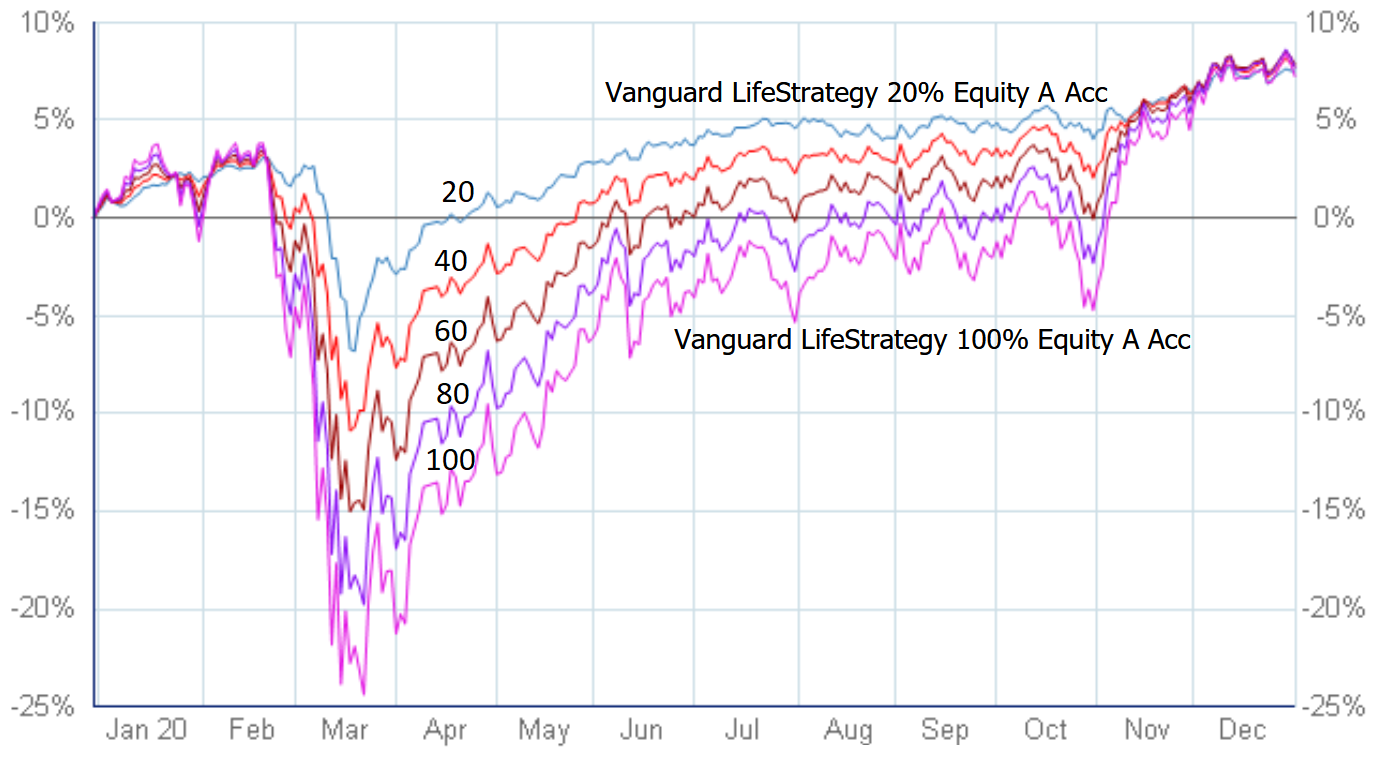 In March, the stock markets took a huge dive. VLS100 went down 25% in a few weeks, then recovered all of it, and ended the year up 7%. VLS20 had mostly bonds, which are less volatile. It too dropped, but not nearly as much. It too made a recovery over the rest of the year.If you look at just 2020 as a whole, you might think VLS20 is the way to go - low volatility and a solid return. On the other hand, the tax year starts April 6th. If you invested on Apr 6th you would have done vastly better with VLS100 with gains of about 27% to year end. VLS20 was only up about 7% in the same period.Please note, I am not some huge VLS fanboy, and I don't own any. It's just a simple way for someone to invest if they don't want to spend all their free time figuring out investing. Better than leaving your money in cash. Annual charges are an important factor as they eat into your returns, and VLS has pretty low charges. Other good funds are available.0












Confirm your email address to Create Threads and Reply

Categories
- All Categories
- 354.2K Banking & Borrowing
- 254.4K Reduce Debt & Boost Income
- 455.3K Spending & Discounts
- 247.2K Work, Benefits & Business
- 603.9K Mortgages, Homes & Bills
- 178.4K Life & Family
- 261.4K Travel & Transport
- 1.5M Hobbies & Leisure
- 16.1K Discuss & Feedback
- 37.7K Read-Only Boards