We’d like to remind Forumites to please avoid political debate on the Forum.
This is to keep it a safe and useful space for MoneySaving discussions. Threads that are – or become – political in nature may be removed in line with the Forum’s rules. Thank you for your understanding.
📨 Have you signed up to the Forum's new Email Digest yet? Get a selection of trending threads sent straight to your inbox daily, weekly or monthly!
The Forum now has a brand new text editor, adding a bunch of handy features to use when creating posts. Read more in our how-to guide
lifetime pensions allowance
Comments
-
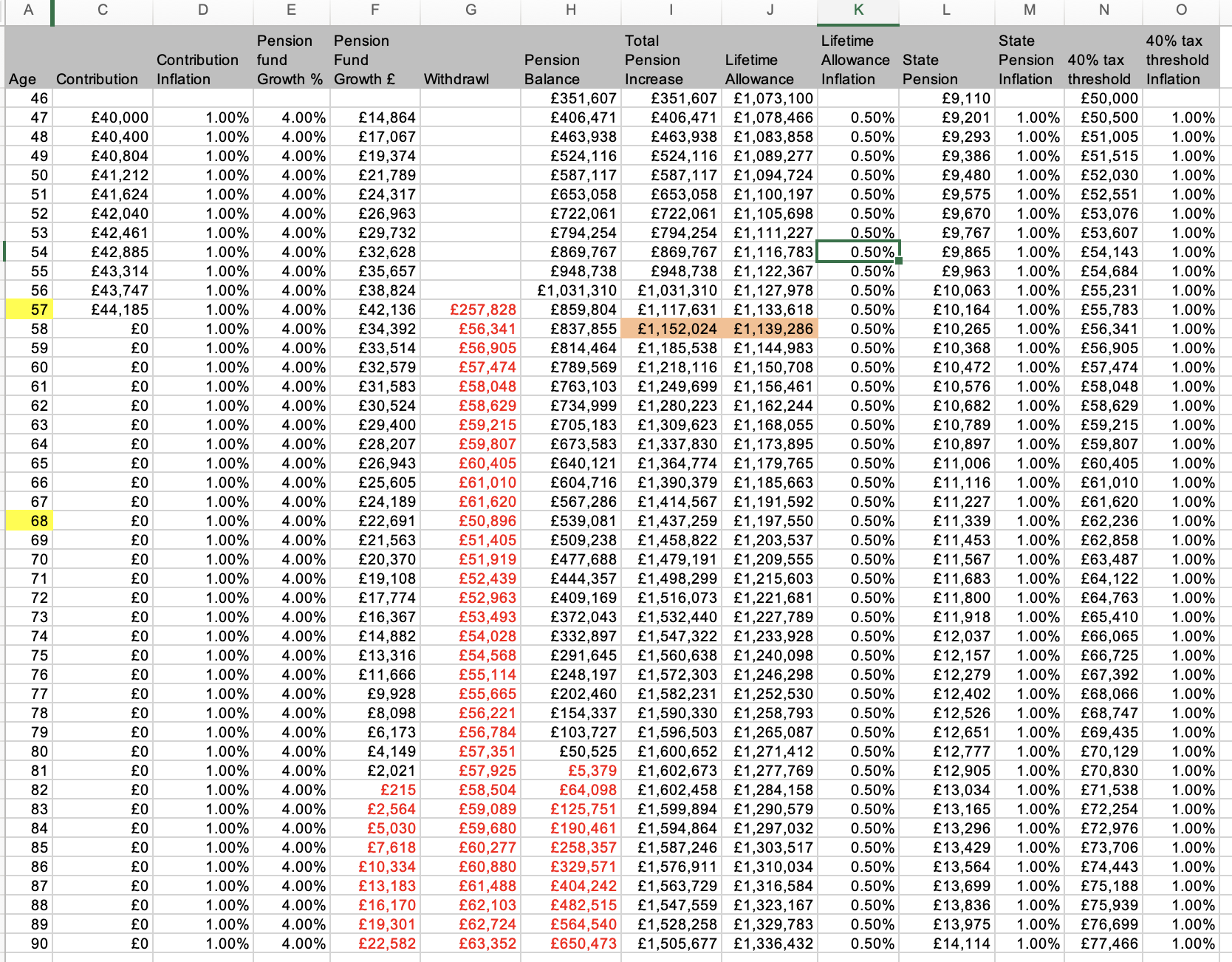
OK true to my word - I goddamned spreadsheeted the heck out of it.
Interesting observations were just how soon the Lifetime Allowance will be exceeded, secondly just how far away state pension age is. If I keep my current rate of contribution till 57 (another 10 years) then I can withdraw up to the 40% tax band until I'm 80 which is absolutely fine by me. I'll do a second sheet now to figure out when you'd have to stop contributions to remain below the LTA.
I'm guessing there are shed load of mistakes here - isn't age 75 important for LTA? Advice sought (from the knowledgeable )
)
0 -
Answer - age 53 in 7 years time, rather than going 11 further years till 57. Though if you do that and retire at 57 then the money dries up age 75.beeza650 said:... I'll do a second sheet now to figure out when you'd have to stop contributions to remain below the LTA.0 -
beeza650 said:
You really are on the wrong website aren't you - this is Money Saving Expert - not Robin Hood fan club.Albermarle said:
Yes exactly , and you gain massively from the 40% relief ( which is an extremely generous tax break by any measure ) for the £1.07 million below the LTA . So if you go over that limit and have to pay some back then seems fair enough really - at best a luxury problem.shortseller09 said:No, £60 invested plus 40% relief on the way in = £100 in pension, and then remain under the higher rate threshold on the way out, you get £100 less 25% LTA penalty = £75, less 20% income tax = £60. So you're back where you started, no worse off, but crucially you have gained (hopefully) from the additional investment.
If I was your tax accountant and you were paying me £500 an hour , I could understand that you would not be pleased by my comments . However you are looking for free advice on a public forum ( when you could easily afford to pay for professional advice) and therefore you are not only going to get feedback that suits your own thinking . Part of the reason you are worrying about LTA is the fact the UK pension tax regime for pensions is so generous in the first place.
Anyway to prove my MSE credentials , I should have mentioned that by reducing your pension contributions to try and avoid the LTA hit , you will have more assets outside the pension which are potentially subject to IHT - also at 40%.
Money in a pension is outside your estate for IHT purposes.
So can often be a choice of LTA tax or IHT tax ( + possibly CGT and dividend tax issues ) .1 -
Some comments:beeza650 said:OK true to my word - I goddamned spreadsheeted the heck out of it.
Interesting observations were just how soon the Lifetime Allowance will be exceeded, secondly just how far away state pension age is. If I keep my current rate of contribution till 57 (another 10 years) then I can withdraw up to the 40% tax band until I'm 80 which is absolutely fine by me. I'll do a second sheet now to figure out when you'd have to stop contributions to remain below the LTA.
I'm guessing there are shed load of mistakes here - isn't age 75 important for LTA? Advice sought (from the knowledgeable )
1. There is no sign that the AA will increase in line with inflation.
2. The LTA does not increase with inflation once you have used some of it. So, in your example, roughly the 90% of LTA that you used when you took out the PCLS doesn't increase. That doesn't matter in your example but it will if you increase your growth assumptions so that the BCE at age 75 is relevant.
3. The "triple lock" on the state pension suggests it may go up my more than 1%. Whether it will survive is another story.
4. No one knows what is going to happen with tax thresholds but at the moment, I'd suggest increasing it by 1% pa is optimistic but over the longer-term that may be right. The assumption that the LTA will increase by less that the tax thresholds seems pessimistic.
5. I guess you are planning on not spending all you withdraw but if you are, you've run out of money way too early.
6. I get frustrated with spreadsheets that show negative funds, even if they are nicely coloured, but that's just a style thing. As is spelling :-)2 -
Adyinvestment said:I was under the impression you can do the below to not pay any LTA penalty?
Crystallise before you reach the LTA (assuming 55 or whatever the age is at that time)
Keep withdrawing any profit each year (or whatever timeframe suits you) until 75 so your pot is not any larger than when you have crystallised, yes you will pay normal bands income tax on what you withdraw but that would only be fair.
Is that correct?That is one way of doing it - though if you have any unused LTA then the increase is tested against that, so you could actually have a higher pot than when crystallised if that were true.Of course the LTA could yet again be reduced, but hopefully the government would once again allow protection against that if your pension savings were higher than the new LTA.0 -
Also you have to work out what to do with the approx £250K tax free cash generated. If you want to keep it invested than most will have to be outside a tax shelter , so you will probably end up with CGT and dividends tax to pay . Also keeping some tax free cash in the pension can be useful for some people when withdrawing money . Plus outside the pension the money is potentially liable for IHT when you die.Adyinvestment said:I was under the impression you can do the below to not pay any LTA penalty?
Crystallise before you reach the LTA (assuming 55 or whatever the age is at that time)
Keep withdrawing any profit each year (or whatever timeframe suits you) until 75 so your pot is not any larger than when you have crystallised, yes you will pay normal bands income tax on what you withdraw but that would only be fair.
Is that correct?
So no simple easy answer .0 -
Thanks for the reply, if you've got a sec to explain the BCE at 75 comment in point 2 please that would be great?Dead_keen said:Some comments:
1. There is no sign that the AA will increase in line with inflation.
2. The LTA does not increase with inflation once you have used some of it. So, in your example, roughly the 90% of LTA that you used when you took out the PCLS doesn't increase. That doesn't matter in your example but it will if you increase your growth assumptions so that the BCE at age 75 is relevant.
3. The "triple lock" on the state pension suggests it may go up my more than 1%. Whether it will survive is another story.
4. No one knows what is going to happen with tax thresholds but at the moment, I'd suggest increasing it by 1% pa is optimistic but over the longer-term that may be right. The assumption that the LTA will increase by less that the tax thresholds seems pessimistic.
5. I guess you are planning on not spending all you withdraw but if you are, you've run out of money way too early.
6. I get frustrated with spreadsheets that show negative funds, even if they are nicely coloured, but that's just a style thing. As is spelling :-)
I've tweaked some of the formula - have to admit, I think the red negative balance was more eyecatching.
Gin consumption in excess of Standard British Spring Allowance (SBSA) this afternoon prevents me from fixing up the formula for withdrawal (but you get the idea).
Re: your point 5 and running out of non-state pension at 80. Yes, I'd probably not spend all withdrawals each year plus there's the tax-free lump sum plus at 80 I'd be living in a way too big a house for just me by then. I think with a combination of downsizing and non-extravagant living there's enough to last until 90. Actually, that tax-free lump amount at 57 alone will last me a while. 4 to 5 years so there's no need to even start withdrawal till 61. I'll run the s/sheet with that scenario too.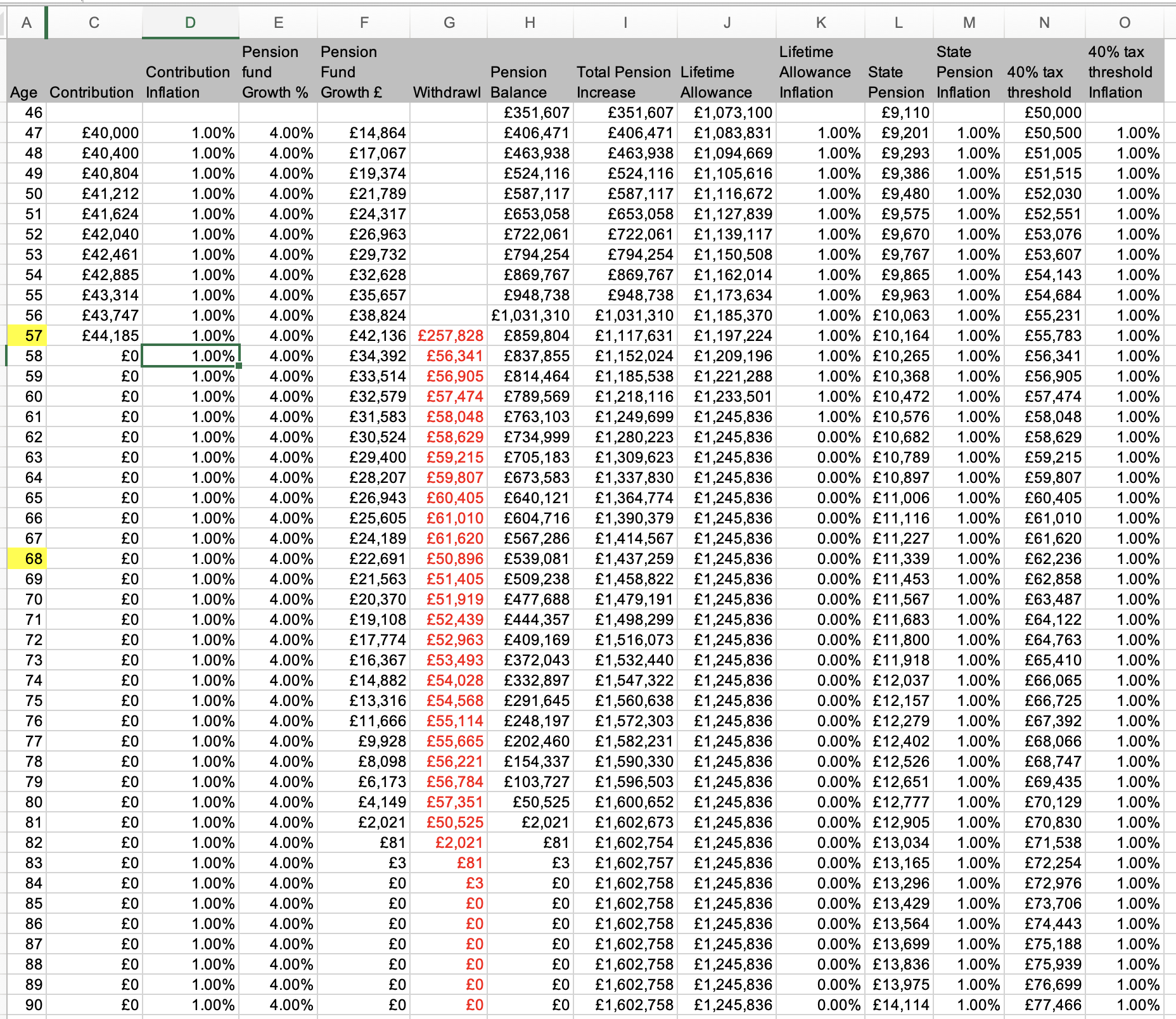
0 -
You could google BCE 5A. At a very high-level, if your fund is exactly equal to the LTA when you take 25% of it as a lump sum then if at age 75 the fund is more than 75% of the original LTA (i.e. when you took the lump sum so not adjusted for inflation) then there will be a one-off 25% tax charge on the excess. This is on top of normal tax when you withdraw the money.0
-
Just wanted to pick up on this one.Cus said:Agree, not much in it when over the LTA and then getting hit with 40% on withdrawal. If so, maybe balance the ISA and pension so you just hit the LTA. Having the lump in the ISA gives you flexibility to take earlier.
I max out my pension because I wish to minimise tax and of course because I'll need the money when there's no employment income. When the tax breaks are small, after LTA kicks in, it feels to me that I'd be better off finding ways to spend the money and ensure I benefit from it before I cop it. I'm not a big spender but the time all this starts to happen is when my 2 and 5 year old are starting to think about cars and university. I'd probably still be want to/be able to put £20k to an ISA but the other £20k could easily be spent.0 -
Blimey I've Googled a bit more, and, unwisley opened some nice Cognac, the two are incompatible but blliiiiimmmeeeeey this is complex. I mean really, crazily, badly explained in terms a layman can convert into dodgy spreadsheet formulae. I'm going to console myself in my previous observation that I can safely bury my head in the sand for the next 7 years (on the current rules) before LTA becomes a concern.Dead_keen said:You could google BCE 5A. At a very high-level, if your fund is exactly equal to the LTA when you take 25% of it as a lump sum then if at age 75 the fund is more than 75% of the original LTA (i.e. when you took the lump sum so not adjusted for inflation) then there will be a one-off 25% tax charge on the excess. This is on top of normal tax when you withdraw the money.
0









Confirm your email address to Create Threads and Reply

Categories
- All Categories
- 354.2K Banking & Borrowing
- 254.4K Reduce Debt & Boost Income
- 455.3K Spending & Discounts
- 247.2K Work, Benefits & Business
- 603.9K Mortgages, Homes & Bills
- 178.4K Life & Family
- 261.4K Travel & Transport
- 1.5M Hobbies & Leisure
- 16.1K Discuss & Feedback
- 37.7K Read-Only Boards