We’d like to remind Forumites to please avoid political debate on the Forum.
This is to keep it a safe and useful space for MoneySaving discussions. Threads that are – or become – political in nature may be removed in line with the Forum’s rules. Thank you for your understanding.
Adding more to Pension or Paying Mortgage off sooner



I'm also planning to move house (using a lump sum of inheritance). I was initially looking at taking out a mortgage over less years but I wondered if I'm better taking a mortgage out over the 17 years (with a view to retiring at 67) and paying less per month into the mortgage which would free up more of my funds to pay into my pension.
Any advice would be appreciated - thanks
Comments
-
This is a very common question on this forum .
Normally the rational financial thing to do is to increase contributions to your pension, but emotionally people like to get the mortgage paid asap .
The decision is also affected by your perceived job security ( if not great then mortgage should come first ), the current interest rate and LTV with your mortgage.
For you personally having very little pension at 50 is not good, so it could swing in that direction. You are limited though in how much you can contribute by your salary level . On the other hand if you have a good salary and are paying higher rate tax this would push further towards the pension route.2 -
Statistically, you would expect the pension to return more than you pay in interest on the mortgage given the interest rates over the last 15 years.
If you are a higher rate taxpayer, even more so. If you are basic rate taxpayer than you can always hedge your bets by going for the full term on the mortgage but overpay and increase your pensionI am an Independent Financial Adviser (IFA). The comments I make are just my opinion and are for discussion purposes only. They are not financial advice and you should not treat them as such. If you feel an area discussed may be relevant to you, then please seek advice from an Independent Financial Adviser local to you.2 -
I'm having a similar conundrum. Currently have no mortgage but around 1.3m in isas and sipps. Thinking of buying a bigger house, additional 400k, and taking out a 10 year fixed rate mortgage for about 200k. Planning to stop work in 2 or 3 years so need to borrow the money before I stop.It's just my opinion and not advice.0
-
Thank you Albermarle and Dunstonh - that's helpful.0
-
How certain are you that you'll still be employed in your role at 67. In later life many people, in the private sector, find themselves encountering a change in circumstances that's often difficult to adjust to.0
-
I'm no more certain of that than I am that I'll be alive at 67 but I have to have some kind of plan in place.Thrugelmir said:How certain are you that you'll still be employed in your role at 67. In later life many people, in the private sector, find themselves encountering a change in circumstances that's often difficult to adjust to.0 -
The nature of your employment , the future of the organisation itself, the manner in which employees are treated are all factors that can be weighed up. For people in later life that lose their jobs. It's often not finding another job which is the issue. It's finding one that pays a similar level of remuneration. Comes as a shock to discover than you aren't in fact indispensable.Mcnoo said:
I'm no more certain of that than I am that I'll be alive at 67 but I have to have some kind of plan in place.Thrugelmir said:How certain are you that you'll still be employed in your role at 67. In later life many people, in the private sector, find themselves encountering a change in circumstances that's often difficult to adjust to.
Dying is predictable and can be planned for. We all hang by a thread every day of our lives.0 -
I agree that is a mental/security/reassurance issue. Over the years, many people well under the pension LTA, have wasted thousands by paying off mortgages using their earnings that they have already paid the tax & NI on, in order to reduce the term on a very low mortgage interest rate. In most cases, they'd be better off with 'interest only' and paying the same over-payment (pre-tax/NI) into a pension (instead of mortgage over-pay). With past compound interest, the additional pension would be worth double the mortgage capital @ 20 years, thus enabling you to pay off the mortgage and have the equivalent of the mortgage size left as additional pension (for the same outlay). Someone clever on here could do the maths on an excel sheet to demonstrate...0
-
itsmeagain said:...With past compound interest, the additional pension would be worth double the mortgage capital @ 20 years, thus enabling you to pay off the mortgage and have the equivalent of the mortgage size left as additional pension (for the same outlay). Someone clever on here could do the maths on an excel sheet to demonstrate...
I've done those calcs before in a spreadsheet. I don't claim to be clever, but I do like a good spreadsheet.
Example…
Mortgage:
Amount: £100,000
APR: 2%
Months: 240 (20 years)Pension
Growth: 6% (gross, as inflation isn't a factor as your mortgage doesn't increase with inflation)
Salary Sacrifice (as that's what I have): 20% tax, 12% NI.
Net Payment: Equivalent to the capital repayment part of mortgage = £339.22 (£498.65 gross)The Red and Green bars are a typical repayment mortgage, you'll have 100% paid off (equity) @ 20 years. The Blue bars is the pension for the equivalent cost, which in this case will be worth £230,396, so more than double the mortgage capital @ 20 years.
With these parameters, for a 40% tax payer, the pension wins x2.88. This can go even higher with optimised NI salary sacrifice and even more if HICBC is applicable.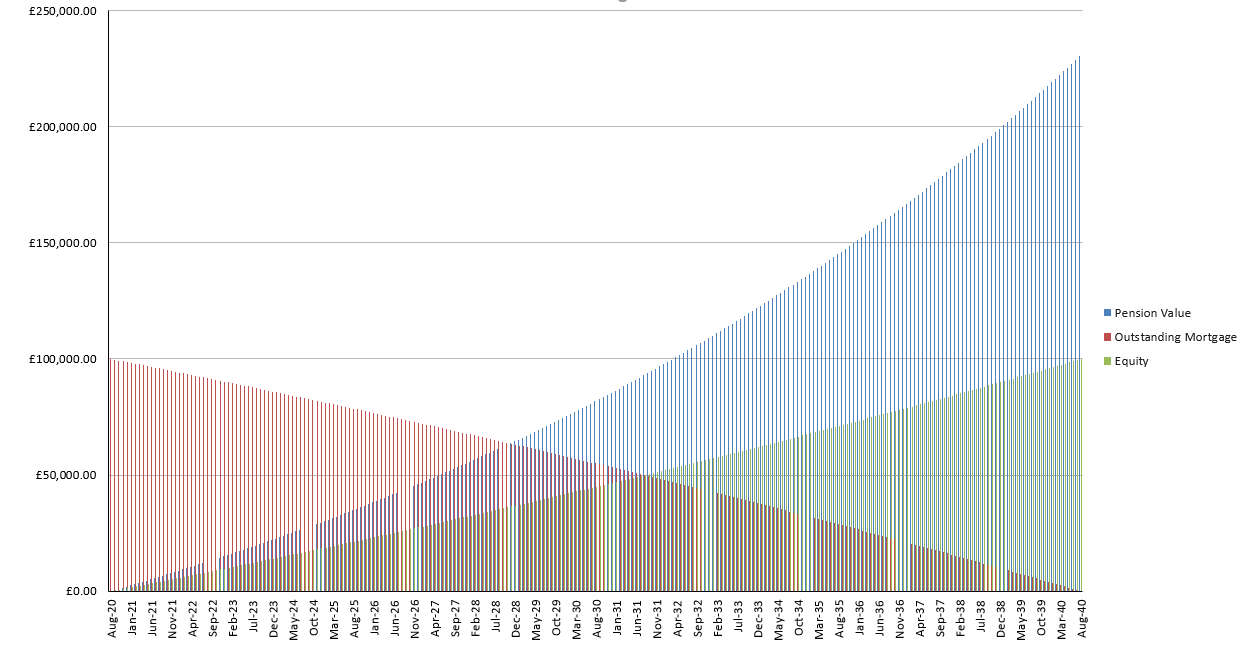
Also, without salary sacrifice (i.e. no NI savings), the pension works out at £196k, so @itsmeagain was very close with his double estimate.2 -
Thanks Bemma - I crown you 'the clever one' and saved me the job!
My example was approximate worst benefit (20% and no SS as per most self employed).
I've seen those threads entitled 'mortgage free wannabe' and I've never plucked up the courage to say - "no you don't"!
If you are going to include the data for the 40% payers, it's worth pointing out that if you have children, you may have also lost out on child allowance too (or whatever its called).
If you can afford to over pay your mortgage, you can afford to pay it in pension and get below the threshold to re-gain child allowance.
Bemma - would you be happy to share your xls with some cells highlighted 'enter your own data / assumptions here' or as 'the clever one' is it a matlab script?
Shame they don't teach you all this at school but who would listen in a class about mortgages and pensions? Needs to be on the GSE maths syllabus.... "calculate how much better off you'd be after 20 years of paying the same money in your pension".... "calculate how many years early you could retire if you didn't buy all those costa coffees"...
If you are such a good earner with the cash flow to max out on £40k contribution or LTA - bad luck - consider it as a nice problem to have!1







Confirm your email address to Create Threads and Reply

Categories
- All Categories
- 354.4K Banking & Borrowing
- 254.4K Reduce Debt & Boost Income
- 455.4K Spending & Discounts
- 247.3K Work, Benefits & Business
- 604.1K Mortgages, Homes & Bills
- 178.5K Life & Family
- 261.6K Travel & Transport
- 1.5M Hobbies & Leisure
- 16K Discuss & Feedback
- 37.7K Read-Only Boards