We’d like to remind Forumites to please avoid political debate on the Forum.
This is to keep it a safe and useful space for MoneySaving discussions. Threads that are – or become – political in nature may be removed in line with the Forum’s rules. Thank you for your understanding.
📨 Have you signed up to the Forum's new Email Digest yet? Get a selection of trending threads sent straight to your inbox daily, weekly or monthly!
The Forum now has a brand new text editor, adding a bunch of handy features to use when creating posts. Read more in our how-to guide
Critique my IT SIPP Please
Comments
-
You might include in this head scratching exercise the fees you pay.Croeso69 said:Linton said:- perhaps the number of UK equity income funds is unnecessarily high. You will probably find you have a lot of duplication. Possibly UK equity as a % of the whole may be rather high.Me too. At some stage you get to the point where you have so many active managers that the above and below market return winners and losers balance out and you get market returns (before costs are taken out). At that point one would be better off with the cheapest tracker which gets market returns. I'm sure you're not at that point, but if you're paying substantial fees for something approaching market returns you might want to do something to reduce fees which on so much money over the next 20 years could add up to a lot.With such a high percentage in UK equity you're taking a bet that UK companies will do better than a global average of companies, because the rest of the world is putting its money into equities to reflect their worth/prospects etc. If everyone thought the UK equities would be better than global equities as an investment they'd be piling most of their money into UK equities, not about 6% of it. Whereas you've got about 70%. Might pay off, no one knows for sure. Essentially you're betting against the wisdom/guesswork of the rest of the investment community to a large extent. I think that logic holds water.1
-
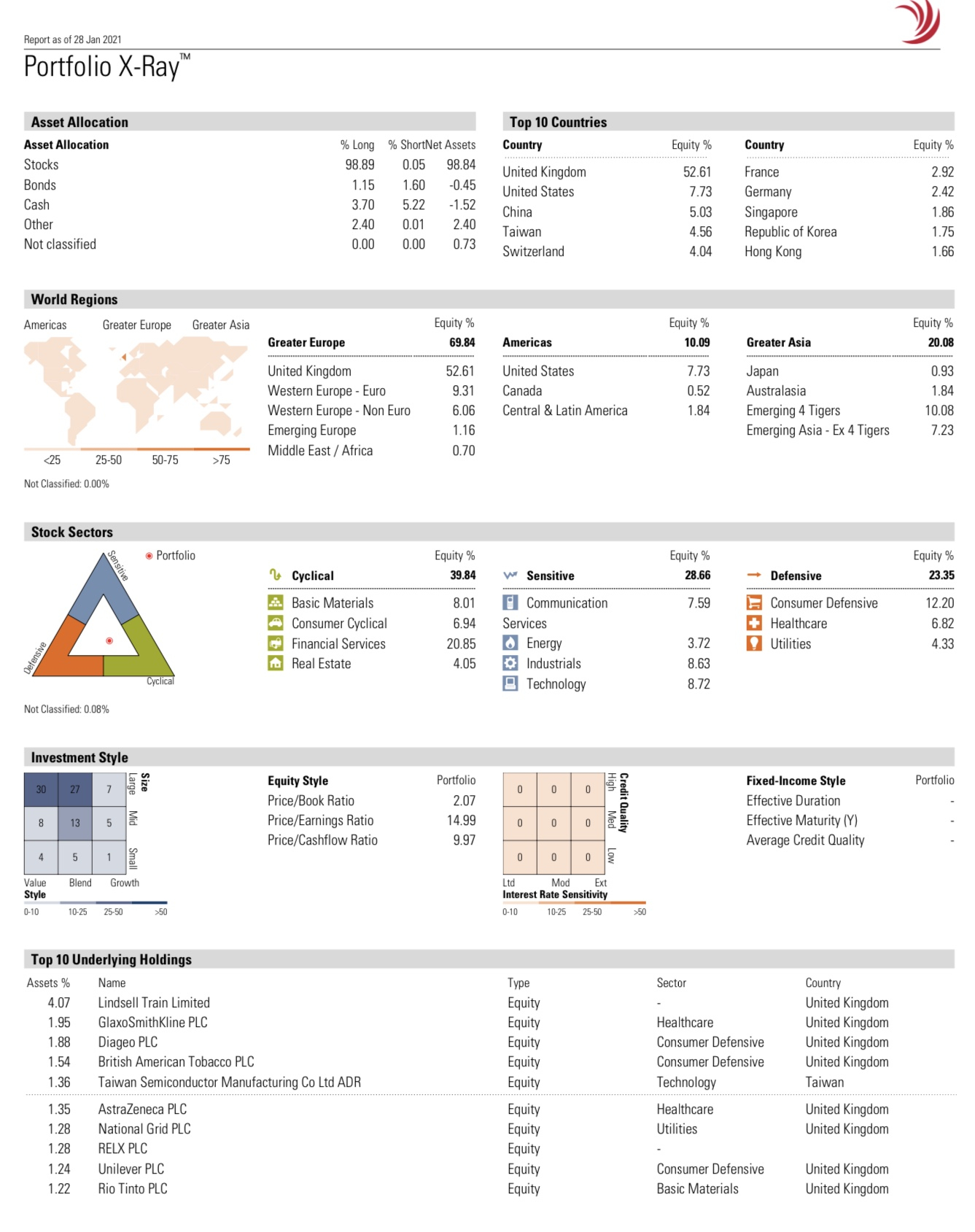
Approx 53% UK, underweight US ...
0 -
Yes, I wouldn't say 53% is crazy high. Here's something to chew on:'The author believes that this study makes a convincing case to seek a high exposure to global (or international) equities, while keeping a tilt towards domestic equities. Some readers might perceive otherwise, but should by now have more factual material to refine their thinking and possible temptations of home country bias.'
1 -
It does seem an old school portfolio where income from dividends is the key.
Nowadays I think the idea is to go for total return and sell shares to deliver income needs (that is what I do).
As such you will not be restricted to a heavy UK dividend style type of investing, I do believe that US companies have a heavy tax dis-incentive to provide dividends.2 -
In my view going 100% for selling shares when you need the cash is as sub-optimal as going 100% for dividends. The advantage of dividends/interest income is that is it more stable than capital value over the short/medium term and therefore can partially fulfil the role of guaranteed income producing a steady income stream with no effort on your part. As always in investing diversification is an important factor.Deleted_User said:It does seem an old school portfolio where income from dividends is the key.
Nowadays I think the idea is to go for total return and sell shares to deliver income needs (that is what I do).
As such you will not be restricted to a heavy UK dividend style type of investing, I do believe that US companies have a heavy tax dis-incentive to provide dividends.
The downside is that since the GFC returns have been lower than for tech-based growth though in the past, particularly in the tech boom/crash around 2000, dividend paying shares have performed better in the long term than growth.
You are not restricted to heavy UK investing, though UK equity generally is the best area for dividend income. There are good dividends available from Europe and the Far East. You can also get income from the US through bonds and more specialist investments. Yet again diversification is key to security.2











Confirm your email address to Create Threads and Reply

Categories
- All Categories
- 354.2K Banking & Borrowing
- 254.4K Reduce Debt & Boost Income
- 455.3K Spending & Discounts
- 247.2K Work, Benefits & Business
- 603.9K Mortgages, Homes & Bills
- 178.4K Life & Family
- 261.4K Travel & Transport
- 1.5M Hobbies & Leisure
- 16.1K Discuss & Feedback
- 37.7K Read-Only Boards