We’d like to remind Forumites to please avoid political debate on the Forum.
This is to keep it a safe and useful space for MoneySaving discussions. Threads that are – or become – political in nature may be removed in line with the Forum’s rules. Thank you for your understanding.
📨 Have you signed up to the Forum's new Email Digest yet? Get a selection of trending threads sent straight to your inbox daily, weekly or monthly!
The Forum now has a brand new text editor, adding a bunch of handy features to use when creating posts. Read more in our how-to guide
Employment law. Non compete / convene ats

Lukeedwards88
Posts: 67 Forumite



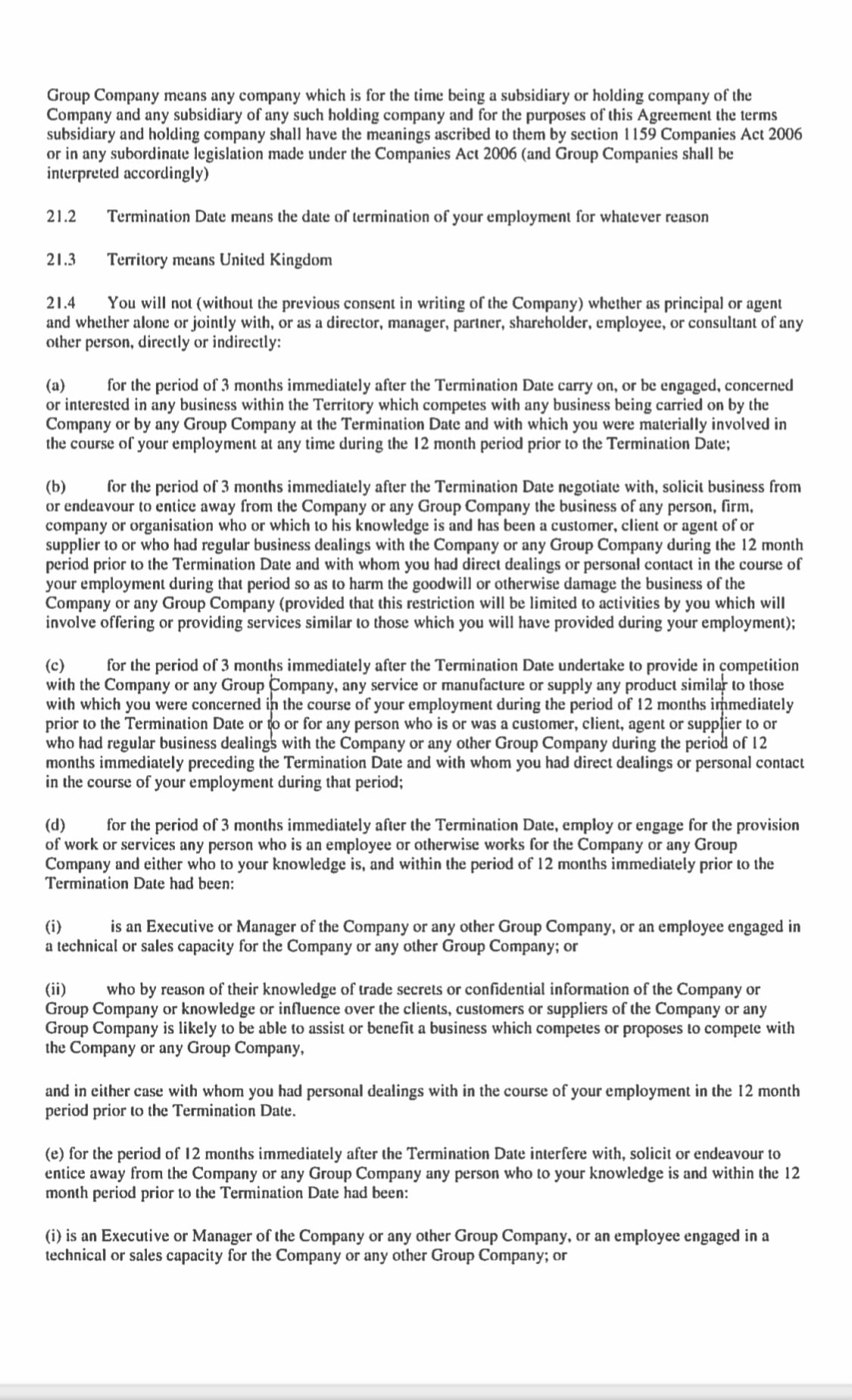 In it above I have some restrictive covenants in my contract.
 Been offered a role opportunity with a competitor.
I take it I wouldn’t be able to take it?
0
Comments
-
Not for three months, you wouldn't. Your current employer is likely to find out that you might be moving to a competitor if the competitor wants a reference for you.The comments I post are my personal opinion. While I try to check everything is correct before posting, I can and do make mistakes, so always try to check official information sources before relying on my posts.0
-
I would think that preventing your working for a competitor in any part of the UK (England, Wales, Scotland, Northern Ireland) is rathert wide. Some may therefore think this is unenforceable.
With full details of your own circumstances you could seek proper legal advice from someone with employment law as a specialism.0 -
Has to be worth asking the company - you could with their written consent.Lukeedwards88 said:In it above I have some restrictive covenants in my contract. Been offered a role opportunity with a competitor.I take it I wouldn’t be able to take it?Googling on your question might have been both quicker and easier, if you're only after simple facts rather than opinions!0 -
The basic legal position is that restrictive covenants will only be enforceable where they go no further than is necessary to protect the "legitimate business interests" of the employer.
The covenants in your contract will not be legally unenforceable if you are a junior or mid-level employee.
If you are a senior manager or executive who possesses confidential information that might be used to harm the business if taken to a competitor, they might be enforceable. Unless your employer is known to be litigious you could still take the role and just not make a song and dance about it.
Edited to fix a typo
0 -
I assume you meant to say "not be legally enforceable" in the line I have highlighted?steampowered said:The basic legal position is that restrictive covenants will only be enforceable where they go no further than is necessary to protect the "legitimate business interests" of the employer.
The covenants in your contract not be legally unenforceable if you are a junior or mid-level employee.
If you are a senior manager or executive who possesses confidential information that might be used to harm the business if taken to a competitor, they might be enforceable. Unless your employer is known to be litigious you could still take the role and just not make a song and dance about it.
Although I would tend to agree, that sadly doesn't stop a litigious employer throwing their weight around and / or contacting the new employer claiming that they have encouraged the OP to break the terms of a non competition agreement they chose to sign.
The new employer then has to decide if they are going to invest time and money in fighting or if they take the easy and safe option of dismissing and hiring somebody else.
It is never a good idea to sign a contract unless you are happy to accept its terms. Signing, but hoping it will prove unenforceable is fraught with problems even if you are ultimately proved to be correct.1 -
This subject has come up before and some have a different view to me. I have checked my position and our HR advisors - an industry leader - conforms that my understanding is correct.
Any restrictive covenant that is in your employment contract is, in effect not enforceable. The basis for this is that your employment contract - together with any and all terms therein - terminates when your employment ends. If an employer wants to impose a restrictive covenant that is enforceable beyond the term of your employment then this needs to be a separate / additional document. On that basis OP, I would be of the opinion that you take the offer if you wish.0 -
I agree with Undervalued.
You can take the new job as long as your start date is3 months after the date your contract with the current employer ends, and will be fully compliant with the restrictions.
You can take the new job if your employer gives their consent, and be fully compliant.
You can argue that the terms are unenforceable, and take the new job, in which case both you and your new employer risk the old employer taking a different view..
I suspect, that, depending on the nature of the business and of your role, they may well be unenforceable as the geographical area covered is so big (For instance, we have restrictive covenants in the contracts for some of our employees but they only prevent them working for a competitor within a 5 mile radius of any of our locations, which prevents someone setting up next door, but doesn't prevent them from getting a job with a competitor in a neighbouring town).
How close is the new employer?
All posts are my personal opinion, not formal advice Always get proper, professional advice (particularly about anything legal!)0 -
I haven't seen that argument anywhere else and tbh I'd be concerned that if you go with the argument that the restrictive covenants are separate from the contract of employment there is no consideration for the RCs and therefore they're not going to be contractually binding.MEM62 said:This subject has come up before and some have a different view to me. I have checked my position and our HR advisors - an industry leader - conforms that my understanding is correct.
Any restrictive covenant that is in your employment contract is, in effect not enforceable. The basis for this is that your employment contract - together with any and all terms therein - terminates when your employment ends. If an employer wants to impose a restrictive covenant that is enforceable beyond the term of your employment then this needs to be a separate / additional document. On that basis OP, I would be of the opinion that you take the offer if you wish.
If I were acting for the other side I'd certainly be running with that argument, though I'm not sure if it'd stand up.“I could see that, if not actually disgruntled, he was far from being gruntled.” - P.G. Wodehouse0 -
Contracts can state that certain provisions outlast the contract termination... these are common in data privacy sections as if I give a supplier some corporate sensitive information and we then go our separate ways we wouldnt want the termination of the contract for services to mean they can suddenly start selling our pricing formula or models etc.
As has been hinted at seniority is a consideration but also what your role is in the organisations... if your the IT helpdesk at a hospital and going to be a IT helpdesk manager at a private hospital its unlikely that most of these covernants will bite because you're not involved in winning new business or designing products etc.
What is also a consideration is your notice period etc... if you've a 3 month covenant like this and there is actual concern about what knowledge you have then often you'll have a 3 month notice period and as quickly as possible you are out the door and paid in lieu and so do get money to cover the period that you shouldnt be earning from others (which helps with enforceability).
The obvious solution, is to get written permission; if you're the national sales director and going to a direct competitor its unlikely they'll give it but if you are at the coal face and not in sales, marketing or product development then your prospects are much better.1 -
Unless they are basing their advice on a relevant ruling from a high enough court to set a legal precedent it does no such thing. I am not aware of such a ruling but by all means cite one if it exists?MEM62 said:This subject has come up before and some have a different view to me. I have checked my position and our HR advisors - an industry leader - conforms that my understanding is correct.
Any restrictive covenant that is in your employment contract is, in effect not enforceable. The basis for this is that your employment contract - together with any and all terms therein - terminates when your employment ends. If an employer wants to impose a restrictive covenant that is enforceable beyond the term of your employment then this needs to be a separate / additional document. On that basis OP, I would be of the opinion that you take the offer if you wish.
Otherwise, my view remains that you are wrong. Their advice may be good practice but I don't think it is any more than that.
There is no reason why some terms of a contract cannot exist for longer than others, in fact it is very common. Equally, an employment "contract" is far more than just a piece of paper with the word contract on it. In fact there doesn't even need to be a piece of paper at all for there to be a binding contract. If there is a piece of paper, it could perfectly well contain the terms of more than one "contract". If a contract has a number of terms it is perfectly normal to have a further term stating that if any term is subsequently proved to be invalid it does not invalidate the rest
And so on....1








Confirm your email address to Create Threads and Reply

Categories
- All Categories
- 354.4K Banking & Borrowing
- 254.4K Reduce Debt & Boost Income
- 455.4K Spending & Discounts
- 247.3K Work, Benefits & Business
- 604K Mortgages, Homes & Bills
- 178.4K Life & Family
- 261.5K Travel & Transport
- 1.5M Hobbies & Leisure
- 16K Discuss & Feedback
- 37.7K Read-Only Boards