We’d like to remind Forumites to please avoid political debate on the Forum.
This is to keep it a safe and useful space for MoneySaving discussions. Threads that are – or become – political in nature may be removed in line with the Forum’s rules. Thank you for your understanding.
How Much Could I Withdraw Annually
Comments
-
Agreed on your first point.shinytop said:Having a cash buffer may be in the same category as paying off a mortgage early. A mathematically poorer but psychologically superior choice.
On SWR, when we are working we often have variable incomes and always have variable expenses and most of us manage this just fine. Some of us even managed for years without inflation-matching pay rises (or even any pay rises). Why as retirees do we need a 100% guaranteed, constant, inflation-matching income for the next 30 years when we managed for the previous 30 without this? I suspect some of the SWR messaging may lead to people living below their means and dying rich instead of applying a bit of common sense to manage the ups and downs.
Regardign your second point, it's worth highlighting that you can have various SWRs including
1. One that allows an inflation-adjusted increased irrespective of what the market is doing
2. One that allows a higher SWR but you must accept fluctuations in income along the way.
But yes, agreed there is always the risk of dying with too much. The problem is, you don't know what is around the corner so cannot deplete your pot too much on the hope that good times will continue.....0 -
BritishInvestor said:
What in particular do you feel was too limiting in the scenarios?kinger101 said:
It's an interesting article, but too limited a set of scenarios to draw any firm conclusions. My understanding from a little playing around with cFireSim is that nobody would pick such a high bond allocation if they were basing their split on historic data.BritishInvestor said:
Medium term @5-10 years. With a withdrawal rate of say 3% that's approx 15-20% of the portfolio in cash? Even if you take it out of the defensive portion of the portfolio it's surely got to have an impact on the "average" outcome?Linton said:
1) Bonds covers a wide variety of different things. In addition after a small amount of thought there is cash, direct commercial property, BTL, commodities, art, whisky, what elsewhere has been called contracts - PFI/Solar/ Toll Roads, doctors surgeries and similar infrastructure-type assets where long term agreements exist to provide a service from ownership of the assets, financial wizardry of various forms, loans, private equity/investment as opposed to public shares. At the moment I rather like infrastructure long term income. Certainly a better prospect than safe government bonds.BritishInvestor said:
Sorry, decade should be centuryLinton said:
No strategy can handle a long term fall in the markets, if that is the scenario you are proposing. Though rising interest rates would benefit a cash buffer. If you havent got the returns at some stage you wont be able to pay yourself the income to meet your expenses. The best you can do is to diversify as much as possible - invest globally, invest in all sectors, invest in as many different types of asset and use as many different sources of income as you reasonably can.BritishInvestor said:
We are fortunate in that we have over a decade of historical market data to evaluate various strategies and outcomes. For example, imagine if you were an investor with a UK biased portfolio in the 1970s with the drawn out stock market slump and additional pressure being placed on the portfolio with rising interest rates. How much would you allocate to a cash buffer to cater for that?Linton said:
When you need your drawdown in order to meet your basic expenses, and the market drops 40-50% what would you do? Continue selling units but at twice the rate?michaels said:
I don't think it matters how matters how many times you point out the research on this, people still imagine you can have a nice cash pot to avoid 'drawdown' when markets are low - the same people who would claim they have no intention of ever trying to 'time the markets'....BritishInvestor said:
Why do you "need" a bigger cash buffer? How does it improve overall outcomes?Albermarle said:I would say the cash element is too low . Especially when you get to the point of drawing from the DC pension , you need a bigger cash buffer to get through market downturns.
The purpose of a cash buffer is to remove all risk in the medium term. During the recent COVID mini-crash many people on the savings forum were panicking. I was able to look on with a serene, possibly smug, smile despite my investments being essential for meeting a significant part of living expenses.
But investment strategies can only go so far, they cannot protect you from everything. Perhaps the best they can do is to help ensure that should the world as we know it collapse one is in at least as good if not better position as everyone else.
One detailed point - you talk about a decade of historical market data. That means absolutely nothing. The past decade has shown unprecedented rises in share prices and is very different to many previous decades. .
.
) I agree that you want diversify globally and across sectors but what asset classes did you have in mind other than equities and bonds?
2) When you say no strategy can survive a long term fall in the markets, we have historical data to suggest that strategies have done and for a given retirement date we can see exactly how each strategy played out
I don't see how the cash buffer removes all risk - how do you know in advance what inflation is likely to be? What is your definition of medium term?
3) Covid (thus far) was a blip and had minimal income on a robust retirement portfolio (it's the long drawn out downturns that have the biggest impact) - we must be clear to differentiate the impact on the portfolio with the impact on the investor - that's a separate discussion.
2) How can any strategy survive on long term zero or negative returns? All expenditure would need to be financed by selling assets which are finite. Similarly there is no way any strategy can handle global Weimar or Zimbabwe levels of inflation, except perhaps a rifle and an infinite supply of baked beans. At some stage you must just shrug your shoulders and say that you will sort it out when it happens. To set up an investment/retirement strategy that could handle the extremes could result in a gross distortion of asset allocation that would jeopardise your ability to handle normal events.
By medium term I am thinking 5-10 years. This will give more than enough time in almost all cases for economic circumstances to improve or for you to re-adjust your spending requirements to correspond with the new reality. A cash buffer cannot remove all risk, just the more immediate ones.
3) Yes the portfolio and the effect on you as an investor dependent on your investments are different facets of the equation. However the two are inextricably linked and in practice the latter is arguably the more important. For example having a large cash buffer could give you the confidence to invest at a higher risk/return basis than would otherwise be the case.
https://finalytiq.co.uk/cash-reserve-buffers-withdrawal-rates-old-wives-fables-retirement-portfolio/
3) By having a combination of a large pile of cash and a riskier portfolio I would suggest you are moving away from the most efficient portfolio. It goes back to my point on theoretical vs real world SWR I made a few days back.
There's a similar article here, which is also unsatisfactory in that many of the differences reported are unlikely to be statistically significant.
https://edrempel.com/reliably-maximize-retirement-income-4-rule-safe/
All of this is however is only historic data. So it's based on assumption that there will be no periods during retirement worse than the dataset used. Slightly more than a century of data suddenly doesn't seem much at all when we're taking possibly 4 decades of retirement. I'm sure a data scientist could come up with something better.
I'm not clear what you mean regarding high bond allocations with reference to historical scenarios.
Historical data may not be perfect, but it's all we currently have.
I'[m sure Abraham (author) would be very interested in what a data scientist could come up with considering he employs quants etc to help him build his market-leading retirement tool
They were very limited in that they looked at 50/50 and 50/40/10 splits. A data scientist would have written him a nice script that took every possible whole integer variant. They might have also suggested using monte carlo simulations using historic data as a basis but decreasing the mean return or increasing standard deviation by a small margin. They'd also report whether the differences in returns were statistically significant or not.
If they were really good, they'd also build some sort of tool that took account that someone's withdrawal rate might be higher early in retirement while they're waiting for SP and DB to kick in. Cfiresim does this, but only seems to use historic data.
Of course, this wouldn't be perfect. We cannot know the future. But it would be more robust IMO than assuming the future won't be worse than the past."Real knowledge is to know the extent of one's ignorance" - Confucius0 -
1) This could well be true but psychology in retirement is a rather more important consideration than paying off the mortgage earlier I think. The object of financial management during retirement is arguably to maximise one's well-being whilst alive rather than knowing on one's deathbed that you were a top financial performer. Minimising worry is an important part of this.shinytop said:1) Having a cash buffer may be in the same category as paying off a mortgage early. A mathematically poorer but psychologically superior choice.
2) On SWR, when we are working we often have variable incomes and always have variable expenses and most of us manage this just fine. Some of us even managed for years without inflation-matching pay rises (or even any pay rises). Why as retirees do we need a 100% guaranteed, constant, inflation-matching income for the next 30 years when we managed for the previous 30 without this? I suspect some of the SWR messaging may lead to people living below their means and dying rich instead of applying a bit of common sense to manage the ups and downs.
Also any portfolio during retirement is more likely to be 60% equity rather than 100%. In my financial accounting I regard cash holdings as part of the non-equity tranche so there is no extra reduction in the equity investment which, because of the cash buffer, can be more focussed towards maximising growth than would otherwise be the case. Using cash as part of the non-equity in a portfolio makes particular sense at the moment as it could provide better future returns than safe government bonds and with less capital volatility.
2) A key advantage that people in work have is that they have much more ability and time to change their financial situation (eg getting a new job or delaying retirement) than retirees who generally are stuck with the assets they retired with. Also people in work are likely to have lower basic day-to-day spending as a % of their income than those in retirement and so are less vulnerable to income variation.
But yes, planning to significantly limit the risk of running out of money must lead in the vast majority of cases to having unused assets when one dies, that is simple mathematics. This can be at least partially mitigated by replanning each year taking into account your actual finances and reducing future life expectancy over time. Blindly running on the initial SWR would be foolish as it is unnecessary.
Another way of managing this is to plan on a reducing but still viable expenditure during retirement. This is not because you believe that your expenditure will actually decrease but rather that you should be able to benefit from some of the dire circumstances you planned for failing to occur.
1 -
Instead of bonds or cash how about a level annuity for that part of the portfolio with the rest being equities?
At least that part of the income would be a known amount.2 -
Abraham will have no doubt run it for all scenarios (he is very thorough like thatkinger101 said:BritishInvestor said:
What in particular do you feel was too limiting in the scenarios?kinger101 said:
It's an interesting article, but too limited a set of scenarios to draw any firm conclusions. My understanding from a little playing around with cFireSim is that nobody would pick such a high bond allocation if they were basing their split on historic data.BritishInvestor said:
Medium term @5-10 years. With a withdrawal rate of say 3% that's approx 15-20% of the portfolio in cash? Even if you take it out of the defensive portion of the portfolio it's surely got to have an impact on the "average" outcome?Linton said:
1) Bonds covers a wide variety of different things. In addition after a small amount of thought there is cash, direct commercial property, BTL, commodities, art, whisky, what elsewhere has been called contracts - PFI/Solar/ Toll Roads, doctors surgeries and similar infrastructure-type assets where long term agreements exist to provide a service from ownership of the assets, financial wizardry of various forms, loans, private equity/investment as opposed to public shares. At the moment I rather like infrastructure long term income. Certainly a better prospect than safe government bonds.BritishInvestor said:
Sorry, decade should be centuryLinton said:
No strategy can handle a long term fall in the markets, if that is the scenario you are proposing. Though rising interest rates would benefit a cash buffer. If you havent got the returns at some stage you wont be able to pay yourself the income to meet your expenses. The best you can do is to diversify as much as possible - invest globally, invest in all sectors, invest in as many different types of asset and use as many different sources of income as you reasonably can.BritishInvestor said:
We are fortunate in that we have over a decade of historical market data to evaluate various strategies and outcomes. For example, imagine if you were an investor with a UK biased portfolio in the 1970s with the drawn out stock market slump and additional pressure being placed on the portfolio with rising interest rates. How much would you allocate to a cash buffer to cater for that?Linton said:
When you need your drawdown in order to meet your basic expenses, and the market drops 40-50% what would you do? Continue selling units but at twice the rate?michaels said:
I don't think it matters how matters how many times you point out the research on this, people still imagine you can have a nice cash pot to avoid 'drawdown' when markets are low - the same people who would claim they have no intention of ever trying to 'time the markets'....BritishInvestor said:
Why do you "need" a bigger cash buffer? How does it improve overall outcomes?Albermarle said:I would say the cash element is too low . Especially when you get to the point of drawing from the DC pension , you need a bigger cash buffer to get through market downturns.
The purpose of a cash buffer is to remove all risk in the medium term. During the recent COVID mini-crash many people on the savings forum were panicking. I was able to look on with a serene, possibly smug, smile despite my investments being essential for meeting a significant part of living expenses.
But investment strategies can only go so far, they cannot protect you from everything. Perhaps the best they can do is to help ensure that should the world as we know it collapse one is in at least as good if not better position as everyone else.
One detailed point - you talk about a decade of historical market data. That means absolutely nothing. The past decade has shown unprecedented rises in share prices and is very different to many previous decades..
) I agree that you want diversify globally and across sectors but what asset classes did you have in mind other than equities and bonds?
2) When you say no strategy can survive a long term fall in the markets, we have historical data to suggest that strategies have done and for a given retirement date we can see exactly how each strategy played out
I don't see how the cash buffer removes all risk - how do you know in advance what inflation is likely to be? What is your definition of medium term?
3) Covid (thus far) was a blip and had minimal income on a robust retirement portfolio (it's the long drawn out downturns that have the biggest impact) - we must be clear to differentiate the impact on the portfolio with the impact on the investor - that's a separate discussion.
2) How can any strategy survive on long term zero or negative returns? All expenditure would need to be financed by selling assets which are finite. Similarly there is no way any strategy can handle global Weimar or Zimbabwe levels of inflation, except perhaps a rifle and an infinite supply of baked beans. At some stage you must just shrug your shoulders and say that you will sort it out when it happens. To set up an investment/retirement strategy that could handle the extremes could result in a gross distortion of asset allocation that would jeopardise your ability to handle normal events.
By medium term I am thinking 5-10 years. This will give more than enough time in almost all cases for economic circumstances to improve or for you to re-adjust your spending requirements to correspond with the new reality. A cash buffer cannot remove all risk, just the more immediate ones.
3) Yes the portfolio and the effect on you as an investor dependent on your investments are different facets of the equation. However the two are inextricably linked and in practice the latter is arguably the more important. For example having a large cash buffer could give you the confidence to invest at a higher risk/return basis than would otherwise be the case.
https://finalytiq.co.uk/cash-reserve-buffers-withdrawal-rates-old-wives-fables-retirement-portfolio/
3) By having a combination of a large pile of cash and a riskier portfolio I would suggest you are moving away from the most efficient portfolio. It goes back to my point on theoretical vs real world SWR I made a few days back.
There's a similar article here, which is also unsatisfactory in that many of the differences reported are unlikely to be statistically significant.
https://edrempel.com/reliably-maximize-retirement-income-4-rule-safe/
All of this is however is only historic data. So it's based on assumption that there will be no periods during retirement worse than the dataset used. Slightly more than a century of data suddenly doesn't seem much at all when we're taking possibly 4 decades of retirement. I'm sure a data scientist could come up with something better.
I'm not clear what you mean regarding high bond allocations with reference to historical scenarios.
Historical data may not be perfect, but it's all we currently have.
I'[m sure Abraham (author) would be very interested in what a data scientist could come up with considering he employs quants etc to help him build his market-leading retirement tool
They were very limited in that they looked at 50/50 and 50/40/10 splits. A data scientist would have written him a nice script that took every possible whole integer variant. They might have also suggested using monte carlo simulations using historic data as a basis but decreasing the mean return or increasing standard deviation by a small margin. They'd also report whether the differences in returns were statistically significant or not.
If they were really good, they'd also build some sort of tool that took account that someone's withdrawal rate might be higher early in retirement while they're waiting for SP and DB to kick in. Cfiresim does this, but only seems to use historic data.
Of course, this wouldn't be perfect. We cannot know the future. But it would be more robust IMO than assuming the future won't be worse than the past.) and it would be trivial to undertaken given he has the underlying data, but a "typical" person reading a huge article with all the data in would probably fall asleep. I think it gets the point across well considering the target audience.
Given the dataset (>100 years with monthly samples), I'm not sure what Monte Carlo would bring to the party. Real data is fact, Monte Carlo inputs are opinions. Note that I'm not against Monte Carlo modelling, and have written a few for "fun", but having seen first hand how assumptions can drive suboptimal outcomes, if sufficient actual data is available I would take that.
They have a tool available that works out withdrawal rate given changing expenditure requirements.
We'll agree to disagree on our vision of perfect and the imperfect solutions we currently have 0 -
Well, my magic spreaddie suggests you could likely take 2k+ pcm and still have a shout at reaching 100 intactnumpty_dumpty said:Currently 51, what does the hive mind think I could pay myself annually if I jumped next year at 52 based on the numbers below:-
Currently have £470k between DC pensions S&S ISA and cash, will add about £30k before 52, so say £500k at 52.
Will get a 7k DB pension at 60 and full state pension (9.1k) at 6
I have my own number but I'm interested to see what others make of it in comparison.
MANY variables not covered....don't know what of that 500k pot is DC versus the rest, can't therefore really account for tax (ignoring tax suggests 30k pa, or 2.5k pcm)
....but using broad & what I (personally) would consider cautious growth in the pot of just 3%, inflation at 2.1%, you can see the numbers here: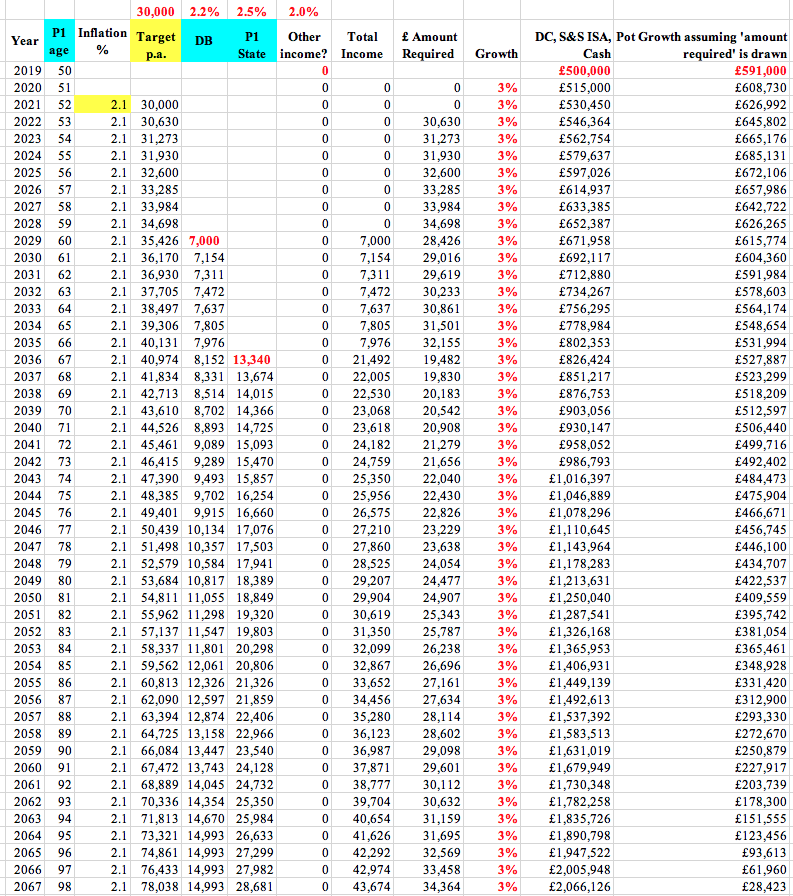
Impossible to get more technical than this, I would suggest, without a lot more detail - but this sort of question was the reason I built the spreaddie!
HTH!
Plan for tomorrow, enjoy today!2 -
Hasn't been possible to trade global equities or investments freely over the past century. US studies are US centric. A UK investor with the same starting portfolio would have experienced a very different outcome. Once exchange rates and taxation (on foreign income) was factored in.BritishInvestor said:
Abraham will have no doubt run it for all scenarios (he is very thorough like thatkinger101 said:BritishInvestor said:
What in particular do you feel was too limiting in the scenarios?kinger101 said:
It's an interesting article, but too limited a set of scenarios to draw any firm conclusions. My understanding from a little playing around with cFireSim is that nobody would pick such a high bond allocation if they were basing their split on historic data.BritishInvestor said:
Medium term @5-10 years. With a withdrawal rate of say 3% that's approx 15-20% of the portfolio in cash? Even if you take it out of the defensive portion of the portfolio it's surely got to have an impact on the "average" outcome?Linton said:
1) Bonds covers a wide variety of different things. In addition after a small amount of thought there is cash, direct commercial property, BTL, commodities, art, whisky, what elsewhere has been called contracts - PFI/Solar/ Toll Roads, doctors surgeries and similar infrastructure-type assets where long term agreements exist to provide a service from ownership of the assets, financial wizardry of various forms, loans, private equity/investment as opposed to public shares. At the moment I rather like infrastructure long term income. Certainly a better prospect than safe government bonds.BritishInvestor said:
Sorry, decade should be centuryLinton said:
No strategy can handle a long term fall in the markets, if that is the scenario you are proposing. Though rising interest rates would benefit a cash buffer. If you havent got the returns at some stage you wont be able to pay yourself the income to meet your expenses. The best you can do is to diversify as much as possible - invest globally, invest in all sectors, invest in as many different types of asset and use as many different sources of income as you reasonably can.BritishInvestor said:
We are fortunate in that we have over a decade of historical market data to evaluate various strategies and outcomes. For example, imagine if you were an investor with a UK biased portfolio in the 1970s with the drawn out stock market slump and additional pressure being placed on the portfolio with rising interest rates. How much would you allocate to a cash buffer to cater for that?Linton said:
When you need your drawdown in order to meet your basic expenses, and the market drops 40-50% what would you do? Continue selling units but at twice the rate?michaels said:
I don't think it matters how matters how many times you point out the research on this, people still imagine you can have a nice cash pot to avoid 'drawdown' when markets are low - the same people who would claim they have no intention of ever trying to 'time the markets'....BritishInvestor said:
Why do you "need" a bigger cash buffer? How does it improve overall outcomes?Albermarle said:I would say the cash element is too low . Especially when you get to the point of drawing from the DC pension , you need a bigger cash buffer to get through market downturns.
The purpose of a cash buffer is to remove all risk in the medium term. During the recent COVID mini-crash many people on the savings forum were panicking. I was able to look on with a serene, possibly smug, smile despite my investments being essential for meeting a significant part of living expenses.
But investment strategies can only go so far, they cannot protect you from everything. Perhaps the best they can do is to help ensure that should the world as we know it collapse one is in at least as good if not better position as everyone else.
One detailed point - you talk about a decade of historical market data. That means absolutely nothing. The past decade has shown unprecedented rises in share prices and is very different to many previous decades..
) I agree that you want diversify globally and across sectors but what asset classes did you have in mind other than equities and bonds?
2) When you say no strategy can survive a long term fall in the markets, we have historical data to suggest that strategies have done and for a given retirement date we can see exactly how each strategy played out
I don't see how the cash buffer removes all risk - how do you know in advance what inflation is likely to be? What is your definition of medium term?
3) Covid (thus far) was a blip and had minimal income on a robust retirement portfolio (it's the long drawn out downturns that have the biggest impact) - we must be clear to differentiate the impact on the portfolio with the impact on the investor - that's a separate discussion.
2) How can any strategy survive on long term zero or negative returns? All expenditure would need to be financed by selling assets which are finite. Similarly there is no way any strategy can handle global Weimar or Zimbabwe levels of inflation, except perhaps a rifle and an infinite supply of baked beans. At some stage you must just shrug your shoulders and say that you will sort it out when it happens. To set up an investment/retirement strategy that could handle the extremes could result in a gross distortion of asset allocation that would jeopardise your ability to handle normal events.
By medium term I am thinking 5-10 years. This will give more than enough time in almost all cases for economic circumstances to improve or for you to re-adjust your spending requirements to correspond with the new reality. A cash buffer cannot remove all risk, just the more immediate ones.
3) Yes the portfolio and the effect on you as an investor dependent on your investments are different facets of the equation. However the two are inextricably linked and in practice the latter is arguably the more important. For example having a large cash buffer could give you the confidence to invest at a higher risk/return basis than would otherwise be the case.
https://finalytiq.co.uk/cash-reserve-buffers-withdrawal-rates-old-wives-fables-retirement-portfolio/
3) By having a combination of a large pile of cash and a riskier portfolio I would suggest you are moving away from the most efficient portfolio. It goes back to my point on theoretical vs real world SWR I made a few days back.
There's a similar article here, which is also unsatisfactory in that many of the differences reported are unlikely to be statistically significant.
https://edrempel.com/reliably-maximize-retirement-income-4-rule-safe/
All of this is however is only historic data. So it's based on assumption that there will be no periods during retirement worse than the dataset used. Slightly more than a century of data suddenly doesn't seem much at all when we're taking possibly 4 decades of retirement. I'm sure a data scientist could come up with something better.
I'm not clear what you mean regarding high bond allocations with reference to historical scenarios.
Historical data may not be perfect, but it's all we currently have.
I'[m sure Abraham (author) would be very interested in what a data scientist could come up with considering he employs quants etc to help him build his market-leading retirement tool
They were very limited in that they looked at 50/50 and 50/40/10 splits. A data scientist would have written him a nice script that took every possible whole integer variant. They might have also suggested using monte carlo simulations using historic data as a basis but decreasing the mean return or increasing standard deviation by a small margin. They'd also report whether the differences in returns were statistically significant or not.
If they were really good, they'd also build some sort of tool that took account that someone's withdrawal rate might be higher early in retirement while they're waiting for SP and DB to kick in. Cfiresim does this, but only seems to use historic data.
Of course, this wouldn't be perfect. We cannot know the future. But it would be more robust IMO than assuming the future won't be worse than the past.) and it would be trivial to undertaken given he has the underlying data, but a "typical" person reading a huge article with all the data in would probably fall asleep. I think it gets the point across well considering the target audience.
Given the dataset (>100 years with monthly samples), I'm not sure what Monte Carlo would bring to the party. Real data is fact, Monte Carlo inputs are opinions. Note that I'm not against Monte Carlo modelling, and have written a few for "fun", but having seen first hand how assumptions can drive suboptimal outcomes, if sufficient actual data is available I would take that.
They have a tool available that works out withdrawal rate given changing expenditure requirements.
We'll agree to disagree on our vision of perfect and the imperfect solutions we currently have0 -
A cash buffer has intuitive appeal but in general the studies that I have read show no benefit from using a cash buffer approach. At a high level, the advantage of using a buffer to reduce or eliminate withdrawals in down years are outweighed by the disadvantage of taking cash away from your portfolio and forgoing investment growth.
I think one issue with the studies is that the return used for cash is usually money market rates. For institutional investors holding cash, this is a realistic return metric but for retail investors holding cash outside a pension wrapper, it underestimates the returns that can be achieved. I have not seen any studies where, for example, cash is put in a ladder of the market leading fixed term retail accounts. If, in addition, this cash in a fixed term ladder is included in the bond element of a 60:40 portfolio, there would be times, such as now, when the return achieved by the fixed term ladder would exceed that of bonds and there would be an advantage in holding cash in this manner. As the studies have not been done, it would be a matter of speculation whether this approach would have the same disadvantage as holding cash at money market rates outside a portfolio.
1 -
In terms of verifying whether the historical data is valid. We have historical global returns in GBP and UK inflation. Why do you feel it is invalid from a UK POV? Not sure why historical taxes are relevant?Thrugelmir said:
Hasn't been possible to trade global equities or investments freely over the past century. US studies are US centric. A UK investor with the same starting portfolio would have experienced a very different outcome. Once exchange rates and taxation (on foreign income) was factored in.BritishInvestor said:
Abraham will have no doubt run it for all scenarios (he is very thorough like thatkinger101 said:BritishInvestor said:
What in particular do you feel was too limiting in the scenarios?kinger101 said:
It's an interesting article, but too limited a set of scenarios to draw any firm conclusions. My understanding from a little playing around with cFireSim is that nobody would pick such a high bond allocation if they were basing their split on historic data.BritishInvestor said:
Medium term @5-10 years. With a withdrawal rate of say 3% that's approx 15-20% of the portfolio in cash? Even if you take it out of the defensive portion of the portfolio it's surely got to have an impact on the "average" outcome?Linton said:
1) Bonds covers a wide variety of different things. In addition after a small amount of thought there is cash, direct commercial property, BTL, commodities, art, whisky, what elsewhere has been called contracts - PFI/Solar/ Toll Roads, doctors surgeries and similar infrastructure-type assets where long term agreements exist to provide a service from ownership of the assets, financial wizardry of various forms, loans, private equity/investment as opposed to public shares. At the moment I rather like infrastructure long term income. Certainly a better prospect than safe government bonds.BritishInvestor said:
Sorry, decade should be centuryLinton said:
No strategy can handle a long term fall in the markets, if that is the scenario you are proposing. Though rising interest rates would benefit a cash buffer. If you havent got the returns at some stage you wont be able to pay yourself the income to meet your expenses. The best you can do is to diversify as much as possible - invest globally, invest in all sectors, invest in as many different types of asset and use as many different sources of income as you reasonably can.BritishInvestor said:
We are fortunate in that we have over a decade of historical market data to evaluate various strategies and outcomes. For example, imagine if you were an investor with a UK biased portfolio in the 1970s with the drawn out stock market slump and additional pressure being placed on the portfolio with rising interest rates. How much would you allocate to a cash buffer to cater for that?Linton said:
When you need your drawdown in order to meet your basic expenses, and the market drops 40-50% what would you do? Continue selling units but at twice the rate?michaels said:
I don't think it matters how matters how many times you point out the research on this, people still imagine you can have a nice cash pot to avoid 'drawdown' when markets are low - the same people who would claim they have no intention of ever trying to 'time the markets'....BritishInvestor said:
Why do you "need" a bigger cash buffer? How does it improve overall outcomes?Albermarle said:I would say the cash element is too low . Especially when you get to the point of drawing from the DC pension , you need a bigger cash buffer to get through market downturns.
The purpose of a cash buffer is to remove all risk in the medium term. During the recent COVID mini-crash many people on the savings forum were panicking. I was able to look on with a serene, possibly smug, smile despite my investments being essential for meeting a significant part of living expenses.
But investment strategies can only go so far, they cannot protect you from everything. Perhaps the best they can do is to help ensure that should the world as we know it collapse one is in at least as good if not better position as everyone else.
One detailed point - you talk about a decade of historical market data. That means absolutely nothing. The past decade has shown unprecedented rises in share prices and is very different to many previous decades..
) I agree that you want diversify globally and across sectors but what asset classes did you have in mind other than equities and bonds?
2) When you say no strategy can survive a long term fall in the markets, we have historical data to suggest that strategies have done and for a given retirement date we can see exactly how each strategy played out
I don't see how the cash buffer removes all risk - how do you know in advance what inflation is likely to be? What is your definition of medium term?
3) Covid (thus far) was a blip and had minimal income on a robust retirement portfolio (it's the long drawn out downturns that have the biggest impact) - we must be clear to differentiate the impact on the portfolio with the impact on the investor - that's a separate discussion.
2) How can any strategy survive on long term zero or negative returns? All expenditure would need to be financed by selling assets which are finite. Similarly there is no way any strategy can handle global Weimar or Zimbabwe levels of inflation, except perhaps a rifle and an infinite supply of baked beans. At some stage you must just shrug your shoulders and say that you will sort it out when it happens. To set up an investment/retirement strategy that could handle the extremes could result in a gross distortion of asset allocation that would jeopardise your ability to handle normal events.
By medium term I am thinking 5-10 years. This will give more than enough time in almost all cases for economic circumstances to improve or for you to re-adjust your spending requirements to correspond with the new reality. A cash buffer cannot remove all risk, just the more immediate ones.
3) Yes the portfolio and the effect on you as an investor dependent on your investments are different facets of the equation. However the two are inextricably linked and in practice the latter is arguably the more important. For example having a large cash buffer could give you the confidence to invest at a higher risk/return basis than would otherwise be the case.
https://finalytiq.co.uk/cash-reserve-buffers-withdrawal-rates-old-wives-fables-retirement-portfolio/
3) By having a combination of a large pile of cash and a riskier portfolio I would suggest you are moving away from the most efficient portfolio. It goes back to my point on theoretical vs real world SWR I made a few days back.
There's a similar article here, which is also unsatisfactory in that many of the differences reported are unlikely to be statistically significant.
https://edrempel.com/reliably-maximize-retirement-income-4-rule-safe/
All of this is however is only historic data. So it's based on assumption that there will be no periods during retirement worse than the dataset used. Slightly more than a century of data suddenly doesn't seem much at all when we're taking possibly 4 decades of retirement. I'm sure a data scientist could come up with something better.
I'm not clear what you mean regarding high bond allocations with reference to historical scenarios.
Historical data may not be perfect, but it's all we currently have.
I'[m sure Abraham (author) would be very interested in what a data scientist could come up with considering he employs quants etc to help him build his market-leading retirement tool
They were very limited in that they looked at 50/50 and 50/40/10 splits. A data scientist would have written him a nice script that took every possible whole integer variant. They might have also suggested using monte carlo simulations using historic data as a basis but decreasing the mean return or increasing standard deviation by a small margin. They'd also report whether the differences in returns were statistically significant or not.
If they were really good, they'd also build some sort of tool that took account that someone's withdrawal rate might be higher early in retirement while they're waiting for SP and DB to kick in. Cfiresim does this, but only seems to use historic data.
Of course, this wouldn't be perfect. We cannot know the future. But it would be more robust IMO than assuming the future won't be worse than the past.) and it would be trivial to undertaken given he has the underlying data, but a "typical" person reading a huge article with all the data in would probably fall asleep. I think it gets the point across well considering the target audience.
Given the dataset (>100 years with monthly samples), I'm not sure what Monte Carlo would bring to the party. Real data is fact, Monte Carlo inputs are opinions. Note that I'm not against Monte Carlo modelling, and have written a few for "fun", but having seen first hand how assumptions can drive suboptimal outcomes, if sufficient actual data is available I would take that.
They have a tool available that works out withdrawal rate given changing expenditure requirements.
We'll agree to disagree on our vision of perfect and the imperfect solutions we currently have
For today's investor, they are able to trade global indices (with reasonable approximation) and we know what current taxes are so we can work out an approximation of net SWR from gross SWR
0 -
I think these are really important points that the examples sometimes neglect. A retail investor is able to achieve more with cash than simply using the money market. I have consistently seen my cash savings rise in line with CPIH. Even now my cash is still averaging just under 2% with yearly CPIH about the same.coyrls said:A cash buffer has intuitive appeal but in general the studies that I have read show no benefit from using a cash buffer approach. At a high level, the advantage of using a buffer to reduce or eliminate withdrawals in down years are outweighed by the disadvantage of taking cash away from your portfolio and forgoing investment growth.
I think one issue with the studies is that the return used for cash is usually money market rates. For institutional investors holding cash, this is a realistic return metric but for retail investors holding cash outside a pension wrapper, it underestimates the returns that can be achieved. I have not seen any studies where, for example, cash is put in a ladder of the market leading fixed term retail accounts. If, in addition, this cash in a fixed term ladder is included in the bond element of a 60:40 portfolio, there would be times, such as now, when the return achieved by the fixed term ladder would exceed that of bonds and there would be an advantage in holding cash in this manner. As the studies have not been done, it would be a matter of speculation whether this approach would have the same disadvantage as holding cash at money market rates outside a portfolio.
And the cash buffer is typically held as an alternative to safe short/medium term government bonds rather than equities so there would be very little to split between those two, especially looking at the current return on bonds.
So does a 60/30/10 portfolio (10 being retail cash investments) really underperform a 60/40?0










Confirm your email address to Create Threads and Reply

Categories
- All Categories
- 354K Banking & Borrowing
- 254.3K Reduce Debt & Boost Income
- 455.3K Spending & Discounts
- 247.1K Work, Benefits & Business
- 603.7K Mortgages, Homes & Bills
- 178.3K Life & Family
- 261.2K Travel & Transport
- 1.5M Hobbies & Leisure
- 16.1K Discuss & Feedback
- 37.7K Read-Only Boards