We’d like to remind Forumites to please avoid political debate on the Forum.
This is to keep it a safe and useful space for MoneySaving discussions. Threads that are – or become – political in nature may be removed in line with the Forum’s rules. Thank you for your understanding.
📨 Have you signed up to the Forum's new Email Digest yet? Get a selection of trending threads sent straight to your inbox daily, weekly or monthly!
The Forum now has a brand new text editor, adding a bunch of handy features to use when creating posts. Read more in our how-to guide
Should I worry about this 'Crack'

aj9648
Posts: 1,396 Forumite



Hi
I moved into my new place a few weeks ago. A few days ago I opened one of the cupboards and to my horror saw the following crack on the ceiling -
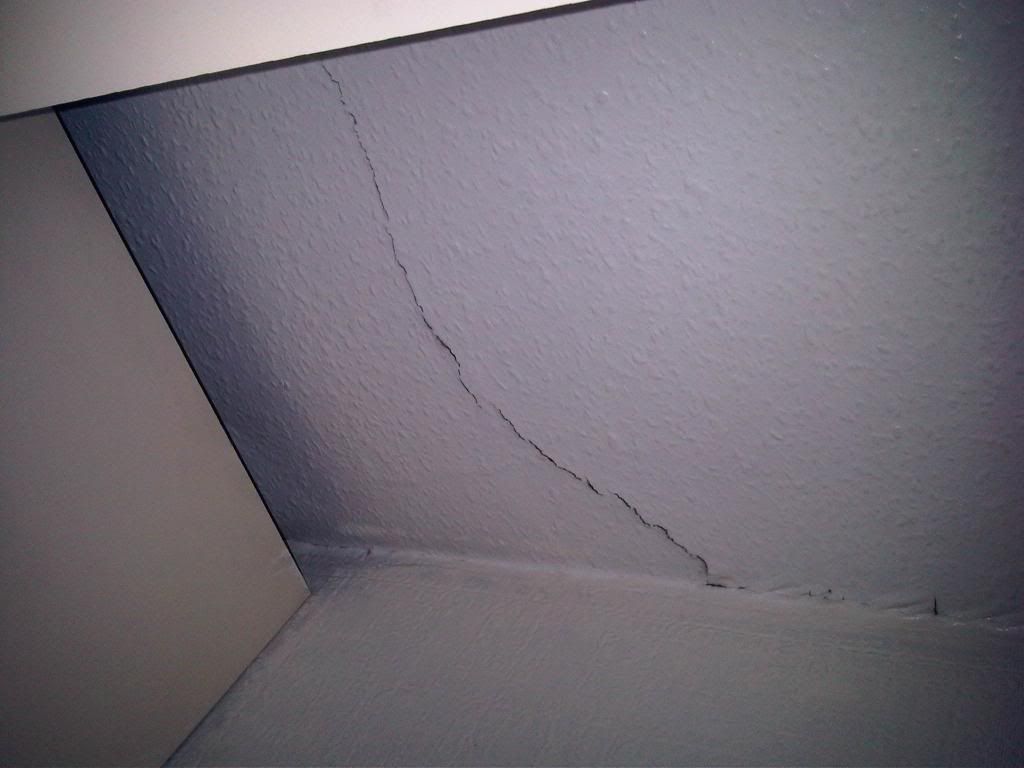
a bit !!!!!! that the surveyor missed it !!! Should I be worried or is it just a natural movement?
Thanks
I moved into my new place a few weeks ago. A few days ago I opened one of the cupboards and to my horror saw the following crack on the ceiling -

a bit !!!!!! that the surveyor missed it !!! Should I be worried or is it just a natural movement?
Thanks
0
Comments
-
Put some dry filler in it and write the date on it to see if there is still movement. If its inside a rarely decorated cupboard it could be years old.0
-
Look at where the crack should continue outside the cupboardYou might as well ask the Wizard of Oz to give you a big number as pay a Credit Referencing Agency for a so-called 'credit-score'0
-
As you say, its on the ceiling and does not link to a structural wall crack. Fill and forget.You scullion! You rampallian! You fustilarian! I’ll tickle your catastrophe (Henry IV part 2)0
-
Why not monitor it?
Get a ruler, position it over the crack to give you the width and take a photo, do it in a couple of locations.
Forget about it for 6 months and then repeat.0 -
In case you are not aware, ceilings are usually made from plasterboard screwed onto the joists, and skimmed with plaster. They are decorative (and to varying degrees sound and heat insulating) and not load bearing. Your crack is odd as it is ragged. Usually they go along the joins between adjacent plaster boards. It's a cupboard, who cares.
 Warning: This forum may contain nuts.0
 -
Its a fairly old house (1930's) and the ceilings are made of 'lath plaster' (I think thats what the builder said)......just had the dining room ceiling down and that is what was under it.0
-
Its a fairly old house (1930's) and the ceilings are made of 'lath plaster' (I think thats what the builder said)......just had the dining room ceiling down and that is what was under it.
If that's the worst crack you have in a 1930's house with lathe and plaster ceilings I think you should count yourself lucky.
As others have said fill and forget, although to be honest I would probably go with 'shut the cupboard door and forget'0 -
unless they are L&P which it turns out that OPs are.In case you are not aware, ceilings are usually made from plasterboard screwed onto the joists
Actually its not odd at all. It looks worse than it really is because the ceiling paper has torn. If the paper is peeled back then the physical crack will be a lot smaller. So many 1930s properties in the SE have cracks like this due to bomb damage during WWII. Additionally I've seen a lot of cracks like this which appeared following the 1987 "hurricane" when lots of roofs (particularly those with no soffits/fascias and exposed rafter feet) had their roofs lifted (albeit by a small amount) and then dropped by the wind that Michael Fish forgot to tell us about. OP - there is no reason for the surveyor to have mentioned it actually. Its of no import.Your crack is odd as it is ragged.
Quite.It's a cupboard, who cares.
CheersThe difference between genius and stupidity is that genius has it's limits. - Einstein0 -
Indeed the crack gives every appearance of not being related to any structural defects in the building whatsoever. You summed it up brilliantly in two little words previously.But it is still non structural.
CheersThe difference between genius and stupidity is that genius has it's limits. - Einstein0





This discussion has been closed.
Confirm your email address to Create Threads and Reply

Categories
- All Categories
- 354.2K Banking & Borrowing
- 254.3K Reduce Debt & Boost Income
- 455.3K Spending & Discounts
- 247.1K Work, Benefits & Business
- 603.8K Mortgages, Homes & Bills
- 178.4K Life & Family
- 261.3K Travel & Transport
- 1.5M Hobbies & Leisure
- 16.1K Discuss & Feedback
- 37.7K Read-Only Boards