We’d like to remind Forumites to please avoid political debate on the Forum.
This is to keep it a safe and useful space for MoneySaving discussions. Threads that are – or become – political in nature may be removed in line with the Forum’s rules. Thank you for your understanding.
Debate House Prices
In order to help keep the Forum a useful, safe and friendly place for our users, discussions around non MoneySaving matters are no longer permitted. This includes wider debates about general house prices, the economy and politics. As a result, we have taken the decision to keep this board permanently closed, but it remains viewable for users who may find some useful information in it. Thank you for your understanding.
📨 Have you signed up to the Forum's new Email Digest yet? Get a selection of trending threads sent straight to your inbox daily, weekly or monthly!
The Forum now has a brand new text editor, adding a bunch of handy features to use when creating posts. Read more in our how-to guide
Nominal price falls are the same as the last crash. Discuss.
Comments
-
There was a large decrease in the value of the money that houses were being priced in during the early 90s. That didn't happen in the late 00s.
Relative to wages, house prices have fallen considerably less in this crash than the last one.
Even if you use the Halifax index, which shows far bigger falls than the other two.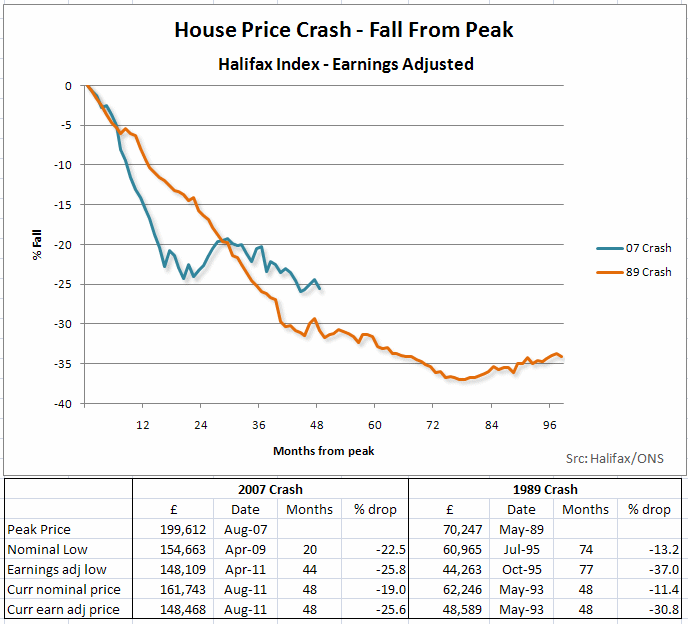 source: http://www.housepricecrash.co.uk/forum/index.php?showtopic=152362&st=195 “The great enemy of the truth is very often not the lie – deliberate, contrived, and dishonest – but the myth, persistent, persuasive, and unrealistic.
Belief in myths allows the comfort of opinion without the discomfort of thought.”
-- President John F. Kennedy”0 -
HAMISH_MCTAVISH wrote: »Relative to wages, house prices have fallen considerably less in this crash than the last one.
Even if you use the Halifax index, which shows far bigger falls than the other two.
source: http://www.housepricecrash.co.uk/forum/index.php?showtopic=152362&st=195
Sorry Hamish. You have neglected to advise whether or not now, on balance and using all the avaliable data, you admit that nominal house price falls are similar to the last crash. Can you please advise.0 -
Sorry Hamish. You have neglected to advise whether or not now, on balance and using all the avaliable data, you admit that nominal house price falls are similar to the last crash. Can you please advise.
Nationwide peak 1989 Q3 = £62,782
Nationwide trough 1993 Q1 = £50,128
Total fall from peak = £12,654 or 20.1%
Today Nationwide is just under 11% below peak, or around half the maximum falls seen in the 90's crash.
So on the Nationwide index house prices did fall a similar amount, but then recovered almost half those losses very rapidly.
So on balance, and using all the available data, it is clear that house prices have currently fallen less from peak than they did in the 90's crash.
It is also clear that house prices have fallen far less compared to income than they did in the 90's crash.
In fact, on balance and using all the data, this has turned into a bit of a damp squib for the bears by comparison to the 90's crash.:)“The great enemy of the truth is very often not the lie – deliberate, contrived, and dishonest – but the myth, persistent, persuasive, and unrealistic.
Belief in myths allows the comfort of opinion without the discomfort of thought.”
-- President John F. Kennedy”0 -
HAMISH_MCTAVISH wrote: »Nationwide peak 1989 Q3 = £62,782
Nationwide trough 1993 Q1 = £50,128
Total fall from peak = £12,654 or 20.1%
Today Nationwide is just under 11% below peak, or around half the maximum falls seen in the 90's crash.
So on the Nationwide index house prices did fall a similar amount, but then recovered almost half those losses very rapidly.
So on balance, and using all the available data, it is clear that house prices have currently fallen less from peak than they did in the 90's crash.
It is also clear that house prices have fallen far less compared to income than they did in the 90's crash.
In fact, on balance and using all the data, this has turned into a bit of a damp squib for the bears by comparison to the 90's crash.:)
Sorry Hamish. You appear to have reset the argument back to where you started and cherry picked your stats yet again.
I am quite certain that NATIONWIDE isn't "all the avaliable data".
Lets try again. On balance, using all the avaliable data, do you believe that nominal falls are similar to what they were in the 90's?0 -
The thing is, by looking at house prices in isolation, we are ignoring the value of the money used to buy those houses. From July 1989 to Feb 1993 the RPI rose from 115.5 to 138.8, an increase of 20%.
From Aug 07 to Mar 09 the RPI rose from 207.3 to 211.3, an increase of 1.9%!
There was a large decrease in the value of the money that houses were being priced in during the early 90s. That didn't happen in the late 00s.
You can't use RPI to measure inflation when looking at house prices, it includes House prices and mortgage payments.
You need to use CPI.Faith, hope, charity, these three; but the greatest of these is charity.0 -
This argument is stupid, of course house prices have crashed, unless you live in London. The housing market is in a complete state, prices only haven't fallen lower because people refuse to sell and would rather wait, because they KNOW their house is worth less than in 2007.
There is no technical definition to "crash" but for all intents and purposes, it is.Faith, hope, charity, these three; but the greatest of these is charity.0 -
HAMISH_MCTAVISH wrote: »Nationwide peak 1989 Q3 = £62,782
Nationwide trough 1993 Q1 = £50,128
Total fall from peak = £12,654 or 20.1%
Today Nationwide is just under 11% below peak, or around half the maximum falls seen in the 90's crash.
So on the Nationwide index house prices did fall a similar amount, but then recovered almost half those losses very rapidly.
So on balance, and using all the available data, it is clear that house prices have currently fallen less from peak than they did in the 90's crash.
It is also clear that house prices have fallen far less compared to income than they did in the 90's crash.
In fact, on balance and using all the data, this has turned into a bit of a damp squib for the bears by comparison to the 90's crash.:)
Damp squib, the crash is coming along nicely around here without comparing it to anything.0





This discussion has been closed.
Confirm your email address to Create Threads and Reply

Categories
- All Categories
- 354.5K Banking & Borrowing
- 254.4K Reduce Debt & Boost Income
- 455.5K Spending & Discounts
- 247.4K Work, Benefits & Business
- 604.3K Mortgages, Homes & Bills
- 178.5K Life & Family
- 261.8K Travel & Transport
- 1.5M Hobbies & Leisure
- 16.1K Discuss & Feedback
- 37.7K Read-Only Boards