We’d like to remind Forumites to please avoid political debate on the Forum.
This is to keep it a safe and useful space for MoneySaving discussions. Threads that are – or become – political in nature may be removed in line with the Forum’s rules. Thank you for your understanding.
Debate House Prices
In order to help keep the Forum a useful, safe and friendly place for our users, discussions around non MoneySaving matters are no longer permitted. This includes wider debates about general house prices, the economy and politics. As a result, we have taken the decision to keep this board permanently closed, but it remains viewable for users who may find some useful information in it. Thank you for your understanding.
📨 Have you signed up to the Forum's new Email Digest yet? Get a selection of trending threads sent straight to your inbox daily, weekly or monthly!
The Forum now has a brand new text editor, adding a bunch of handy features to use when creating posts. Read more in our how-to guide
Quantative Easing
Comments
-
massively interesting video. However in the UK, the BoE base rate has nowt to do with LIBBOR, (is it different in the USA? is the FED rate the same rate banks lend to each other)?
Confused as to how it applies here in UK when LIBOR is what encourages the bansk to lend to each other and therefore 'us' and not the BoE base rate. can anyone explain please?
thanks
You're conflating different things.
1. Base Rate. That's the rate at which the Bank of England will lend money to banks using a product called a Repo. That is where a bank will borrow some money using UK Government Bonds (Gilts) as collateral. It is an incredibly safe way to lend money as if the bank goes bust, the BoE just keeps the Gilts.
2. LIBOR (The London InterBank Offer Rate) is an average of the rates at which certain UK banks will lend money unsecured to each other for various periods of time. IIRC, there is overnight, 7 day, 1 month, 3 month and 6 month LIBOR.
It will be impacted by things other than the base rate including lending risk, perceived likely future interest rate movements (for longer period LIBORs this is more important) and how eager banks are to lend cash on a relatively low margin.
The BBA website has more on exactly how the calculation is done but that's about it.
3. Fed (target?) Rate. I'm a little weaker on this but I think that it is a target rate for the rate at which banks will lend to each other, that is to say, the Fed intervenes in the money markets in an attempt to ensure that banks are lending to each other at about the target rate. It does this by introducing funds or taking them out of the banking system.0 -
Fed Funds rate vs. LIBOR, Wiki:FT:
Quantitative easing and qualitative easing: a terminological and taxonomic proposal
Willem Buiter
[...former external member of the MPC...]
A short post for once! I propose the following taxonomy for measures the central bank may take, other than changing the official policy rate (the short risk-free nominal interest rate), changing reserve requirements or changing the exchange rate (where this is an instrument of monetary policy).
Quantitative easing is an increase in the size of the balance sheet of the central bank through an increase it is monetary liabilities (base money), holding constant the composition of its assets. Asset composition can be defined as the proportional shares of the different financial instruments held by the central bank in the total value of its assets. An almost equivalent definition would be that quantitative easing is an increase in the size of the balance sheet of the central bank through an increase in its monetary liabilities that holds constant the (average) liquidity and riskiness of its asset portfolio.
Qualitative easing is a shift in the composition of the assets of the central bank towards less liquid and riskier assets, holding constant the size of the balance sheet (and the official policy rate and the rest of the list of usual suspects). The less liquid and more risky assets can be private securities as well as sovereign or sovereign-guaranteed instruments. All forms of risk, including credit risk (default risk) are included.
The Fed is engaged in aggressive quantitative and qualitative easing. The Bank of England is engaged in reluctant quantitative and qualitative easing. The ECB has done less quantitative easing (proportionally) than the Bank of England or the Fed, but has engaged in quite a bit of qualitative easing - not by buying risky and illiquid private securities outright, but by accepting them as collateral in repos and at the discount window (its marginal lending facility).
Before this crisis is over, the two largest European central banks will engage in both quantitative and qualitative easing on a much larger scale.
December 9th, 2008
The operations of the Federal Reserve, by one of the best commentators on the political economy of the financial crisis:Comparison with LIBOR
Though the London Interbank Offered Rate (LIBOR) and the federal funds rate are concerned with the same action, i.e. interbank loans, they are distinct from one another, as following:- The federal funds rate is a target interest rate that is fixed by the FOMC for implementing U.S. monetary policies.
- The federal funds rate is achieved through open market operations at the Domestic Trading Desk at the Federal Reserve Bank of New York which deals primarily in domestic securities (U.S. Treasury and federal agencies' securities).[5]
- LIBOR is calculated from prevailing interest rates between highly credit-worthy institutions.
- LIBOR may or may not be used to derive business terms. It is not fixed beforehand and is not meant to have macroeconomic ramifications.[6]
Asia Times Online
Aug 24, 2007
Central bank impotence and market liquidity
By Henry C K Liu
...
How the discount window works
Eligible depository institutions are allowed to borrow against high-grade collaterals directly from the Fed's discount window to meet short-term unanticipated liquidity needs. One category of these collateralized loans, termed "adjustment credit", comprises loans that are usually overnight in maturity and are made at an administered discount rate.
However, banks traditionally only make sparing use of the discount window for adjustment credit borrowing. The discount window is also used for seasonal borrowings, mostly associated with agricultural production loans, and for "extended credit" for banks with longer-maturity liquidity needs resulting from exceptional circumstances.
The most potent power bestowed by Congress on the Federal Reserve system is the setting of the discount rate. Raising the discount rate generally increases the cost of bank borrowing and slows the economy, while lowering it stimulates economic activity, since banks set their loan rates above the discount rate, and not by market forces.
In contrast, while the Fed Funds rate is also set by the Fed, it is implemented by the Fed Open Market Committee participating in the repo market to keep the short-term rate close to the Fed's target. The discount rate affects cost of funds without affecting money supply while the Fed Funds rate changes the level of the money supply. Both rates are set by fiat by the Fed based on the Fed's best judgement within its theoretical preference.
The difference between the two rates is that the discount rate is set independently of market forces, while the Fed Funds rate acts through market forces. With the discount rate, the Fed sets the rules of the money market game while with the Fed Funds rate, the Fed acts as a key money market participant.
...0 -
LIBOR is calculated from prevailing interest rates between highly credit-worthy institutions
Slightly incorrect definition.
LIBOR is calculated from the rates the British Bankers Association obtains by asking their panel of Banks for their offer rates for the periods in question.
There is no obligation for the rate that the Bank tells the BBA is their LIBOR, to be the actual rate they will lend at, in fact it is often in their interests for the LIBOR set for a particular day to be slightly higher or lower (by a 1/64th of so)
LIBOR is of course based on Euro value funds, whilst the BOE Base Rate, and the Fed Funds target are domestic funds.'In nature, there are neither rewards nor punishments - there are Consequences.'0 -
purch,
True, as I understand it. Does the incentive arise from their position in other markets pegged against LIBOR, so they may want to move nudge calculated rate up or down?
I recall that at the hight of the credit 'crunch' attention moved from bringing down the spread between base rate and LIBOR, which was thought would encourage interbank lending, towards a realisation that LIBOR itself had become a problematic as a measure of the crisis.
LIBOR had become the rate at which banks couldn't lend or borrow. [Though still a rate that set others, transmitting the credit crunch from the financial sector into the general economy].
As I understood it, that was for a couple of reasons. The rate setting mechanism assumes rate setting institutions of good credit standing and that was no longer the case, and the creation of new/looser lending facilities by central banks had created an alternative source of funding to interbank lending.naked capitalism
Saturday, October 11, 2008
"Are Central Banks Making Libor WORSE?"
Equity analyst and market commentator James Bianco of Arbor Research e-maileda a discussion of the breakdown of interbank lending to us along with a few others, His note illustrates a point made by FT Alphaville a couple of weeks ago that we have harped on since, namely, that central banks' efforts to provide liquidity to the money markets are not simply ineffective, but in fact counter-productive.
Bianco has put together a tidy and cogent analysis. He was looking for further insight and comment, so I hope readers with some perspective will speak up in comments.
From James Bianco (boldface his):The Fed’s massive and numerous liquidity facilities are making things worse. The problem is more than banks unwilling to lend to each other, they are also unwilling to borrow from each other. Banks can get all the funding they need (and then some) from their central bank so they do not need to seek a loan from another bank. I believe it has gotten so bad that they don’t even bother to make a decent market for inter-bank loans anymore. No reason to, they don’t need them anymore as central banks have replaced them.
We can see this in the recent movement of 3-month USD Libor. See the following table.
It breaks down the 16 reporting banks for USD Libor during October. These banks are listed on the chart below the table. These 16 banks report their 3-month inter-bank lending rate to the British Bankers Association or BBA. The BBA calculates a Trimmed Mean by throwing out the four highest and lowest and averaging the eight in the middle (“Trim Mean” on the table below near the bottom). This is how they arrive at the Libor measure we anxiously await every morning (called “Posted Libor” in bold on the table below near the bottom).
Notice the huge spreads from bank to bank (see “range” in red near the bottom of the table). They suggest this is not a real market anymore. Real markets do not have this wide a variation. If it was a real market, these banks would have rates all similar to each other (click to enlarge).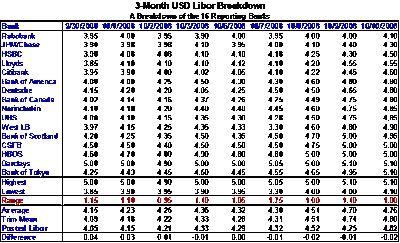
To give you an idea of how the current variation between reporting banks is “off the charts”, see the following charts. Prior to August 2007, it was unusual if the variation between the highest and lowest reporting bank was more than 1 or 2 basis points. Now it is regularly above 100 bps. As we like to say, a number so big no one understands it (click to enlarge).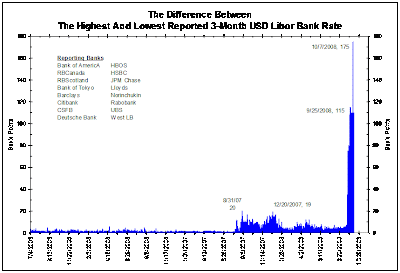
Too much central bank liquidity has destroyed the inter-bank lending market. This would be an “inside baseball” issue for the banking system except Libor is the benchmark for the “real economy” to get a loan. Libor is written into contracts and we have no good substitute. If Libor is screwed up, then the real economy pays because it needs Libor to get a loan.
This also means the market’s new favorite idea of having G7 countries guarantee all inter-bank loans will do nothing. If enacted, banks would still be missing an incentive to use the inter-bank loan market because they can get all the funding (loans) they need from their neighborhood central bank and at a much lower rate.
Posted by Yves Smith at 1:14 AM0 -
Does the incentive arise from their position in other markets pegged against LIBOR, so they may want to move nudge calculated rate up or down?
Yes
Even in 'ye olde' days (1980's) I often remember on days when the Bank had Loan fixings, i.e. Corporate Loans agreed at LIBOR + a margin, the Cash Book trader would be praying to a higher LIBOR fixing, and would set his/her LIBOR as high as they thought they could get away with.
With the rise of so many Derivative products fixed at or tied to the LIBOR fixings the fact that the Banks (or a panel of them) decide on the LIBOR fix makes it open to manipulation, and considering the large amounts involved in these contracts a miniscule 1/64 (0.015625%) can mean a huge amount to the P&L.
As for the relevance of LIBOR in the modern world....as far as I know the size of the inter-bank Cash markets have contracted massively over the past 10-15 years, so even before the credit-crunch dried-up these markets almost completely the actual relevance of LIBOR had diminished.'In nature, there are neither rewards nor punishments - there are Consequences.'0




This discussion has been closed.
Confirm your email address to Create Threads and Reply

Categories
- All Categories
- 354K Banking & Borrowing
- 254.3K Reduce Debt & Boost Income
- 455.3K Spending & Discounts
- 247K Work, Benefits & Business
- 603.6K Mortgages, Homes & Bills
- 178.3K Life & Family
- 261.2K Travel & Transport
- 1.5M Hobbies & Leisure
- 16.1K Discuss & Feedback
- 37.7K Read-Only Boards