Ready, steady… save!
You don’t need a chart to join in. Here are 2 ways to record your savings:
1. Cross it off
Pop a chart into your first post. Saved an amount? Cross it out! Read more »
£0.01 £0.02 £0.03
2. Write it down
Skip the chart and add updates to your first post. Read more »
“Another +£3 saved today. Go me!”
Use +£ before each new saving so it counts towards your total.
We’d like to remind Forumites to please avoid political debate on the Forum.
This is to keep it a safe and useful space for MoneySaving discussions. Threads that are – or become – political in nature may be removed in line with the Forum’s rules. Thank you for your understanding.
LGPS 25% Tax Free calculation

Random47
Posts: 176



 Forumite
I must be missing some info as don't understand how Pension tax free calculation is working out.
See example below.
If 25% of £40K is £10K, how is LGPS calculator showing this as £14,285, with standard commutation of 12/1 so 25% tax free lump sum is £171,428.
My brain is telling me it should be 1/4 of 40 which is10 and 10x12 = £120K TFL.
? help needed

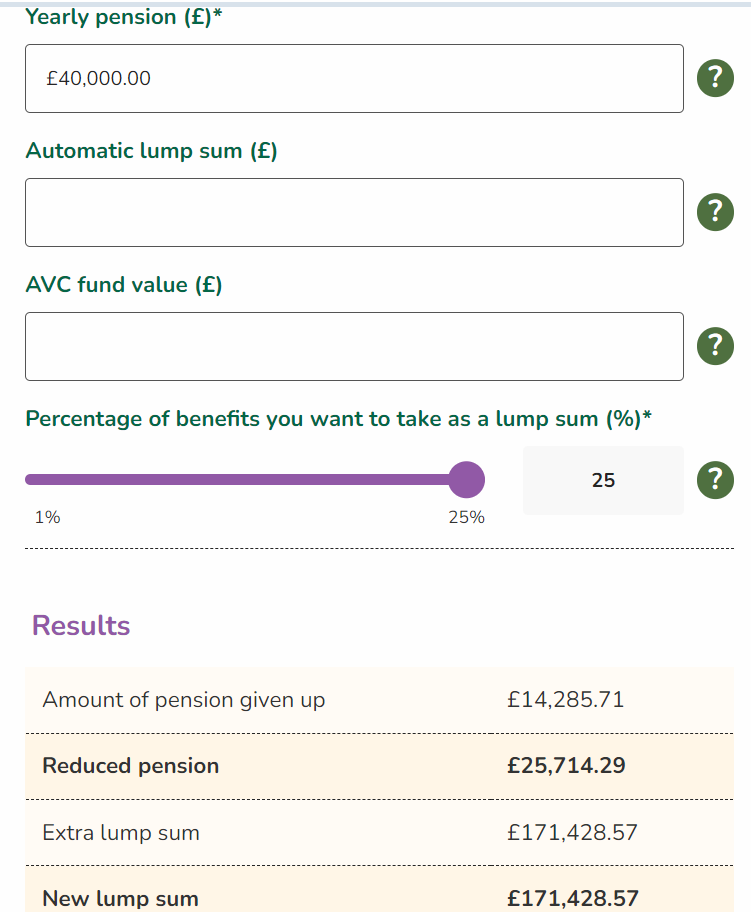
See example below.
If 25% of £40K is £10K, how is LGPS calculator showing this as £14,285, with standard commutation of 12/1 so 25% tax free lump sum is £171,428.
My brain is telling me it should be 1/4 of 40 which is10 and 10x12 = £120K TFL.
? help needed

0
Comments
-
There isn't usually a 25% TFLS with a defined benefit scheme.
You can get a (tax free) Pension Commencement Lump Sum. Which often used to be a multiple of the annual pension but with newer schemes there often isn't a standard PCLS anymore.
You are being offered £12 for each £1 of pension you give up.
I presume you realise that the £12 is a one off. And you lose the £1 for ever. And the £1 would have inflation protection in LGPS. So in year 2 you would be losing say £1.03 for each £12 you took.
So after say 30 years of retirement that £12 has cost you a fortune in lost pension.
0 -
You don't have a 25% tax free amount, as D&C has said...you have a fixed lump sum tax free, depending on when your pension was started. You have used the calculator to display the highest lump sum as opposed to minimum.Unless you REALLY need the cash, or have significant health issues that suggest an early demise, don't do it...it's not a great deal.You have a defined benefit pension, there is no 25% tax free lump sum.1
-
I understand the pros & cons to the choice. I also understand I cant have my cake and eat it.Dazed_and_C0nfused said:There isn't usually a 25% TFLS with a defined benefit scheme.
You can get a (tax free) Pension Commencement Lump Sum. Which often used to be a multiple of the annual pension but with newer schemes there often isn't a standard PCLS anymore.
You are being offered £12 for each £1 of pension you give up.
I presume you realise that the £12 is a one off. And you lose the £1 for ever. And the £1 would have inflation protection in LGPS. So in year 2 you would be losing say £1.03 for each £12 you took.
So after say 30 years of retirement that £12 has cost you a fortune in lost pension.
See link which describes option https://www.scotlgpsmember.org/your-pension/planning/taking-a-lump-sum/
What I am not grasping is their calculation as shown in link.0 -
There is 5p of rounding but basically,
£14,285.71 x 12 = £171,428.57
It's just the standard LGPS ratio for giving away some of your hard earned pension.
They may be unusually high but the last two LGPS inflation increases have been 10.1% and 6.7%.
So £14,285.71 given up in year 1 would have been £16,782 lost by year 3 😳1 -
Ah ok that now makes sense. So essentially LGPS are allowing a member up to very roughly 34% of their pension as as a PCLS which is tax free.sg1000 said:You don't have a 25% tax free amount, as D&C has said...you have a fixed lump sum tax free, depending on when your pension was started. You have used the calculator to display the highest lump sum as opposed to minimum.Unless you REALLY need the cash, or have significant health issues that suggest an early demise, don't do it...it's not a great deal.You have a defined benefit pension, there is no 25% tax free lump sum.
I note other points made. But on flip side you are taking out tax free and if leaving in it would mean paying 42% income tax in Scotland (indexed linked of course).
There is obviously a cross over point when one would indeed be worse off, but its the decision of sometimes living for now on the hope you live forever...
Its just something I want to be aware of so any future decisions are adequately considered.0 -
Dazed_and_C0nfused said:There isn't usually a 25% TFLS with a defined benefit scheme.
Not againsg1000 said:You don't have a 25% tax free amount, as D&C has said... In covering pensions tax legislation, the 25% limit is for both DB and DC. Since many private sector DB schemes still track pre-A Day limits however, the 25% concept is frequently not immediately relevant to them. For public sector schemes like the LGPS though, the scheme limit is explicitly 25% of the 'capital value' defined on LTA/LSA terms as annual pension x 20 + lump sum. Since the 12/1 commutation rate is clearly worse than 20/1, this means if a member does have a LTA/LSA problem, commuting pension for lump sum is actually opportune... 1
-
LGPS though, the scheme limit is explicitly 25% of the 'capital value' defined on LTA/LSA terms as annual pension x 20 + lump sum.hyubh said:Dazed_and_C0nfused said:There isn't usually a 25% TFLS with a defined benefit scheme.
Not againsg1000 said:You don't have a 25% tax free amount, as D&C has said... In covering pensions tax legislation, the 25% limit is for both DB and DC. Since many private sector DB schemes still track pre-A Day limits however, the 25% concept is frequently not immediately relevant to them. For public sector schemes like the LGPS though, the scheme limit is explicitly 25% of the 'capital value' defined on LTA/LSA terms as annual pension x 20 + lump sum. Since the 12/1 commutation rate is clearly worse than 20/1, this means if a member does have a LTA/LSA problem, commuting pension for lump sum is actually opportune...
Thanks that's a bit I was unsure of. There is also the opportunity for a member to pay in AVC which can then be taken as lump sum element to still get a tax free amount but minimise the amount of reduction in DB annual pension.
For background I only have 1/60th and 1/49th contributions so no 1/80th which came with automatic lump sum payment.0 -
I thought the capital value is worked out by:
(Yearly Pension * 120) + (Automatic Lum Sum * 10) / 7
So for the OP's example with no automatic sum:
40,000 * 120 / 7 = £685,714.28 - and 25% of that is £171,428.57 as per the OP's screenshot.1 -
Random47 said:
Ah ok that now makes sense. So essentially LGPS are allowing a member up to very roughly 34% of their pension as as a PCLS which is tax free.sg1000 said:You don't have a 25% tax free amount, as D&C has said...you have a fixed lump sum tax free, depending on when your pension was started. You have used the calculator to display the highest lump sum as opposed to minimum.Unless you REALLY need the cash, or have significant health issues that suggest an early demise, don't do it...it's not a great deal.You have a defined benefit pension, there is no 25% tax free lump sum.
I note other points made. But on flip side you are taking out tax free and if leaving in it would mean paying 42% income tax in Scotland (indexed linked of course).
There is obviously a cross over point when one would indeed be worse off, but its the decision of sometimes living for now on the hope you live forever...
Its just something I want to be aware of so any future decisions are adequately considered.
It's a behavioural decision, or gamble, as much as a financial one. You are taking a punt on not living very long. The 12:1 commutation rate is widely seen as pretty poor, private sector pensions may give 20:1 or even more.
There are good reasons for taking a lump sum; financial necessity, debt, need for a new roof, commitment to a round the world cruise, life-limiting conditions etc.
I'm also in Scotland, had no automatic lump sum, retired before I was 60 and didn't take a lump sum at all. I didn't see higher rate tax as an issue, but I've had two chunky CPI increases to my pension and once state pension kicks in I may reach higher rate.
My main concerns were maximising my income and bridging the gap between retiring and reaching state pension age. We had enough resources to draw on to fund that gap, but so far I've needed to draw less than I expected.
Three years in I've no regrets about my decision, but it is my decision, your one might be different, and might work equally well for you.1 -
Could you please explain this?hyubh said:Since the 12/1 commutation rate is clearly worse than 20/1, this means if a member does have a LTA/LSA problem, commuting pension for lump sum is actually opportune...0









Categories
- All Categories
- 356K Banking & Borrowing
- 255K Reduce Debt & Boost Income
- 456.3K Spending & Discounts
- 248.5K Work, Benefits & Business
- 606.3K Mortgages, Homes & Bills
- 179.1K Life & Family
- 264.1K Travel & Transport
- 1.6M Hobbies & Leisure
- 16.2K Discuss & Feedback
- 37.7K Read-Only Boards