We’d like to remind Forumites to please avoid political debate on the Forum.
This is to keep it a safe and useful space for MoneySaving discussions. Threads that are – or become – political in nature may be removed in line with the Forum’s rules. Thank you for your understanding.
📨 Have you signed up to the Forum's new Email Digest yet? Get a selection of trending threads sent straight to your inbox daily, weekly or monthly!
The Forum now has a brand new text editor, adding a bunch of handy features to use when creating posts. Read more in our how-to guide
Changing funds/pension

monaymadlol
Posts: 479 Forumite



Hi
I've been with Scottish widows for 12 years, I'm 39 and paying in currently £300 a month, £4500 annually with tax relief.
I used to have an advisor who chose the funds, and then I was left to my own devices the last few years, just continually putting in money as they moved company and left me. They helped set up as they were a family friend type arrangement.
I decided I need to take better control. I called SW who advised that my funds are all in category 2, the amc range from 1 to 1.89%, preliminary research shows that it's too high and they need to be under 0.75%.
Yearly charges deducted were 1.53%
Is it too late or can I recover money after haemorrhaging this much?
Funds are
SW Baillie Gifford 1.33%
SW fidelity Asia 1.93%
SW fidelity special situations 1.90
SW Invesco perpetual distribution 1.86%
SW Newton managed 1.19%
SW Schroeder managed 1.25%
SW Schroeder Tokyo 1.89%
SW balanced solutions 1.80%
SW multi manager global real estate security 1.70%
After 12 years , yes it's grown, but I've overpaid charges. Is it too late?
Do I need an ifa?
I'm not confident selecting my own so I think sipp out the question ❓
What should I do? Switch provider? Which? Switch funds? Where? What? How? Costs switching?
Feeling deflated
I've been with Scottish widows for 12 years, I'm 39 and paying in currently £300 a month, £4500 annually with tax relief.
I used to have an advisor who chose the funds, and then I was left to my own devices the last few years, just continually putting in money as they moved company and left me. They helped set up as they were a family friend type arrangement.
I decided I need to take better control. I called SW who advised that my funds are all in category 2, the amc range from 1 to 1.89%, preliminary research shows that it's too high and they need to be under 0.75%.
Yearly charges deducted were 1.53%
Is it too late or can I recover money after haemorrhaging this much?
Funds are
SW Baillie Gifford 1.33%
SW fidelity Asia 1.93%
SW fidelity special situations 1.90
SW Invesco perpetual distribution 1.86%
SW Newton managed 1.19%
SW Schroeder managed 1.25%
SW Schroeder Tokyo 1.89%
SW balanced solutions 1.80%
SW multi manager global real estate security 1.70%
After 12 years , yes it's grown, but I've overpaid charges. Is it too late?
Do I need an ifa?
I'm not confident selecting my own so I think sipp out the question ❓
What should I do? Switch provider? Which? Switch funds? Where? What? How? Costs switching?
Feeling deflated
0
Comments
-
Is it too late or can I recover money after haemorrhaging this much?The charges are high but that is to be expected with an old-fashioned plan. However, they are not exactly haemorrhaging level.After 12 years , yes it's grown, but I've overpaid charges. Is it too late?You haven't over paid. You have paid what was typically the going rate for charges at the time. Financial products are like many retail products. They change with more functionality, options etc and they can change in price. Do you still use a mobile phone from 12 years ago? Is your TV still a black and white tube box? You need to keep these things under review. Modern options are better in around 4 out of 5 cases.Do I need an ifa?No. That is choice. The choice should be to either DIY or use an IFA.What should I do? Switch provider? Which? Switch funds? Where? What? How? Costs switching?Unless there are any contractual reasons to remain that are beneficial, then you should consider alternatives.Feeling deflatedWhy? Its done its job. The funds are not bad and plenty of cheaper options would have done worse. Cost is a secondary concern to suitability.
I am an Independent Financial Adviser (IFA). The comments I make are just my opinion and are for discussion purposes only. They are not financial advice and you should not treat them as such. If you feel an area discussed may be relevant to you, then please seek advice from an Independent Financial Adviser local to you.3 -
Thank you. What are the 'alternatives' specifically? Where should I start? How often do I review, and based on what? Just charges? Is transfer fee-free?dunstonh said:Is it too late or can I recover money after haemorrhaging this much?The charges are high but that is to be expected with an old-fashioned plan. However, they are not exactly haemorrhaging level.After 12 years , yes it's grown, but I've overpaid charges. Is it too late?You haven't over paid. You have paid what was typically the going rate for charges at the time. Financial products are like many retail products. They change with more functionality, options etc and they can change in price. Do you still use a mobile phone from 12 years ago? Is your TV still a black and white tube box? You need to keep these things under review. Modern options are better in around 4 out of 5 cases.Do I need an ifa?No. That is choice. The choice should be to either DIY or use an IFA.What should I do? Switch provider? Which? Switch funds? Where? What? How? Costs switching?Unless there are any contractual reasons to remain that are beneficial, then you should consider alternatives.Feeling deflatedWhy? Its done its job. The funds are not bad and plenty of cheaper options would have done worse. Cost is a secondary concern to suitability.0 -
Other pension products from SW, or other products from other providers.monaymadlol said:
Thank you. What are the 'alternatives' specifically?dunstonh said:Is it too late or can I recover money after haemorrhaging this much?The charges are high but that is to be expected with an old-fashioned plan. However, they are not exactly haemorrhaging level.After 12 years , yes it's grown, but I've overpaid charges. Is it too late?You haven't over paid. You have paid what was typically the going rate for charges at the time. Financial products are like many retail products. They change with more functionality, options etc and they can change in price. Do you still use a mobile phone from 12 years ago? Is your TV still a black and white tube box? You need to keep these things under review. Modern options are better in around 4 out of 5 cases.Do I need an ifa?No. That is choice. The choice should be to either DIY or use an IFA.What should I do? Switch provider? Which? Switch funds? Where? What? How? Costs switching?Unless there are any contractual reasons to remain that are beneficial, then you should consider alternatives.Feeling deflatedWhy? Its done its job. The funds are not bad and plenty of cheaper options would have done worse. Cost is a secondary concern to suitability.
From what you've said above, probably with a one-off advice session with an IFA to help you pick the product and fund choices/improve your general understanding of how funds and charges work.monaymadlol said:
Where should I start? How often do I review, and based on what? Just charges? Is transfer fee-free?
Charges need to be taken into consideration, but taken in isolation, they aren't a deciding factor. Knowing your own risk appetite and picking suitable funds are key considerations.
Check the paperwork of your current pension for information about transferring out.Googling on your question might have been both quicker and easier, if you're only after simple facts rather than opinions!1 -
Are the % I've quoted, do you think, the management charge only? Or part of a wider buy/sell, platform fee too?
Do I effectively have a SIPP?0 -
Do I effectively have a SIPP?No. You have a PPP (personal pension plan)Are the % I've quoted, do you think, the management charge only? Or part of a wider buy/sell, platform fee too?The SW PPP of that era is mono charged. i..e. the AMC is the only charge. It includes the other costs in its total rather than breaking them down as you would with most modern plans that work to a transparent basis.
I am an Independent Financial Adviser (IFA). The comments I make are just my opinion and are for discussion purposes only. They are not financial advice and you should not treat them as such. If you feel an area discussed may be relevant to you, then please seek advice from an Independent Financial Adviser local to you.1 -
Ok great, so the average 1.5% 'all in' isn't too bad then.dunstonh said:Do I effectively have a SIPP?No. You have a PPP (personal pension plan)Are the % I've quoted, do you think, the management charge only? Or part of a wider buy/sell, platform fee too?The SW PPP of that era is mono charged. i..e. the AMC is the only charge. It includes the other costs in its total rather than breaking them down as you would with most modern plans that work to a transparent basis.0 -
Not too bad considering they are all appear to be actively managed funds. However if they were passive funds, then you would hopefully be looking at half that charge, even with a big traditional provider like SW.monaymadlol said:
Ok great, so the average 1.5% 'all in' isn't too bad then.dunstonh said:Do I effectively have a SIPP?No. You have a PPP (personal pension plan)Are the % I've quoted, do you think, the management charge only? Or part of a wider buy/sell, platform fee too?The SW PPP of that era is mono charged. i..e. the AMC is the only charge. It includes the other costs in its total rather than breaking them down as you would with most modern plans that work to a transparent basis.
If you were using a low cost retail SIPP, with low cost passive funds ,then it would be less than 0.5%.
1 -
it is not bad but it could be better. For example, if I do a case with a 0.25% platform charge and 0.10% fund charge and ongoing adviser charge of 0.50% then the total cost is 0.85%. However, if that person was an ESG investor, their fund charges could be 0.6% instead of 0.10%. Or if someone wanted fully active funds, then you head closer to 0.8% (so 0.8+0.25+0.5 =1.55%. Same ballpark as you but with an adviser). As you are not using an adviser and if you were fully active, then you would expect around 1%. If you went fully passive without an adviser then around 0.3-0.5%monaymadlol said:
Ok great, so the average 1.5% 'all in' isn't too bad then.dunstonh said:Do I effectively have a SIPP?No. You have a PPP (personal pension plan)Are the % I've quoted, do you think, the management charge only? Or part of a wider buy/sell, platform fee too?The SW PPP of that era is mono charged. i..e. the AMC is the only charge. It includes the other costs in its total rather than breaking them down as you would with most modern plans that work to a transparent basis.
The point is that you can do better and its not great by modern standards but its not a disaster and many of the funds you have are well regarded on the whole..
if you take the highest charged fund in the list, SW Fidelity Asia and compare that with a cheap index tracker costing 0.16%, then the SW fund has performed better.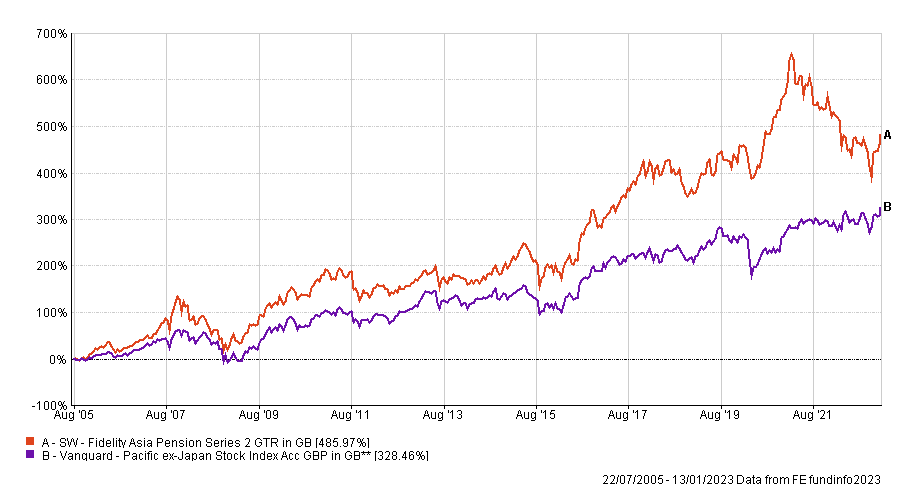
Plus, the SW fund is the total charge. There is no platform charge to add on. With the cheaper fund, there is a platform charge to deduct from that.
However, that SW Fidelity Asia fund is available on a platform at 0.94%. Add on a typical 0.25% and you are still cheaper than what you have at the moment. So, you could, if you wanted, pretty much replicate what you have more cheaply.
Hence, why you shouldn't feel down about paying more in charges because had you been charges focused (instead of returns focused), yes you would have paid less but you could well have had a lower return..... but it is time to bring it a bit more up-to-date as there are still savings to be made, even on a like-for-like basis.
I am an Independent Financial Adviser (IFA). The comments I make are just my opinion and are for discussion purposes only. They are not financial advice and you should not treat them as such. If you feel an area discussed may be relevant to you, then please seek advice from an Independent Financial Adviser local to you.1 -
...SW Fidelity Asia and compare that with a cheap index tracker costing 0.16%, then the SW fund has performed better.Yes, that is a comparison of an active fund (more expensive, better performance) with a tracker.It’s also a comparison of a fund whose shares are: 64% Australia; 22% HK; 12% Singapore, and USA, with a fund whose shares are: 31% China; 19% India; 12% Taiwan; 11% Korea.
Now tell me, are the differences in performance between a fund whose objective is to invest 70% in Asia ex-Japan, and a fund whose objective is to invest in the Pacific ex-Japan, due to the managers’ brilliance or due to the different markets the funds are invested in?Note to beginners: compare like with like, or be careful of your conclusions.Ok great, so the average 1.5% 'all in' isn't too bad then. ‘I think it’s terrible, and hopefully you’ll be able to look back sometime and think the same thing, but it doesn't matter what I think, you need to quantify the ‘terribleness’ with a compound interest formula.
Compare the gain you get when fees are 1.5%/year rather than 0.8%/year, see the difference and tell me.
You’re 39 years old with another 40 years of investing ahead, perhaps more.
If your fund was worth £20,000 now and grew at 2.5%/year because of fees of 1.5%/year, it would finish at £53,700 in 40 years. If it grew at 3.2%/year because fees were only 0.8%/year, it would finish at £70,500. That’s how to measure if the fees are ‘not too bad’. That's giving up 24% of your gains. You'll be able to say 'With my investments I got two children into private schools, my fund manager's children'.Open the calculator on your phone, turn the phone on its side to get the scientific calculator, enter 1.025 for the 2.5%/year, then press the ‘x with the little y above it’ key, then press 40, then press ‘times 20000’.Edit: It's worse than that. You'd forego 33% of your gains, which is 24% of your final value.1 -
It’s also a comparison of a fund whose shares are: 64% Australia; 22% HK; 12% Singapore, and USA, with a fund whose shares are: 31% China; 19% India; 12% Taiwan; 11% Korea.If the OP was to build a portfolio of passive funds to match the current active funds then there is a very high chance that Vanguard trackers would be utilised. Indeed, certain regular posters here and many DIY supporting websites push Vanguard very heavily as the cheap solution. Indeed, it is amongst the cheapest option for many people. If you are cost focused then Vanguard would be high on your list.
Now tell me, are the differences in performance between a fund whose objective is to invest 70% in Asia ex-Japan, and a fund whose objective is to invest in the Pacific ex-Japan, due to the managers’ brilliance or due to the different markets the funds are invested in?
Note to beginners: compare like with like, or be careful of your conclusions.
If you start saying that you can get different returns by changing where you invest then you are bringing in a whole load of management decisions that take knowledge and understanding. You may have to structure your portfolio differently. For example Fidelity's pacific tracker is developed Asia on the basis you would have an emerging markets tracker for your emerging markets holdings. However, some trackers will hold emerging markets in their Asia fund.Edit: It's worse than that. You'd forego 33% of your gains, which is 24% of your final value.
The op came to his site and the posting indicated that they were almost disgusted with the level of charges. We have all acknowledged they are high and can be improved on. Its a yesteryear product with yesteryear pricing. However, the funds they have are not bad funds on the whole and despite the higher charges their returns have been higher than lower cost funds.
So, the OP has paid more in charges but had a greater return than lower charged options. So, is better off than had they paid less.
BG Managed hit recently with technology drops but still nearly double sector average since launch (194.10% for BG vs 106.50% for sector average)
SW fidelity special situations better than sector average since launch (189.71% vs 123.86%)
SW Invesco perpetual distribution better than sector average (158.30% vs 90.34%)
SW Newton managed better than sector average (206.00% vs 130.99%)
SW Schroder managed better than sector average (182.69% vs 153.89%)
SW Schroder Tokyo not as good as sector average (175.42% vs 177.36% - performance is almost closet tracker level and indeed a tracker shows is almost identical)
SW balanced solution underperformed sector average (85.10% vs 105.30%)
SW multi manager global real estate better than average (160.81% vs 90.62%.
We don't know the rations of dates but all but two of the funds the OP is in have outperformed sector average. Some by a long way. So, subject to weightings ratios and dates of contributions, there is a very high chance they have done much better than cheaper options.
i.e. they have paid more but got more. Is it better to get 6% after 1.5% in charges or 5% after 0.5% in charges?
They may have got lucky and with the benefit of hindsight it would be easy to pick out alternatives that did better but 7 out of 9 funds outperformed their sector average after charges (and the two that didnt were not far off).
The point is that they should not be disgusted at what they have paid as it paid off. But change is needed.
I am an Independent Financial Adviser (IFA). The comments I make are just my opinion and are for discussion purposes only. They are not financial advice and you should not treat them as such. If you feel an area discussed may be relevant to you, then please seek advice from an Independent Financial Adviser local to you.6





Confirm your email address to Create Threads and Reply

Categories
- All Categories
- 353.4K Banking & Borrowing
- 254.1K Reduce Debt & Boost Income
- 455K Spending & Discounts
- 246.5K Work, Benefits & Business
- 602.8K Mortgages, Homes & Bills
- 178K Life & Family
- 260.5K Travel & Transport
- 1.5M Hobbies & Leisure
- 16K Discuss & Feedback
- 37.7K Read-Only Boards