We’d like to remind Forumites to please avoid political debate on the Forum.
This is to keep it a safe and useful space for MoneySaving discussions. Threads that are – or become – political in nature may be removed in line with the Forum’s rules. Thank you for your understanding.
Should I be concerned about the performance of a DB scheme




I no longer work for the retail company, and the DB scheme closed to new members on 1 April 2002.
I can start to withdraw the pension from age 55 (I am 50 now). But I don't intend to to touch it (not even a lump-sum), until I'm at least 65.
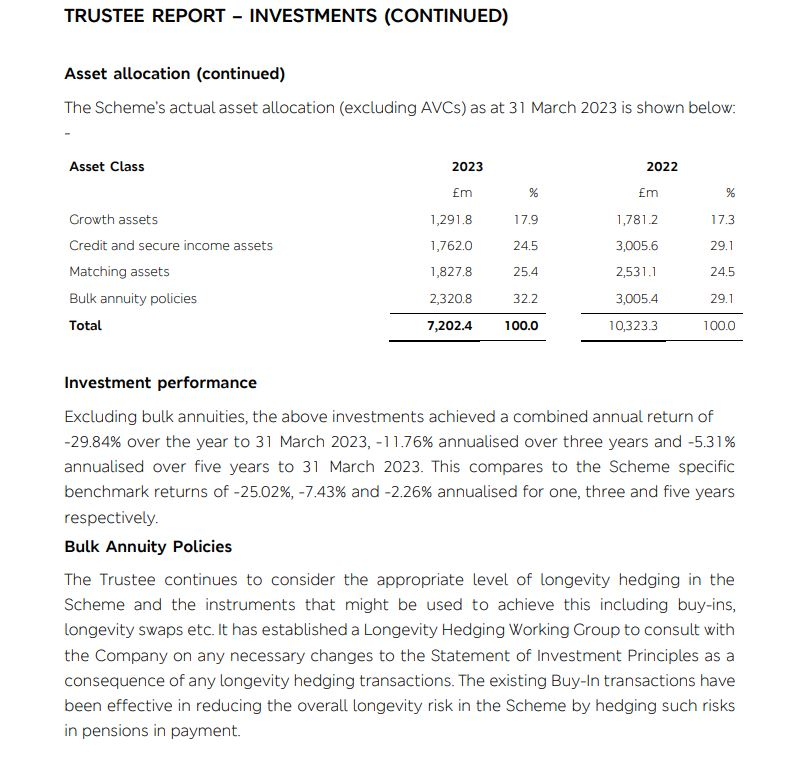
As you can see, the fund hasn't performed well. (The trust has yet to publish it's 2024's figures). I know fully-well I have no control over how it's invested, but is it a concern in any way shape or form?
I must admit, I had no clue I was enrolled onto this scheme from my old employer, until they got in touch with me only recently - I left the company 20 years ago! I understand how DC pensions work, as I have had one for years with my current employer. But the DB schemes are all new to me.
Comments
-
Does the company still operate and have a DC scheme for it's newer employees? If so I wouldn't get too stressed about this. If the company is a going concern then they are obliged to prop up the DB scheme even if it means funding it directly. At least that's how I understand it all.
There were a number of DB schemes that employers wanted to close down completely but that meant offering to buy out members such as yourself and move them into DC schemes. I don't think anyone could get away with the very easily now as a transfer is likely to not provide anything like the benefits of the original scheme. But who knows? If you do get a letter offering to buy you out of the scheme they would need to provide a big enough offer to guarantee something like you would have received with increases from 65 to whenever. Unlikely to happen.I’m a Forum Ambassador and I support the Forum Team on Debt Free Wannabe, Old Style Money Saving and Pensions boards. If you need any help on these boards, do let me know. Please note that Ambassadors are not moderators. Any posts you spot in breach of the Forum Rules should be reported via the report button, or by emailing forumteam@moneysavingexpert.com. All views are my own and not the official line of MoneySavingExpert.
Click on this link for a Statement of Accounts that can be posted on the DebtFree Wannabe board: https://lemonfool.co.uk/financecalculators/soa.php
Check your state pension on: Check your State Pension forecast - GOV.UK
"Never retract, never explain, never apologise; get things done and let them howl.” Nellie McClung
⭐️🏅😇🏅🏅🏅🏅🏅1 -
Do you have a protected pension age enabling you to access your pension at 55 (otherwise it'll be 57 - minimum age for everyone increases to 57 in 2028)?tel_ said:Even though I will get a guaranteed income, the fund's performance has not been great (as you can see, illustrated below).
I no longer work for the retail company, and the DB scheme closed to new members on 1 April 2002.
I can start to withdraw the pension from age 55 (I am 50 now). But I don't intend to to touch it (not even a lump-sum), until I'm at least 65.
As you can see, the fund hasn't performed well. (The trust has yet to publish it's 2024's figures). I know fully-well I have no control over how it's invested, but is it a concern in any way shape or form?
I must admit, I had no clue I was enrolled onto this scheme from my old employer, until they got in touch with me only recently - I left the company 20 years ago! I understand how DC pensions work, as I have had one for years with my current employer. But the DB schemes are all new to me.
If the employer is still solvent and expected to remain so, you've got no cause for concern - they are still on the hook for 'deficit repair contributions' if necessary. If the worst happens, the Pension Protection Fund kicks in and gives you a good level of protection, as its name suggests.
The buy-in is good news.
If you paid AVCs while you were an active member of the scheme, worth checking how those are doing, if only to set your mind at rest.Googling on your question might have been both quicker and easier, if you're only after simple facts rather than opinions!1 -
You have shown the total assets, but that is of limited use without knowing the scheme's liabilties. The scheme has been closed to new accrual for a long time, so payments to pensioner members will be taking a good chunk out of the assets, as well as investment performance. But those payments will also be reducing the liabilties.
Your security is based on three 3 things:- Solvency of the employer - whilst solvent, they stand behind the scheme
- Scheme funding - if the scheme is fully funded, even if the employer fails pension benefits can be secured for members.
- PPF - if the employer fails and the funding is insufficient to provide at least PPF levels of benefit, the PPF steps-in. This guarantees you between 50-90% of your accrued benefits prior to reaching the Normal Pension age of the scheme (the range is due to differences in indexation between the PPF and scheme, which means the loss can grow over time if PPF pays less than scheme, but cannot fall below 50%)
2 -
Very different to DC in terms of the "correct" investments as well.
The other thing to be aware of with a closed DB scheme aging out.
There are declining cashflows required to pay pensions as the pensioner group (now fixed) die off. Ultimately - 0 to pay out. A profile based on the age range of the employees that were in it. Can be early or late on the journey as a scheme in terms of deferred members reaching pension age and the "in payment" group.
The objective for the fund is to meet its exact cashflows and defined indexation of them - and stop close to empty at the end. Assets depleted.
Not to deliver "better returns" at the risk of shortfalls along the way - with nobody left to pay a surplus to at the end.
So the investments will involve bonds, linkers especially - laddered to generate a matching cashflow - explicit annuity products and such like.
They want a cashflow for the scheme which matches the defined cashflow going out the door. As small schemes shrink. They can be bought out entirely by a life company who takes the asset pool and the promise on to pay the pensions until the bitter end.
The employer does not want to be asked to top it up - ever again. Historical.
Earlier in the journey the mix may be leavened - a little - with some higher risk assets.
So you need to approach it with the expectations clear about what the scheme it trying to do and why. Short term interest rate movements will of course affect short term reported returns on bonds and linkers. They don't care. They are interested in the cashflow
1 -
Just expand on what others have said - it is the funding ratio not investment returns that is important - essentially this is a measure of whether the pension will be able to cover all of future liabilities with the future value of their assets (it might also be referred to by the funding level). If you look through the trustee report, it should mention one or other of these terms somewhere. While there are some complexities in the funding ratio calculation, if it is close to or over 100% ('in surplus') then the scheme (and your pension) should be OK, if it is well below 100% ('in deficit') then the position is not so clear particularly for closed schemes.
1 -
,,,but it's important to recognise that funding levels can fluctuate quite dramatically and many schemes have been in serious deficit in recent years, with no actual risk or detriment to members' benefits, for the reasons explained in posts earlier in this thread.OldScientist said:Just expand on what others have said - it is the funding ratio not investment returns that is important - essentially this is a measure of whether the pension will be able to cover all of future liabilities with the future value of their assets (it might also be referred to by the funding level). If you look through the trustee report, it should mention one or other of these terms somewhere. While there are some complexities in the funding ratio calculation, if it is close to or over 100% ('in surplus') then the scheme (and your pension) should be OK, if it is well below 100% ('in deficit') then the position is not so clear particularly for closed schemes.
The fact a scheme is closed doesn't alter the requirement for the sponsoring employer to remain 'on the hook' to ensure it is in a position to pay benefits as they fall due, until such point as the scheme is wound up and bought out with an insurance company, as it will be eventually.Googling on your question might have been both quicker and easier, if you're only after simple facts rather than opinions!2 -
Thank you for all the valuable comments so far.
The company is solvent, it's Marks & Spencer PLC.
Apologies - I thought that I could start withdrawing the pension from 55, but can't find the detail on this yet. Maybe I wrote down the default age off 55 for some reason. Will clarify that bit when I can.
I didn't pay-in any AVC's, so no concern there.
Yes, I should have included liabilities. Here's the statement of net assets.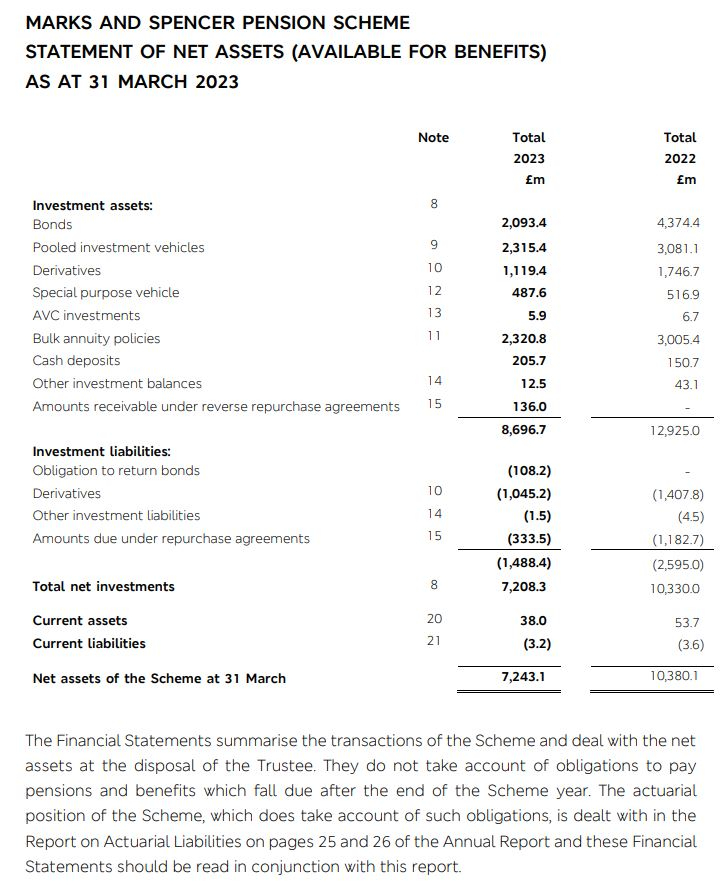
0 -
I can start to withdraw the pension from age 55 (I am 50 now). But I don't intend to to touch it (not even a lump-sum), until I'm at least 65.You don't really "withdraw" money from a DB pension as there is no pot for you to take from.
You are entitled to whatever you accrued under the scheme rules.
And according to the scheme website it seems your normal pension age is 60 so why wouldn't you take your pension then? Have you checked what happens to the 5 years with of payments if you choose not to take it at 60?
The normal age for retirement from the Scheme is 65 (or age 60 if you joined the Scheme on or before 31 December 1995). The earliest you can take your pension is set by the government as age 55 and this will increase to age 57 in 2028. To take your pension early from the Scheme, you will also need the agreement of the Trustee and for your payments to meet a minimum amount.1 -
If a DB scheme is under funded. (Funding ratio). And the sponsoring employer fails and can no longer contribute. If nobody buys the remains out of administration. Then the scheme may not get more contributions from the employer or a successor company (because there isn't one). In which case. A scheme may then fall into the Pension Protection Fund (PPF). Funded by a levy on all DB schemes.
It pays the pensions for failed schemes that are now underfunded and have no sponsor anymore. And consumes the assets such as they are.
If I recall there is a floor of 90% of benefits for a 10% haircut that can (optionally) be imposed (for a radically underfunded one). And the scheme specific indexation and other terms get junked and replaced with the PPF ones. Anything more generous which failed. Disappears. This is still a 90% + CPI underpin. And some spouse terms. Which is a fine thing as a fallback.
It is not generally worth contriving to run away just because an employer is looking a bit sickly. Especially now with CETV values down (Interest rates are up - cheaper to produce the income promise).
And the need for expensive advice to move anything at all within the close to defacto ban on it FCA have pursued.
But each case, funding level etc. is different.
Google British Steel pension scheme scandal for what happens when shiny suits and buckle shoed spivs bluff the naive and transfer them out of a DB scheme using fear - for pleasure and profit.
1 -
I must admit, I had no clue I was enrolled onto this scheme from my old employer,
I seem to remember that the M&S Final Salary DB Scheme was non contributory- if so, the fact that you had been enrolled may have passed you by like the idle wind you regarded not!
That said, I feel pretty sure (from my own experience with another such scheme) that it would have been mentioned in glowing terms as an outstanding employee benefit on your induction day....
While it was closed to new employees in 2002, existing members were permitted to accrue benefits for a number of years after that - I
think this was mentioned by a scheme member in a post several years ago, around the time when all the staff were transferred to a DC
Scheme.
Did you join the scheme on or before 31/12/95?
1








Confirm your email address to Create Threads and Reply

Categories
- All Categories
- 354.6K Banking & Borrowing
- 254.5K Reduce Debt & Boost Income
- 455.5K Spending & Discounts
- 247.5K Work, Benefits & Business
- 604.4K Mortgages, Homes & Bills
- 178.6K Life & Family
- 261.9K Travel & Transport
- 1.5M Hobbies & Leisure
- 16.1K Discuss & Feedback
- 37.7K Read-Only Boards